Civil-military fusion vital for national security
Civil-military fusion key to national security
- By Gurmehar --
- Sunday, 04 Jan, 2026
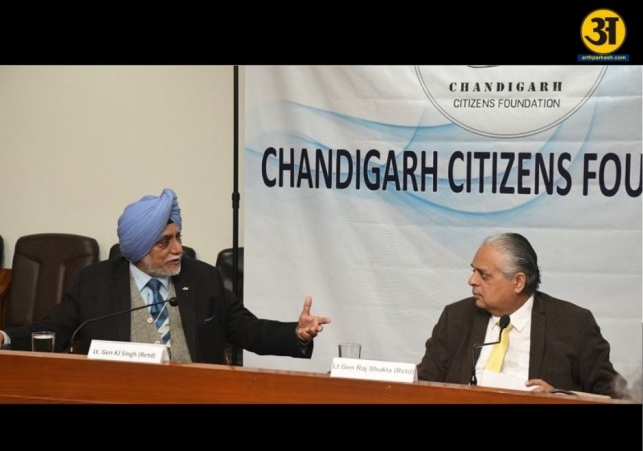
Amid fast-changing global security challenges and rapid advances in military technology, civil-military fusion has become essential for India’s national security, said retired Lieutenant General Raj Shukla. He was speaking at a discussion on his new book, Civil Military Fusion as a Metric of National Power and Comprehensive Security, held in Chandigarh on Saturday.
The discussion took place at the Centre for Research in Rural and Industrial Development (CRRID) in Sector 19. The book was released in October 2025 by Defence Minister Rajnath Singh. Senior military officers, defence experts, and policy thinkers attended the event, highlighting the growing importance of cooperation between civilian and military sectors.
Why civil-military fusion matters
During the discussion, Lt Gen Shukla explained that modern warfare is no longer limited to the battlefield. Today’s conflicts involve cyber attacks, artificial intelligence, space technology, drones, and economic pressure. To deal with these threats, he said, India must fully integrate its military with civilian industries, academic institutions, startups, and diplomatic systems.
Lt Gen Shukla was in conversation with Lt Gen KJ Singh (retd), during which he stressed that civil-military fusion is not just about coordination. Instead, it requires deep integration, where different sectors work together as a single system.
He pointed out that many cutting-edge technologies used in modern warfare come from civilian innovation. Startups and private companies often develop tools in artificial intelligence, data analysis, satellite systems, and robotics that later become crucial for defence. He cited global entrepreneurs such as Elon Musk and Alex Karp, whose technologies have played a key role in recent conflicts, including the war in Ukraine.
According to Lt Gen Shukla, if India fails to involve its private sector and startups in defence innovation, it risks falling behind in future wars. He said that talent retention, innovation, and technological self-reliance can only be achieved when the military and civilian sectors grow together.
He also explained that technologies like artificial intelligence have dual-use applications, meaning they are useful both for civilian purposes and national security. Treating such technologies separately, he said, weakens a country’s overall strength.
ALSO READ: Explained: Why China’s contraceptive tax shows the limits of pro-natalist policies
Lessons from China and India’s path ahead
Lt Gen Shukla also spoke about China’s rapid rise as a military and technological power, calling it a clear example of successful civil-military fusion. He explained that China deliberately linked its civilian manufacturing, scientific research, and private industries with its military goals.
He shared data to underline his point. In 2002, China’s civilian manufacturing capacity was only half that of the United States. By 2022, it had grown to twice the size of the US manufacturing capacity. This growth, he said, directly strengthened China’s military-industrial complex and made it far more efficient.
He warned that military strength cannot grow in isolation. Without expanding civilian manufacturing and innovation, even the strongest armed forces will struggle to modernise and compete globally.
Reflecting on India’s past, Lt Gen Shukla said one of the country’s major mistakes after Independence was allowing civil, military, academic, and private sectors to operate separately. This division slowed innovation and reduced efficiency. He said that while India has made progress in recent years, much more needs to be done.
He added that civil-military fusion is not a new idea for India. According to him, it lies at the heart of India’s civilisational wisdom, where knowledge, security, and economic strength were traditionally linked. What is needed now, he said, is a modern and careful application of these principles.
Lt Gen Shukla stressed that India’s rise as a global power will depend not only on the size of its armed forces but also on how smoothly its civil, industrial, scientific, and strategic systems work together. True national security, he said, comes from synergy between soldiers, scientists, engineers, and entrepreneurs.
“Civil-military fusion redefines our understanding of national power,” he said. “It creates comprehensive security by bringing together all elements of the nation.”
The discussion was attended by several senior retired military leaders, including former Army chief Gen VP Malik and former Navy chief Admiral Sunil Lanba. Many defence experts and veterans also participated in the conversation.
The event was jointly organised by the Chandigarh Citizens Foundation and the Gyan Setu Think Tank. Participants agreed that civil-military fusion should become a core part of India’s defence and development strategy in the years ahead.
As global threats continue to evolve, speakers at the event said India must act quickly and decisively to break down barriers between civilian and military sectors. Doing so, they said, will help ensure long-term security, innovation, and national strength.
Related News