Maduro’s capture by US sparks concerns on Ukraine and Taiwan dynamics
US detains Venezuela’s President Maduro, raising questions over impact on Ukraine war and Taiwan tensions
- By Gurmehar --
- Monday, 05 Jan, 2026
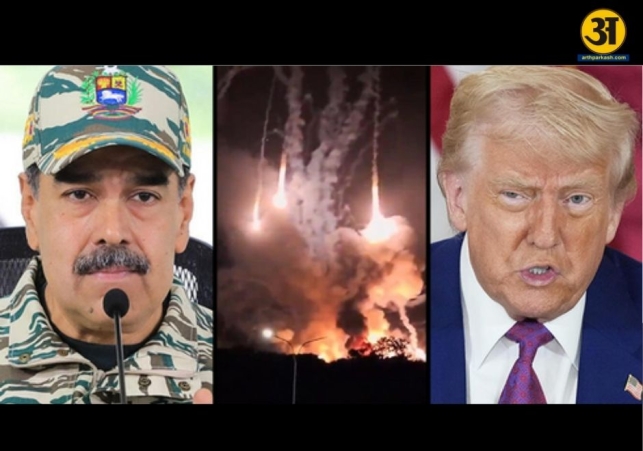
On January 3, 2026, the US military captured Venezuelan President Nicolas Maduro on charges of drug trafficking. The operation took Maduro from Venezuela to New York to face legal action. While this event may seem far away from most countries, experts believe it could have major effects on global politics, especially for Russia and China. Many analysts are asking whether this bold US action could encourage Russia to increase its attack on Ukraine or give China more confidence to act on Taiwan.
The capture of Maduro has already caused a lot of discussion in international relations. Some experts and countries see it as a violation of international law, because it involved taking the leader of a sovereign nation by force. However, others say this move shows a new type of global power: the US can act decisively against leaders it considers threats without facing immediate consequences.
For Russia, this could be seen as a warning or an opportunity. Russian President Vladimir Putin has long wanted to control parts of former Soviet territories, especially Ukraine. Since Russia invaded Ukraine in 2022, Putin has used the excuse of "denazifying" the country to justify his attacks, although many countries see it as a cover for his expansionist goals.
Now, some analysts think that the US operation in Venezuela might give Putin more confidence to intensify military operations in Ukraine. The idea is that if the US can act against Maduro without facing strong consequences, Russia might feel justified to push harder in Ukraine. This could mean more fighting, stronger attacks, and a prolonged conflict.
Ukrainian President Volodymyr Zelenskyy made a short comment after the US operation: "If you can do this with dictators, so easily, then the United States knows what needs to be done next." Zelenskyy did not directly ask for US action against Russia, but his remark suggests that the US’s decisive approach to Maduro might set an example for other global conflicts.
China’s ambitions and possible effects on Taiwan
While Russia may take inspiration from the US strike on Venezuela, China is watching closely. President Xi Jinping has always claimed that Taiwan is part of China, even though Taiwan is a democratic nation with its own government. Analysts believe that the US’s capture of Maduro could give China more confidence to act in its territorial disputes, including Taiwan.
China could argue that the US itself has ignored international rules in Venezuela. William Yang, an analyst at the International Crisis Group, says, "Washington always criticises China for breaking international law, but now its own actions in Venezuela are damaging that argument." This could allow China to justify stronger actions in places like the South China Sea, Tibet, and Taiwan, while also criticizing the US.
China may use this moment to gain global sympathy by claiming that the US is acting unfairly. This could help Beijing strengthen its position in territorial disputes. Experts note, however, that an immediate takeover of Taiwan is unlikely. Xi Jinping has long said Taiwan must eventually reunite with China, but analysts argue that China still lacks the full military capability to carry out such an operation safely. Professor Shi Yinhong of Renmin University in Beijing says, “Taking over Taiwan depends on China’s developing but still insufficient capability rather than what Trump did in a distant continent.”
ALSO READ: US strikes Venezuela, captures Nicolas Maduro, but is it legal under international law?
ALSO READ: Explained: Why China’s contraceptive tax shows the limits of pro-natalist policies
The broader concern is that the US’s capture of Maduro might set a dangerous precedent. Other countries could feel that it is acceptable to break international rules if they claim national security or other reasons. This could lead to more aggressive military actions globally. For Russia, it might justify a stronger offensive in Ukraine, and for China, it could justify more pressure on Taiwan and other disputed regions.
Experts also warn that this action could increase global instability. The world could see more conflicts and riskier military moves if leaders use the Venezuelan operation as a model. At the same time, the US may face criticism for acting unilaterally and ignoring international norms, which could affect its relationships with allies and global institutions.
In summary, the US capture of Maduro is not just a local event in Latin America. It has major global consequences. Russia may use it as a reason to escalate its attacks in Ukraine, and China may feel more confident in pursuing territorial claims, especially regarding Taiwan. The operation also raises questions about international law and global norms, as countries may be tempted to follow the US example to justify their own actions.
The world is now watching closely how Russia and China respond. Analysts believe that the US strike on Venezuela could influence future conflicts and power dynamics across multiple regions, making global security more uncertain. While the US sees it as a step against crime and dictatorship, the potential ripple effects could be far-reaching, impacting the stability of Europe, Asia, and Latin America.
Related News

.jpg)