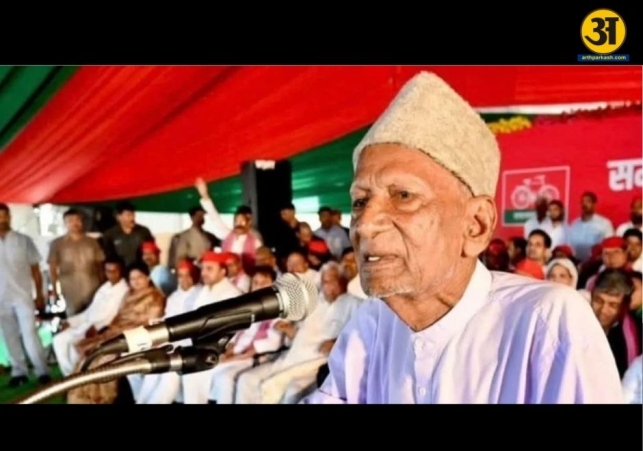
Akhilesh Yadav pays tribute to five-time MLA from Azamgarh
Veteran SP leader Alam Badi Azmi passes away at 90, leaves behind a legacy of simplicity and public service
Senior Samajwadi Party (SP) leader and five-time MLA Alam Badi Azmi passed away at the age of 90 while undergoing treatment at a hospital in Lucknow. His death marks the end of a long political journey that was defined by honesty, simplicity and a deep connection with ordinary people.
Azmi, who represented the Nizamabad Assembly constituency in Uttar Pradesh’s Azamgarh district five times, was widely respected not only within his party but also across political lines. News of his passing has led to an outpouring of grief from political leaders, supporters and residents who remembered him as a leader who remained grounded throughout his life.
Among those who paid tribute was Samajwadi Party chief Akhilesh Yadav, who expressed deep sorrow over the loss of one of the party’s senior-most leaders. In a message shared on social media, Yadav described Azmi as a popular and respected public representative and offered condolences to his family.
For many people in Azamgarh, Alam Badi Azmi was more than a politician. He was seen as a leader who remained accessible, approachable and committed to serving the public even after decades in politics.
A life dedicated to public service
Born in 1936 in Bindwal village of the Bilariaganj area in Azamgarh district, Alam Badi Azmi came from a modest background. He completed his education in Mechanical Engineering and initially worked in Gorakhpur for a short period.
However, his interest in public life soon led him toward politics. Inspired by national leaders such as Mahatma Gandhi, Jawaharlal Nehru and Subhas Chandra Bose, Azmi decided to devote himself to serving society rather than pursuing a conventional professional career.
His political journey gained momentum when he joined the Samajwadi Party. In 1996, he won the Nizamabad Assembly seat for the first time and entered the Uttar Pradesh Legislative Assembly. Over the years, he continued to earn the trust of voters and went on to represent the constituency five times.
His repeated electoral victories reflected the strong bond he shared with local residents. People often viewed him as a grassroots leader who understood their concerns and remained connected to the realities of everyday life.
Unlike many politicians who become distant from the public after attaining power, Azmi maintained close contact with his constituents throughout his career. Residents recall that he regularly met people, listened to their problems and tried to resolve issues personally whenever possible.
His focus remained on local development, public welfare and transparent governance. Many supporters believe that his success was rooted in his ability to connect with people on a personal level rather than relying solely on political influence.
One of the most talked-about moments of his political career came in 2012 when the Samajwadi Party formed the government in Uttar Pradesh. At a time when many politicians aspire to become ministers, Azmi reportedly declined the opportunity to join the state cabinet.
He chose instead to continue working directly with the people of his constituency. This decision strengthened his image as a leader who valued public service over power and prestige.
ALSO READ: US launches fresh strikes on Iran as tensions rise across the Gulf region
ALSO READ: Ram Temple Trust resumes donation counting with new supervision amid ongoing probe
Remembered for honesty and simplicity
What truly distinguished Alam Badi Azmi from many other political leaders was his simple way of life.
Despite holding public office for several years and serving multiple terms as an MLA, he continued to live modestly. Residents often saw him wearing a simple kurta-pyjama and slippers rather than expensive clothing. He carried a basic mobile phone and used a small hearing aid in his later years.
His home reflected the same simplicity. Visitors who came to meet him were welcomed warmly and served tea without any formality. Family members personally attended to guests, and there was little sign of the luxury often associated with political leaders.
People who knew him closely say he never allowed power to change his lifestyle. He preferred spending time with local residents, discussing their concerns and understanding the issues affecting their communities.
Many residents remember seeing him sitting under a simple shed outside his house, meeting people who came with requests or complaints. He often travelled on foot through neighbourhoods, interacting directly with citizens and gathering feedback about local problems.
His straightforward approach helped him build trust among voters. Even political opponents acknowledged his honesty and personal integrity.
Throughout his public life, Azmi maintained a reputation for clean politics. He was widely regarded as someone who believed that politics should be used as a tool for public welfare rather than personal gain.
This reputation earned him respect beyond party boundaries. Leaders from different political backgrounds have expressed condolences following his death and praised his contribution to public life.
Many people in Azamgarh believe that his passing leaves a significant void in local politics. At a time when public trust in politicians is often questioned, Azmi represented a generation of leaders who were known for simplicity, accessibility and commitment to public service.
His supporters say his greatest achievement was not the number of elections he won but the goodwill he earned from ordinary people. Even those who disagreed with his political views often respected him for his character and dedication.
As tributes continue to pour in from across Uttar Pradesh, Alam Badi Azmi is being remembered as a leader who stayed true to his principles throughout his life. His journey from a small village in Azamgarh to becoming a five-time legislator reflects a career built on public trust, honesty and service.
While his death marks the end of an era, his legacy of clean politics, humility and people-centric leadership is likely to remain an inspiration for future generations of public representatives.
Related News