Trump’s India tariffs begin, sectors hit and spared explained
Trump’s tariffs on India take effect: Sectors impacted and exemptions explained
The United States has officially raised tariffs on Indian goods to 50%, and the impact is already being felt across India’s export hubs. The decision, announced earlier this month by US President Donald Trump, came into effect on August 27, 2025.
This is the second hike in just three weeks. On August 7, the US had already imposed a 25% tariff, and now another 25% has been added. That means most Indian goods entering the US market will now attract a massive 50% duty, making them far more expensive for American buyers.
Trump’s move is not just about trade—it is linked to politics. The US is targeting countries that maintain close economic ties with Russia. India has continued to buy Russian crude oil and defence equipment, which has angered Washington. New Delhi has strongly criticised the decision, while Moscow has openly supported India’s trade independence.
Which Indian sectors will be hit hardest?
The US is India’s largest export market, and these tariffs will directly hurt industries that depend on American demand.
1. Textiles and apparel:
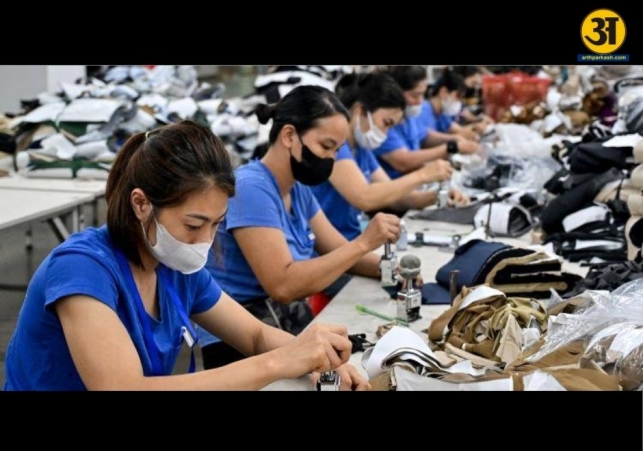
India exports more than USD 10.8 billion worth of textiles and garments to the US every year. Now, with nearly 64% effective duties, hubs like Tiruppur in Tamil Nadu—which employs over 6 lakh workers—face order cancellations and production cuts.
2. Gems and jewellery:
The Surat diamond industry, which processes 80% of India’s diamonds, is badly hit. Exports worth nearly USD 10 billion will now face duties of over 52%. Many small workshops are already reporting job losses.
3. Shrimp and seafood:
India’s seafood exports to the US are worth USD 2.4 billion, with shrimp alone making up half of this. But with new duties of 60%, US buyers are turning to Ecuador, whose shrimp face only 15% tariffs.
4. Carpets and home textiles:
India exports carpets worth USD 1.2 billion to the US. But now, with duties of 53%, American retailers are shifting orders to Turkey and Vietnam.
5. Leather and footwear:
This sector, which provides jobs to lakhs of workers in Uttar Pradesh and Tamil Nadu, will now face the full 50% duty. For an industry already struggling with high input and freight costs, this comes as a heavy blow.
6. Auto components:
India exports auto parts worth USD 6.6 billion to the US. Of this, around half will face 25% tariffs, and the rest will face 50% tariffs. This threatens India’s competitiveness in key components like gearboxes and engine parts.
7. Chemicals and organic compounds:
Exports worth USD 2.7 billion, much of it by small and medium businesses, will now be hit with tariffs above 50%. Countries like Japan and South Korea, which enjoy preferential access, are likely to grab India’s share of the US market.
8. Agricultural products:
India’s agri-food exports—worth USD 6 billion—including basmati rice, tea, and spices, will now face 50% tariffs. Rivals like Pakistan and Thailand are expected to benefit.
Which sectors are safe for now?
Not everything is covered by the tariffs. A few key sectors remain exempt, at least for now.
-
Pharmaceuticals: India exports USD 10.5 billion worth of generic drugs to the US. These remain duty-free, though American pressure to manufacture locally could increase in the future.
-
Electronics: Goods worth USD 14.6 billion, including iPhones assembled in India, are not affected due to earlier bilateral deals.
-
Petroleum products: Exports worth USD 4.1 billion, along with books, plastics, and some industrial inputs, remain untouched.
ALSO READ: INS Himgiri and INS Udaygiri: India commissions indigenous stealth frigates to Navy
ALSO READ: PM Modi’s vision sparks a new era in India’s space journey
Opinion: The real impact is on India’s small businesses
While large corporations may survive, the real pain will be felt by India’s MSMEs (Micro, Small and Medium Enterprises). These small firms make up over 70% of India’s export capacity in textiles, gems, seafood, and chemicals. Most of them operate on razor-thin margins and depend heavily on American buyers.
Take Tiruppur in Tamil Nadu, Surat in Gujarat, or Panipat in Haryana—these hubs are powered by small workshops and family-run units. With a 50% tariff, Indian products will simply be too expensive compared to competitors. That means fewer orders, production cuts, and job losses. For millions of workers, especially women and migrant labourers, this could be devastating.
From a political perspective, the US tariffs show how vulnerable India’s export-led industries are to global politics. By continuing to buy Russian oil and defence equipment, India has asserted its independence. But at the same time, its exporters are paying the price.
At Arthprakash, we believe this is a wake-up call for India’s policymakers. The government must act quickly to support MSMEs—through subsidies, credit support, and finding new markets beyond the US. Otherwise, lakhs of jobs could vanish, and India’s export growth could stall.
Related News