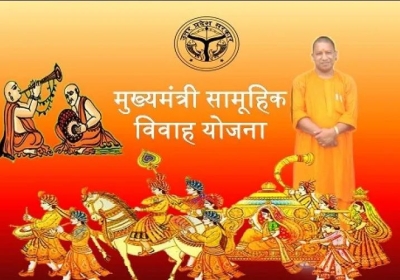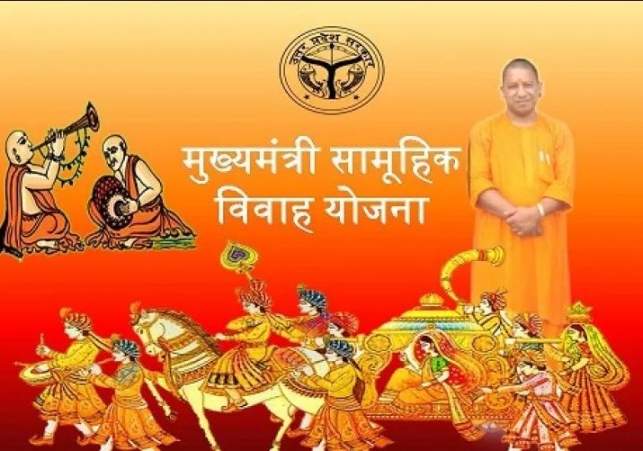
Chief Minister’s Mass Marriage Scheme
Chief Minister’s Mass Marriage Scheme emerges as a lifeline for Dalit, Backward, and Minority daughters
As the wedding season begins, mass marriage ceremonies are being held across the state
CM Yogi govt increases the grant amount; applications exceed targets by double
CM Yogi’s initiatives ease the burden of marriage for daughters from underprivileged families
The Yogi government’s development-driven agenda puts the opposition on the defensive
Over 2.20 lakh Dalit daughters across the state have benefited from the scheme
More than 1.30 lakh daughters from poor backward-class families have been married under the scheme
The CM Yogi govt has supported the marriages of over 40,000 daughters from the minority community
Lucknow, December 14: Chief Minister Yogi Adityanath’s Mass Marriage Scheme has ushered in a transformative change in the lives of economically weaker families, particularly those from backward classes, Dalit, and minority communities. Launched in 2017, the scheme has emerged as a strong pillar of social support, empowering daughters, easing financial burdens, and promoting social harmony and inclusion.
Over the past eight years, the Yogi government has facilitated the dignified marriages of more than four lakh underprivileged girls, ensuring that all rituals are performed with respect. In the current financial year 2025–26, the response has been unprecedented.
Against a target of 57,000, over 1.20 lakh applications have already been received, and more than 14,000 marriages have been solemnized so far. Officials expect these numbers to rise significantly in the coming months.
The scheme has also exposed the hollow claims of parties that ruled for decades on the politics of backward, Dalit, and minority communities but failed to deliver real development.
By translating intent into action, the Yogi government has demonstrated that true social empowerment is achieved through concrete initiatives, not empty promises. This model has not only set a benchmark for Uttar Pradesh but has also inspired similar efforts across the country, reaffirming the government’s commitment to the principle of “Sabka Saath, Sabka Vikas.”
Data from the scheme highlights its wide-ranging impact. To date, over 2.20 lakh daughters from poor Dalit families have benefited the most. This is followed by more than 1.30 lakh beneficiaries from backward classes and over 40,000 from minority communities. Additionally, around 16,000 poor families from the general category have also availed of the scheme.
Applications received in 2025–26: Over 1.20 lakh
Approved applications: Over 21,000
Rejected applications: Over 18,000
Total marriages solemnized: Over 14,000
R.P. Singh, Nodal Officer of the scheme, said, “The initiative goes beyond financial assistance. It fosters collective participation, strengthens community bonds, and upholds respect for women. Each couple receives assistance of ₹1 lakh, which includes essential marriage items, a cash transfer directly to the bride’s account, and full arrangements for the ceremony, providing both social dignity and economic security.”
Throughout his eight-and-a-half-year tenure, Chief Minister Yogi Adityanath has consistently prioritized the empowerment of the underprivileged. Through the Mass Marriage Scheme, the government is ensuring that backward classes, Dalits, minorities, and other weaker sections are brought into the mainstream with tangible support. So far, over ₹2,200 crore has been spent on the scheme, with an allocation of ₹550 crore for the financial year 2025–26.
Category-wise beneficiaries added in 2025–26
General Category: 494 couple
Minority Category: 828 couple
OBC Category: 5,500 couple
Dalit Category: 6,556 couple
One of the scheme’s greatest strengths is its inclusivity. It rises above caste and religious divisions, offering equal opportunity to all. Marriages are conducted in accordance with the religious traditions of Hindu, Muslim, Sikh, and Christian communities alike, reinforcing the values of social harmony, mutual respect, and brotherhood across the state.
Related News