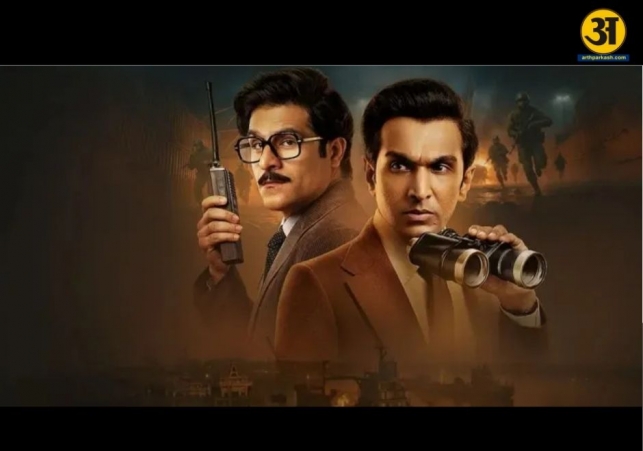
Spy drama blends suspense with a patriotic twist
Netflix’s Saare Jahan Se Accha puts patriotism at the heart of espionage
Netflix’s Saare Jahan Se Accha is a spy thriller set in the 1970s, blending history, patriotism, and suspense. It follows the battle of wits between India’s intelligence agency RAW and Pakistan’s ISI during the race to become nuclear powers. While the performances are strong and the setting is interesting, the series suffers from uneven writing, making it a one-time watch rather than a must-see thriller.
Story and setting
The show focuses on unsung heroes of espionage—agents who work in the shadows for the country’s safety but rarely receive recognition. The story is set in the early 1970s, a time when nations across the world were racing to build nuclear weapons. The series opens with the death of Nobel Prize-winning scientist Dr. Homi Bhabha in a plane crash, shortly after he had supported the idea of India developing a nuclear bomb for self-defense.
We experience the events through the eyes of Vishnu Shankar (Pratik Gandhi), a talented RAW agent who fails to save Dr. Bhabha due to a delay, something he regrets deeply. Around the same time, Pakistan’s then-President Zulfikar Ali Bhutto—still recovering from the defeat in the 1971 war—decides to build a nuclear bomb to retaliate against India. To make this happen, he entrusts the mission to Murtaza Malik (Sunny Hinduja), a skilled ISI officer.
RAW learns of this plan, and the responsibility to stop it falls on Vishnu Shankar and his team. Their mission takes them deep into Pakistan, where the two spies—Vishnu and Murtaza—are set on a collision course.
ALSO READ: Significance of IAF downing an ELINT, AEW&C aircraft in Operation Sindoor
ALSO READ: India’s strategic options to counter Trump’s tariff pressure
Writing and direction
Directed by Sumit Purohit, the series uses creative freedom while drawing inspiration from real events. It attempts to balance patriotism with realism, showing spies from both sides as capable and committed. One of the strengths of the writing is that it does not portray Pakistan as a villain for wanting nuclear power—just as India does.
However, the writing, handled by a team of several writers, is inconsistent. The first three episodes are compact and engaging, but the later episodes lose momentum. By episode five, the hook weakens, and the climax becomes predictable. The nuclear test in 1974—central to the story—is only mentioned in the final episode, which feels rushed.
Another flaw is Murtaza’s sudden change of heart at a key moment, which makes the ending less impactful. Vishnu’s frequent voice-over commentary also becomes distracting. While the pacing is decent thanks to the six-episode format, the uneven storytelling keeps the series from being gripping all the way through.
If Saare Jahan Se Accha works at all, it is because of its cast. Pratik Gandhi plays Vishnu Shankar with intensity, while Rajat Kapoor as RAW chief Kao brings a quiet authority. Tillotama Shome adds depth to her role despite limited screen time.
The standout performance comes from Sunny Hinduja as Murtaza Malik. His mastery of the Urdu accent and nuanced portrayal of a committed ISI officer make him the most compelling character in the series. Suhail Nair, as spy Sukhbir, also delivers a strong performance. Actors like Anup Soni, Kritika Kamra, Kunal Thakur, and Ninad Kamat perform well, but their roles are underdeveloped, leaving them with little room to shine.
Final verdict
Saare Jahan Se Accha is a show that will appeal to viewers interested in historical spy dramas and stories of hidden national heroes. Its release on the occasion of India’s 79th Independence Day adds a patriotic touch. The background score and dialogues help boost the emotional tone, and the respectful portrayal of both Indian and Pakistani spies adds some freshness to the narrative.
However, the weak writing and predictable climax prevent it from being a standout in the spy-thriller genre. It neither matches the intensity of hits like Special Ops nor adds anything significantly new to espionage storytelling.
In the end, this is a series you can watch once for the performances and period setting, but it requires patience. The makers’ decision not to plan a second season might be for the best, as the story feels complete—but unfortunately, not memorable.
Related News