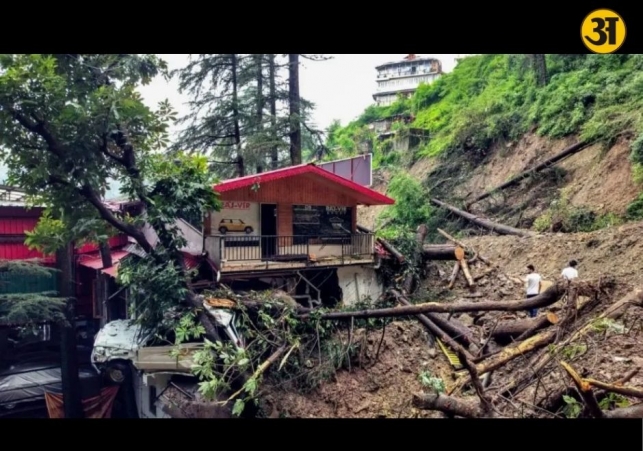
Landslide in Himachal’s Chaukar village puts five houses in danger
Massive landslide strikes Himachal’s Chaukar village, five houses face destruction risk
A huge landslide hit Chaukar village in Himachal Pradesh’s Sirmaur district on Saturday, creating panic in the area. The landslide occurred near the Nauhradhar region when a large part of the hill collapsed, covering nearly 200 metres. Luckily, five people who were present at the spot escaped safely, but the incident has placed five nearby houses in danger.
The disaster has added to the series of damages caused by the ongoing monsoon season. Local people recorded visuals showing the landslide sweeping away trees and thick vegetation. Large boulders could also be seen rolling down the slope, making the area unsafe for residents. Voices in the video could be heard alerting others about the landslide, warning that a major tragedy was narrowly avoided.
Heavy rains continue to damage Himachal Pradesh
The monsoon has been extremely harsh in Himachal Pradesh this year. Continuous rains since June 20 have caused landslides, road blockages, and destruction across the state. According to official data, the state has already suffered losses of more than ₹3,690 crore. Out of this, the Public Works Department alone reported damages of about ₹2,252 crore, while the Jal Shakti Department suffered losses worth ₹1,147 crore.
Chief minister Sukhvinder Singh Sukhu said the state is facing “widespread devastation, leading to heavy loss of lives and properties.” Speaking in Kullu during his visit to disaster-hit areas, he added that Himachal is using its own limited resources as no help has come yet from the Centre. He also announced that all examinations in the state have been cancelled due to unsafe weather and damaged roads.
To support affected families, the state government has written to the Centre seeking permission to provide one bigha of forest land to every household impacted by the rains. The government is also preparing a ₹3,000-crore project to get financial assistance from the World Bank for disaster management and rehabilitation.
The monsoon has not only damaged infrastructure but also disturbed the lives of common people. Hundreds of villages are still cut off because of blocked roads. Many farmers have reported damage to their fields, while others have been forced to move to temporary shelters. The government has asked people living in risky zones to remain alert as more landslides may occur in the coming weeks.
Government speeds up relief and reconstruction
To speed up relief and rebuilding work, the state government has given more powers to deputy commissioners. They can now approve new works under the MGNREGA scheme without waiting for approvals from the gram sabha, panchayat samiti, or zila parishad. These clearances can be taken later, so that work starts quickly.
Deputy commissioners can now also sanction different types of development projects, including land development, without being restricted to the earlier limit of 20 works per gram panchayat. The financial ceiling for individual land development projects has been doubled from ₹1 lakh to ₹2 lakh. This move is expected to fast-track small but urgent works such as road repairs, slope strengthening, and rebuilding damaged houses.
The state government has assured people that all possible steps are being taken to protect lives and property. However, officials admit that the scale of the damage is very high and recovery will take time. With heavy rainfall likely to continue in some parts, the risk of more landslides remains.
ALSO READ: How to get your protein intake right for better health and energy
ALSO READ: WHO says over one billion people lived with mental health conditions in 2021
Despite the tough conditions, locals have shown resilience. Villagers in affected areas have been helping each other, clearing debris, and warning authorities about new cracks in hillsides. Social organisations and volunteers are also stepping in to provide food, shelter, and emergency supplies.
The Chaukar landslide is a reminder of how fragile the Himalayan ecosystem is and how easily extreme weather can trigger disasters. Experts say that while nature cannot be controlled, proper planning, early warning systems, and strict construction rules are necessary to reduce risks. The government’s focus now is on rebuilding, but it is also being urged to adopt long-term measures like better drainage, slope protection, and controlled construction in vulnerable areas.
For now, the people of Chaukar and nearby villages remain on edge. The sight of collapsing hillsides, rolling boulders, and damaged roads has created fear, but it has also brought communities together in the face of adversity. With strong efforts from both the government and citizens, Himachal hopes to recover from this devastating monsoon season.
Related News