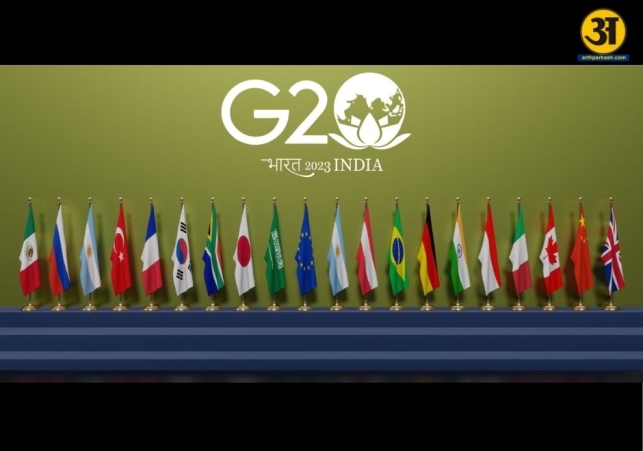
India’s G20 leadership continues to advance
India’s global influence grows stronger with its evolving G20 role
In a world troubled by wars, economic instability, and growing mistrust between major powers, global platforms often fail to deliver real solutions. But over the last eleven years, India has tried to steadily push the G20 in a more constructive direction. Under Prime Minister Narendra Modi’s leadership, the G20 has gradually moved from being a group that simply manages crises to a forum that discusses long-term global challenges.
During the latest discussions, India announced four major proposals. These include a Global Initiative on Countering the Drug-Terror Nexus, a Global Traditional Knowledge Repository, the Africa Skills Multiplier Initiative, and a Global Healthcare Response Team. These ideas highlight India’s attempt to offer practical solutions to world problems instead of just speeches and statements.
The first proposal, focused on the drug-terror connection, is particularly important. Across many regions, drug trafficking and terrorism are closely linked. Illegal drug money supports violent extremist groups and fuels instability. India has faced both problems for decades, so it is well placed to suggest a coordinated global system. This mechanism aims to improve intelligence sharing, detect emerging threats early, and prevent drug money from reaching terror networks. India sees this not only as a security step but as a way to make the world safer and more stable.
The second idea, a global repository of traditional knowledge, reflects India’s long civilizational heritage. As the world looks for natural healthcare, environment-friendly practices, and sustainable ways of living, ancient systems such as Ayurveda, Yoga, Siddha, and tribal medicine offer valuable lessons. A global repository would collect, organise, and protect this knowledge while respecting the intellectual property rights of local and indigenous communities. It also supports India’s Mission LiFE initiative, which urges people around the world to adopt environmentally responsible behaviour.
The third proposal, the Africa Skills Multiplier Initiative, shows India’s focus on development partnerships. Africa is home to one of the world’s youngest populations, but to benefit from this demographic strength, the continent needs strong skill-building systems. India already has strong connections with African nations through digital training, healthcare cooperation, development programs, and green energy projects. The new initiative aims to expand these efforts and help African countries grow faster in technology and green sectors. It also builds on India’s success in securing permanent G20 membership for the African Union during the New Delhi Summit in 2023.
The fourth proposal, the Global Healthcare Response Team, comes from lessons learned during the COVID-19 pandemic. The world struggled during the crisis because there was no coordinated global system to respond quickly. India, which supplied medicines and vaccines to many countries, now suggests creating a multinational team that can send doctors, mobile hospitals, essential supplies, and telehealth services during emergencies. This idea reflects India’s humanitarian approach to crises.
ALSO READ: When heart trouble hides: Why major artery blockages often show no symptoms
ALSO READ: What happens if antibiotics stop working: the rising threat of superbugs
A decade of consistent leadership at the G20
These four new proposals are not isolated efforts. They are part of a clear, decade-long pattern of how India has tried to influence global decision-making. Since 2014, PM Modi has repeatedly raised issues that were often ignored or considered uncomfortable. His early push for global financial transparency and action against black money showed his willingness to address problems that impact many countries.
In 2015, he emphasised the need to combat terror financing—an issue that later became central to global security discussions. By 2016, India had started linking economic progress with sustainability, innovation, and environmental responsibility. India also urged global leaders to see development, technology, and climate action as interconnected goals.
Over the next few years, India highlighted several ideas at the G20. In 2017, it called for stronger global health security, which proved foresighted when the pandemic arrived. In 2018, India presented the Nine-Point Agenda to deal with fugitive economic offenders, pushing the world to take financial crime more seriously. In 2019, it discussed digital governance, a topic that dominates global debates today as countries face challenges related to data privacy, digital payments, and artificial intelligence.
During the pandemic in 2020, India proposed that global development should focus on “Ease of Living”, shifting attention to human welfare rather than only economic statistics. In 2021, India promoted the “One Earth, One Health” principle, arguing that the health of people, ecosystems, and economies is deeply connected.
In 2022, India took two of its successful domestic ideas—Mission LiFE and the Aarogya Maitri humanitarian initiative—and introduced them at a global level. These efforts prepared the ground for India’s historic G20 Presidency in 2023. During that year, India achieved several important outcomes, including the consensus-based Delhi Declaration, permanent African Union membership, the launch of the Global Biofuels Alliance, and the creation of a Digital Public Infrastructure Framework.
Even after the presidency moved to Brazil in 2024 and South Africa in 2025, India’s influence continued. Discussions on implementing the Delhi Declaration, creating ethical AI standards, and helping debt-stressed countries have all reflected India’s ongoing role in shaping debates.
Across these eleven years, one idea stands out clearly: India believes global leadership must be fair, responsible, and humane. It argues that technology should be accessible to all, that growth must include vulnerable countries, and that global cooperation should be based on trust rather than power politics.
Today, as geopolitical divisions deepen around the world, India’s steady and consistent approach at the G20 offers direction and hope. By bringing forward practical and inclusive ideas, India has moved from being just one of the members of the G20 to becoming one of the key thinkers shaping its future.
Related News