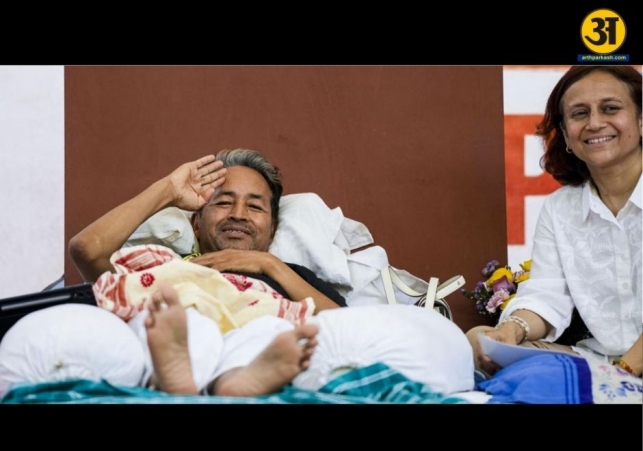
Hazare asks government to engage with Wangchuk
Anna Hazare urges Centre to hold talks with Sonam Wangchuk amid hunger strike standoff
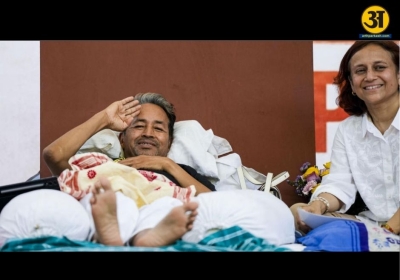
Veteran social activist Anna Hazare has appealed to the Union government to open a dialogue with educationist and climate activist Sonam Wangchuk, who has been on an indefinite hunger strike in New Delhi. Hazare said the government should not ignore Wangchuk's demands and should either accept or reject them after proper discussions instead of allowing the situation to continue without a resolution.
His remarks came after Wangchuk was taken to Safdarjung Hospital by Delhi Police on Saturday for a medical examination and treatment. The development triggered fresh controversy, with supporters alleging that the activist was moved against his wishes, while authorities maintained that the action was taken in accordance with a court order related to monitoring his health.
The ongoing protest has attracted national attention as Wangchuk completed 21 days of fasting at Jantar Mantar. His supporters say the hunger strike is aimed at drawing attention to issues he considers important, including accountability in the wake of the NEET paper leak controversy.
As tensions grew around the protest site and the activist's health, Hazare stepped in with an appeal for dialogue, recalling the importance of communication between governments and protesters during democratic movements.
Hazare calls for dialogue
Speaking on the issue, Anna Hazare said the government should not push the situation to a point where Wangchuk's health deteriorates further.
According to Hazare, discussions are an essential part of democracy and there is nothing wrong with engaging with someone who is raising concerns through peaceful protest.
He said the government should clearly state its position on Wangchuk's demands rather than allowing uncertainty to continue.
"The government should not test his limits. Say yes or no to his demands, but discussions should take place," Hazare said while speaking to reporters.
His comments carry significance because Hazare himself became the face of one of India's most prominent anti-corruption movements in 2011. During that campaign, he undertook a hunger strike demanding the implementation of the Lokpal Act, which led to widespread public support and put significant pressure on the then United Progressive Alliance (UPA) government.
Many observers have drawn comparisons between Hazare's earlier protests and Wangchuk's current hunger strike, though the issues and political contexts are different.
Wangchuk, who is widely known for his work in education, environmental conservation and sustainable development in Ladakh, has been staging his protest at Jantar Mantar in the national capital. One of his key demands has been accountability over the NEET paper leak controversy, including the resignation of Union Education Minister Dharmendra Pradhan.
The hunger strike has entered its third week, raising concerns among supporters and health professionals about its potential impact on Wangchuk's wellbeing.
ALSO READ: Iran claims it destroyed US aircraft in Jordan after deadly American strikes in Iran
ALSO READ: Trump imposes 25% tariff on some Brazilian imports after trade investigation
Hospitalisation sparks controversy
The situation took a dramatic turn when Delhi Police shifted Wangchuk to Safdarjung Hospital on Saturday.
According to the police, the move was made in compliance with directions issued by the Delhi High Court regarding regular monitoring of the activist's health during the hunger strike.
Authorities said ensuring Wangchuk's safety and medical wellbeing was their responsibility, especially considering the prolonged duration of the fast.
However, supporters of the activist disputed the circumstances surrounding the hospitalisation.
Members of the Citizens for Justice and Peace (CJP), who have been associated with the protest, alleged that Wangchuk was taken away forcefully and without proper consent.
Abhijeet Dipke of the organisation claimed that the activist had not agreed to be moved and that the action amounted to an unnecessary intervention.
Several protesters present at Jantar Mantar also alleged that police personnel arrived at the site in plain clothes and initially identified themselves as members of a medical team. According to their claims, volunteers supporting the protest were asked to move aside before Wangchuk was taken away.
The allegations have added another layer of controversy to the ongoing protest.
Meanwhile, some students participating in the demonstration claimed that police used force against protesters and alleged that a lathicharge took place near the protest site. Authorities have not publicly confirmed these allegations.
The CJP has further accused the Delhi Police of misinterpreting the High Court's directions regarding Wangchuk's health.
According to the organisation's spokesperson, the court had instructed authorities to monitor Wangchuk's condition and intervene only if his health showed signs of serious deterioration.
The group argued that Wangchuk's health had been regularly assessed by an independent medical team several times a day and that he had been publicly sharing updates about his condition through videos.
Based on this, the organisation claimed that there was no immediate medical emergency that justified shifting him to a hospital.
CJP spokesperson Saurav Das described the action as a misreading of the court's order and alleged that the detention amounted to contempt of court. He argued that medical monitoring and forced hospitalisation were two separate issues and that authorities had exceeded the scope of the directions issued by the judiciary.
The controversy has also drawn attention to the broader debate surrounding protest rights, public safety and state intervention during hunger strikes.
While governments often face pressure to ensure the health and safety of protesters, supporters of such movements frequently argue that forced medical intervention can undermine the purpose of peaceful demonstrations.
As the standoff continues, attention is likely to remain focused on both Wangchuk's health and the government's response to his demands.
For now, Anna Hazare's intervention has added a new voice to calls for dialogue and negotiation. His message to the government is straightforward: engage with the activist, discuss the issues being raised and provide a clear response rather than allowing the dispute to escalate further.
Whether such discussions take place remains uncertain, but the events surrounding Wangchuk's hunger strike have once again highlighted the role of peaceful protest in democratic societies and the challenges governments face when balancing public order, health concerns and freedom of expression.
Related News