UGC changes driven by courts, not new policy
Nothing new in revised UGC rules, says Yogendra Yadav at Panjab University lecture
- By Gurmehar --
- Friday, 30 Jan, 2026
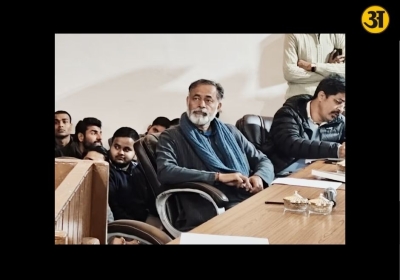
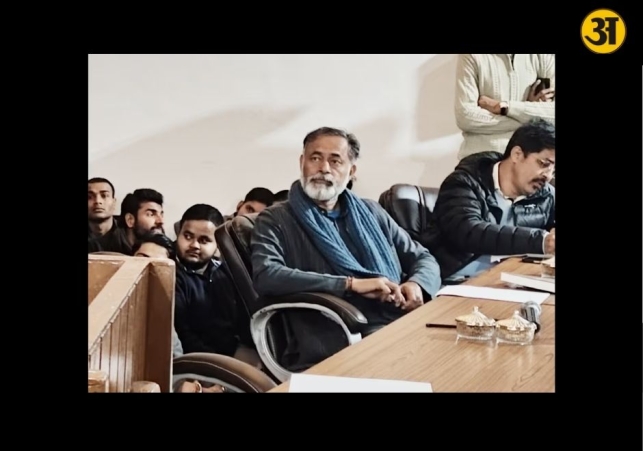
Political activist and academic Yogendra Yadav said on Thursday that the Union government has not introduced anything substantially new in the revised University Grants Commission regulations on equity and inclusion. Speaking at a guest lecture at Panjab University in Chandigarh, Yadav said the updated rules are mainly the result of judicial directions rather than a fresh policy initiative by the government.
His remarks come amid ongoing controversy and debate over the revised UGC guidelines, which are meant to address discrimination in higher education institutions. Yadav was addressing students and faculty members at a panel discussion held at PU’s English Auditorium. The event also featured Saroj Giri, associate professor at Delhi University, and Kuldeep Puri, a retired professor of education from Panjab University.
Yadav used the platform not only to clarify the background of the revised UGC regulations but also to outline what he described as five interlinked crises facing higher education in India today. According to him, these crises affect access, social justice, the idea of education itself, employment outcomes, technology, and democracy within universities.
No major change in UGC regulations
Addressing the controversy around the newly notified anti-discrimination guidelines, Yadav said the regulations do not introduce any fundamentally new provisions. He reminded the audience that the UGC had already framed anti-discrimination rules in 2012 and said he himself was part of the committee that drafted those earlier regulations.
He explained that the recent changes came after a 2019 Supreme Court case filed by the mothers of two students who allegedly died by suicide due to caste-based discrimination. Following the case, the Supreme Court directed the UGC in late 2024 to revisit and revise its framework on equity and inclusion. According to Yadav, the revised rules are largely a response to those court directions.
The updated guidelines, he said, make certain aspects more explicit. They clearly include Other Backward Classes along with Scheduled Castes and Scheduled Tribes and define more clearly the spaces and forms in which discrimination can take place on university campuses. However, Yadav stressed that this should not be seen as a major policy shift, as the core ideas already existed in earlier regulations.
ALSO READ: Trump warns Iran next attack will be far worse if no nuclear deal is reached
ALSO READ: Netanyahu’s taped phone camera sparks online debate over digital safety
He also spoke about Panjab University’s long-pending implementation of OBC reservation. Although a 27 percent OBC quota was introduced at the national level over three decades ago, PU delayed adopting it due to confusion over whether to follow Punjab’s 12 percent OBC policy or the Centre’s 27 percent norm. A committee appointed by PU vice-chancellor Renu Vig recommended in May 2024 that 27 percent of seats be reserved, with 12 percent set aside for OBC candidates from Punjab. However, because the university senate is not functioning, the proposal was sent to the Centre and is yet to be implemented.
Five crises facing higher education
During his lecture, Yadav outlined what he called five interlinked crises affecting higher education in India. The first crisis, he said, relates to access to adequately funded public institutions. While student enrolment from across the country has increased over the years, public investment in infrastructure and faculty has steadily declined. Using Panjab University as an example, he pointed out that only about half of its 1,378 sanctioned teaching posts are currently filled by regular faculty, with contractual and guest teachers handling much of the academic work.
The second crisis, according to Yadav, is social in nature. He said universities are seeing positive changes in terms of gender and caste diversity, but institutions have failed to create strong safeguards to deal with discrimination. As a result, students from marginalised backgrounds often face exclusion and bias without effective support systems.
The third crisis lies in the current idea of education itself. Yadav and Saroj Giri criticised the National Education Policy, arguing that it borrows heavily from foreign models and weakens the emancipatory role of education. Yadav said that while India achieved political independence, it has become increasingly dependent in cultural and intellectual terms. He argued that education should encourage critical thinking and social transformation, not just skill training.
Kuldeep Puri highlighted employability as another major fault line. He said higher education is increasingly failing to prepare students for meaningful employment. Degrees often do not translate into stable jobs, leaving many young people frustrated and uncertain about their future.
Yadav also warned about a technology-driven crisis, especially the unchecked use of artificial intelligence. He said excessive dependence on AI could erode human labour, creativity, and academic agency if not carefully regulated. Finally, he described democracy as the fifth crisis, stressing that universities must remain spaces where students and teachers can ask questions freely without fear. According to him, academic freedom and open debate are essential for a healthy education system.
The discussion at Panjab University sparked wide interest among students and faculty, as it connected policy debates with everyday realities on campuses. Yadav’s remarks underlined the need for deeper reforms in higher education, beyond symbolic changes in regulations.
Related News