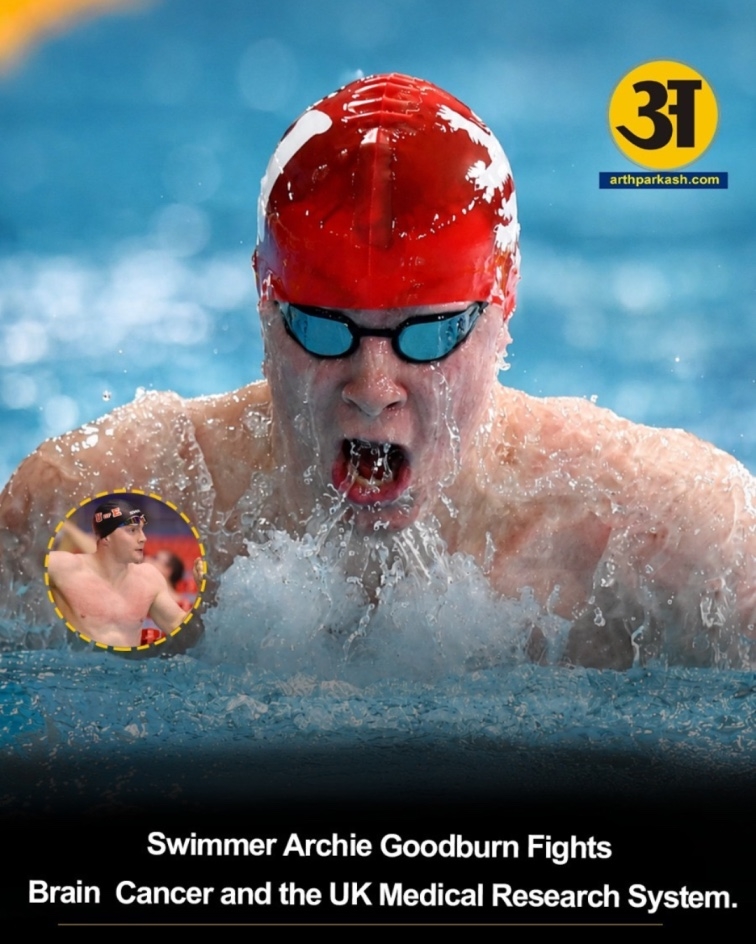
Swimmer Fights Brain Cancer Along With Health Research Systems
The Valley of Death: Why a Champion Swimmer is Fighting a System That Offers Patients ‘One Drug in 20 Years’
EDINBURGH — For an elite athlete, progress is measured in fractions of a second. Every lap, every breath, every heartbeat is carefully crafted toward forward movement. But when 24-year-old Scottish champion swimmer Archie Goodburn was diagnosed with three inoperable, incurable brain tumors, he collided with a medical reality that had been standing completely still.
“I grew up representing my country, and I want to see my country supporting me back,” says Goodburn, a Commonwealth Games athlete and chemical engineering student.
Goodburn is currently surviving, thriving, and remarkably training to compete for Scotland at the upcoming Commonwealth Games in Glasgow. His lifeline is Vorasidenib, a revolutionary daily oral tablet that prevents the proteins feeding his tumors, allowing him to delay the brain-damaging effects of immediate chemotherapy and radiation.
Yet, instead of quietly celebrating his luck, Goodburn is furious. Vorasidenib is the first major drug approved for his condition in over two decades. For Goodburn and advocacy groups like Brain Cancer Justice, one breakthrough every 20 years is not a success story—it is a catastrophic systemic failure.
The 1% Statistic
The severe mathematical gap in UK medical research is necessary to fully understand Goodburn's outrage. Brain tumors are the biggest cancer killer of children and adults under the age of 40 across the United Kingdom. Despite this sad and harsh label, the disease has historically received a mere 1% of the national cancer research budget since 2002.
The result of this absolute underfunding is a stagnant pool of therapeutic options. While treatments for breast, prostate, and blood cancers have seen rapid, progressive breakthroughs over the last twenty years, brain cancer patients are routinely handed the same decades-old protocols.
“Vorasidenib only bought me four years, according to the trials,” Goodburn warns openly. “I need more. And I'm not going to stop campaigning until my last breath.”
Escaping the 'Valley of Death'
According to Goodburn, the primary roadblock to saving lives isn't a lack of scientific imagination but a bureaucratic blockage. UK lawmakers and the All-Party Parliamentary Group on Brain Tumours have explicitly referred to this systemic failure as the “valley of death”—the vast, tangled, and risk-averse gap between discovering a breakthrough in a lab and actually funding the clinical trials required to get it to patients.
Even Vorasidenib’s arrival in the UK was a battleground. The National Institute for Health and Care Excellence (NICE) initially issued a provisional recommendation against funding the drug for the NHS. It required a fierce, public outcry from the brain cancer community—with Goodburn leveraging his platform at the forefront—to successfully overturn the decision and grant patients NHS access.
“Patients should not be left to navigate research gaps and clinical trial access on their own at the most frightening point of their lives,” Goodburn stated during a recent push at the Scottish Parliament in Holyrood.
Defiance in the Water
Goodburn’s campaign is given massive weight by his pure physical defiance. In late 2023, while training at the peak of his career for the Paris Olympic qualifiers, he began suffering from what he thought were intense migraines. During heavy training sets, his left flank would go completely numb, accompanied by terrifying waves of nausea and a feeling that his “consciousness was being pulled away.”
He missed the Olympic cutoff by a mere few tenths of a second while unknowingly harboring three brain tumors.
Today, powered by the very medical innovation he fights for, he is breaking records. Shortly after starting his Vorasidenib treatment, Goodburn broke the Scottish record in the 50m breaststroke—the exact event he will race in Glasgow. For him, his performance in the pool is living proof of what science can achieve when it is actually allowed to reach the patient.
“There's that much space for change,” Goodburn says, looking toward the future of cancer care. “Change is so possible.”
The clock is ticking, not just for Goodburn’s upcoming race, but for thousands of young patients across the UK. And as long as he has breath, this champion swimmer refuses to let the medical community tread water for another twenty years.
Related News