Vote-bank politics outweighs caste survey logic in Bihar elections
Power over parity: Vote-bank strategy dominates caste survey logic in Bihar polls
- By Gurmehar --
- Friday, 24 Oct, 2025
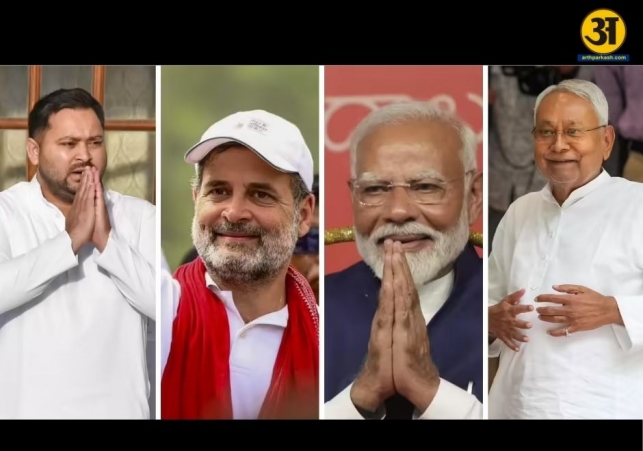
As Bihar prepares for the upcoming assembly elections on November 6 and 11, political parties are prioritising vote-bank calculations over proportional representation based on the state’s caste survey. The recent caste survey showed that Extremely Backward Classes (EBCs) make up 36 percent of the population, Other Backward Classes (OBCs) 27 percent, upper castes 15.5 percent, and Scheduled Castes and Tribes 21 percent. The survey implied that ticket distribution should reflect these proportions, but in practice, parties have allocated tickets largely to consolidate their core supporters rather than ensure social equity.
The National Democratic Alliance (NDA) and Mahagathbandhan have both abandoned proportional representation logic. Instead, their ticket strategies focus on consolidating communities that have historically supported them. This has resulted in overrepresentation of some groups and underrepresentation of others, highlighting the continued dominance of vote-bank politics in Bihar.
NDA and its ticket strategy
The BJP, the main party in the NDA, draws strong support from Hindu upper castes. Of its 101 tickets, it has given 49 to upper castes, including 21 to Rajputs, 16 to Bhumihars, 11 to Brahmins, and one to a Kayastha. This is a clear overrepresentation considering upper castes constitute only 11 percent of Bihar’s population. The party allocated 18 tickets to non-Yadav OBCs and 16 to EBCs, a combined 34 percent, slightly lower than their population share.
The Janata Dal (United), led by Chief Minister Nitish Kumar, relies on Kurmis, Koeris, and Hindu EBCs. The JDU gave 29 tickets to non-Yadav OBCs and 22 to EBCs, totaling 51 percent, which is higher than their actual population of 37 percent. Upper castes received 22 tickets, while Muslim representation fell sharply from 11 in 2020 to just four this time. The ticket strategy aims to reinforce Nitish Kumar’s image as a champion of backward classes, but proportionality remains secondary to securing votes.
Together, BJP and JDU have reduced Yadav candidates compared to 2020, fielding just six and eight candidates, respectively. Yadavs are traditionally RJD’s core vote bank, and this reduction reflects a tactical move to weaken the rival bloc.
ALSO READ: Experts raise alarm over increasing breast cancer in young women
ALSO READ: India faces rising concerns over adulterated eggs alongside fake paneer
Mahagathbandhan and other parties
On the Mahagathbandhan side, the Rashtriya Janata Dal (RJD) relies on the Muslim-Yadav alliance. Out of 143 candidates, 51 are Yadavs (36 percent) and 19 are Muslims (14 percent). This overrepresents Yadavs relative to their 14 percent population share, while Muslims, who make up 18 percent, are slightly underrepresented. About 75-80 percent of Yadavs and Muslims have historically supported the Mahagathbandhan, making them a strategic focus.
The RJD has also increased focus on Kushwahas (Koeris), a smaller community that has shown support for the alliance in past elections. This time, the RJD has fielded 14 Kushwaha candidates, doubling its 2020 number. The Congress, contesting 60 seats, relies on upper castes and Muslims, giving 20 tickets to upper castes and nine to Muslims. Despite promises to benefit EBCs, the Congress allocated only six tickets to this group, far below their population share of 26 percent.
The ticket distribution highlights how parties have discarded proportional representation from the caste survey in favour of consolidating key vote blocs. Five social groups—Rajputs, Bhumihars, Kushwahas, Yadavs, and Muslims—traditionally account for more than half the Bihar assembly. The NDA and Mahagathbandhan have focused heavily on these communities, with 44-48 percent of JDU and BJP tickets and 48-67 percent of RJD and Congress tickets going to these groups.
In conclusion, Bihar’s upcoming elections illustrate the enduring dominance of vote-bank politics over social equity. Parties are using caste-based calculations selectively, favouring groups that are likely to deliver electoral victories rather than adhering to proportional representation suggested by the caste survey. As voters head to the polls, these strategic decisions will test whether traditional vote-bank arithmetic continues to shape Bihar’s political landscape or if a more equitable representation can influence outcomes.
The elections will show if parties can secure their core bases without alienating smaller groups, and whether communities like EBCs, OBCs, and Muslims can assert greater political influence despite being underrepresented in ticket allocation. In the end, Bihar voters will decide if vote-bank arithmetic outweighs fairness in shaping the next assembly.
Related News