Trump says meetings will happen only as peace deal nears end
Trump signals he’ll meet Putin and Zelensky only when peace talks near conclusion
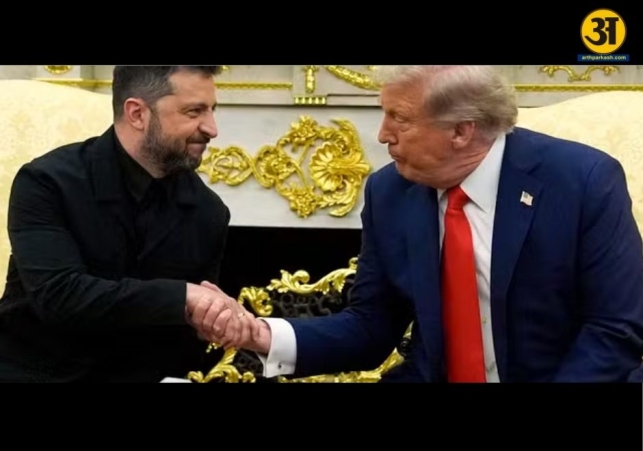
Former US President Donald Trump has sent two senior representatives to hold new talks with Russia and Ukraine as part of a fresh attempt to end the ongoing war. However, he made it clear that he will personally meet Russian President Vladimir Putin and Ukrainian President Volodymyr Zelensky only when the peace deal reaches its “final stages.”
Trump said the original 28-point peace plan prepared by the US has been updated with suggestions from both countries. According to him, only a few points remain unresolved, and “tremendous progress” has been made in the last week. Still, he warned that he will step in only at the end of the negotiation process.
Trump asked Special Envoy Steve Witkoff to meet Putin in Moscow. He also directed Army Secretary Dan Driscoll, who has already been involved in talks with Russian officials in Abu Dhabi, to speak with Ukrainian representatives as well. Trump posted online that he hopes to meet both leaders soon, but only if the deal is close to completion.
The renewed push for peace comes at a time when the White House has shown cautious optimism, while many international analysts remain unsure if the negotiations can actually produce a long-lasting agreement. Previous attempts have failed because any deal acceptable to Ukraine has usually been rejected by Russia, and vice-versa.
Ukraine’s government has also been hoping for a personal meeting with Trump. The Ukrainian President reiterated that no final deal has been approved yet. He said communication with the US continues and expressed gratitude for American efforts to end the conflict.
Meanwhile, a news report from ABC suggested that Ukraine had agreed to a possible peace plan with only minor points left to settle. But there is still uncertainty, as Russia’s approval remains far from guaranteed.
A former US ambassador commented that both countries still have completely different objectives. According to him, Trump wants a durable peace, while Russia seeks political control over Ukraine. He said a deal will be impossible unless Russia is convinced it cannot achieve its political goals through force.
Talks between the US and Russian teams have taken place in Abu Dhabi, following a meeting in Geneva where some progress was made. A Kremlin spokesperson refused to share details, saying there was nothing new to report. Earlier versions of the US proposal had upset Ukraine and its European partners because they asked Ukraine to drop its plan to join NATO and to give up territory in the eastern Donbas region. Some of that territory is not even under Russian control yet.
ALSO READ: Dharmendra’s political journey reveals his surprising wish for absolute control
ALSO READ: When heart trouble hides: Why major artery blockages often show no symptoms
The initial draft of the peace plan was based partly on discussions held between Witkoff and Russian officials. Reports have revealed that in mid-October, Witkoff gave guidance to a top aide of Putin on how the Russian leader could approach Trump on the issue.
Ukraine’s intelligence chief also attended meetings in Abu Dhabi, though officials did not respond to media questions. The peace plan has now been shortened to 19 proposals after discussions in Geneva. But sensitive issues like territory can only be addressed in a direct meeting between the US President and the Ukrainian President, a Ukrainian official said.
International involvement grows as Europe enters the discussion
Ukraine’s National Security and Defense Council confirmed that US and Ukrainian teams had reached a “common understanding” on major terms discussed in Geneva. Ukraine is now trying to arrange a visit by its President to the US as soon as possible.
European leaders have also moved into the process. The prime ministers of the UK, France, Germany, and Italy, along with leaders of Sweden, Estonia, New Zealand, and the European Union, held a call with Ukraine to discuss the negotiations. The US Secretary of State also joined the meeting, showing growing American involvement.
During the call, the British Prime Minister noted that Ukraine has offered “constructive changes” to the peace plan and that most of the text appears acceptable. This indicates that diplomatic momentum is building, even though a final agreement remains far away.
Russia is now waiting for the US to present a revised version of the plan after speaking with European and Ukrainian officials. But Russia’s foreign minister warned that any changes that differ from the understandings reached earlier this year between Trump and Putin would not be acceptable. He said that if the “spirit and letter” of those earlier talks are ignored, Russia will not support any proposal.
Amid all these discussions, the situation on the ground remains dangerous. Russia and Ukraine exchanged fire again overnight, with heavy air raids reported in Kyiv and attacks launched on parts of southern Russia. The renewed violence is a reminder that even though diplomatic activity is increasing, the war continues with significant intensity.
For now, both Russia and Ukraine appear to be listening to the proposals, but each side remains firm on its key demands. The path to peace still looks complicated. While Trump has taken a strong interest in pushing the talks forward, his decision to stay personally distant until the end may make negotiations slower. Whether both sides can agree on difficult compromises is still uncertain.
Even though there is more communication than before, the major questions — territory, political control, and long-term security guarantees — remain unresolved. Diplomats hope progress will continue, but the final deal, if it comes, will require tough decisions from both Russia and Ukraine. Until then, the war shows no sign of ending immediately.
Related News