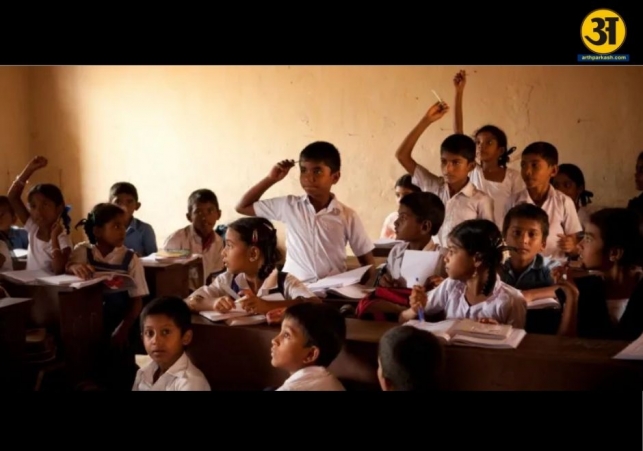
Survey finds one-third of students take private coaching
One-third of school students rely on private coaching, urban areas dominate: CMS Education survey
A new education survey by the government has revealed how Indian families are spending on school education and private coaching. The Comprehensive Modular Survey on Education (CMS: E), conducted as part of the 80th round of the National Sample Survey (NSS), collected data from more than 52,000 households and about 58,000 students across the country.
The survey studied important aspects such as enrollment trends, education costs, funding sources, and the growing dependence on private coaching. Its findings show that while government schools continue to serve most students, private schools and coaching classes are creating a sharp urban-rural divide in education spending.
Government schools remain backbone of education
According to the survey, government schools account for 55.9% of total student enrollments in India. Their presence is strongest in rural areas, where almost two-thirds (66%) of students attend government schools. In contrast, only 30.1% of urban students study in government schools, as private schools dominate in cities. Private unaided recognised schools now make up nearly one-third (32%) of all enrollments across the country.
The survey highlights a huge gap in spending between government and private schools. Only 26.7% of students in government schools pay course fees, while in private schools the number rises dramatically to 95.7%. On average, families spend just Rs 2,863 per student annually in government schools compared to Rs 25,002 in private schools.
The biggest financial burden for families is course fees. The average cost of fees nationally is Rs 7,111, but this differs widely between cities and villages. Urban households pay almost Rs 15,143 annually, while rural households pay only Rs 3,979. Other expenses such as textbooks, uniforms, and transportation add further to the difference.
This shows how rural families depend heavily on affordable government schooling, while urban families face much higher education costs due to their preference for private institutions.
Private coaching grows, especially in cities
One of the most important findings of the CMS: E survey is the rapid rise in private coaching. Nearly 27% of students across India now take coaching outside their regular schools. The share is much higher in urban areas (30.7%) compared to rural areas (25.5%).
The cost of coaching is also very uneven. Families in cities spend nearly Rs 3,988 per student each year on coaching, while in villages the cost is about Rs 1,793. At higher education levels, the expenses rise further. For example, higher secondary students in urban areas spend almost Rs 10,000 annually on coaching classes. This shows that coaching has become a major expense for families, especially in cities where competition is more intense.
The growing dependence on coaching also reflects concerns among parents about the quality of regular schooling. Many families, particularly in urban areas, believe coaching is necessary for their children to perform well in competitive exams and secure good careers.
Families bear almost all education costs
The survey also studied how education is being financed in India. It found that 95% of all education expenses are paid by family members themselves. This is true for both rural and urban households. Government support in the form of scholarships or subsidies is very limited, with only 1.2% of students depending on such schemes as their main source of funding.
This means that the financial burden of education falls almost entirely on families. With rising costs of private schooling and coaching, many households are under pressure to manage these expenses. The survey points to the need for stronger public support in order to make education more affordable and inclusive.
New features in survey design
The CMS: E survey has introduced some changes compared to previous education surveys. For the first time, it has separately reported the spending on private coaching, recognising its growing importance in India’s education system. It also includes anganwadi centres under pre-primary education, giving a fuller picture of early childhood learning.
However, officials caution that while the survey provides reliable national-level estimates, data at the state or regional level should be interpreted carefully due to smaller sample sizes. Despite these limitations, the findings give an important snapshot of how Indian households are dealing with education expenses in the current academic year.
The full report is available on the website of the Ministry of Statistics and Programme Implementation, which is responsible for conducting the survey.
ALSO READ: PM Modi’s vision sparks a new era in India’s space journey
ALSO READ: Why the UN declaring a famine in Gaza holds critical global importance | Explained
Key takeaways
The CMS: E survey highlights some important realities of India’s education system:
-
Government schools still play the biggest role, especially in rural India.
-
Private schools dominate in urban areas, but they come with very high costs.
-
Families spend far more on education in cities than in villages.
-
Private coaching is becoming widespread, with nearly one in three students taking extra classes.
-
Households themselves pay almost all education costs, with minimal help from government schemes.
Overall, the report shows that while India has made progress in school enrollments, education is becoming more expensive and unequal, with urban families spending much more than rural ones. The rise of coaching is also reshaping how students prepare for exams and careers, raising questions about the role of schools in meeting learning needs.
Related News