Proposed bill could reshape state-wise representation
How Lok Sabha seats may change after the Delimitation Bill
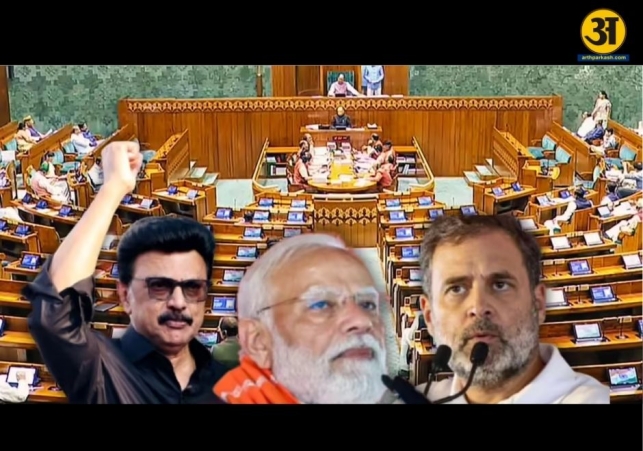
New Delhi: A major political debate has started after the Union government introduced important bills during the special session of Parliament. Among them, the Delimitation Bill, 2026, has drawn the most attention because it proposes to redraw constituencies, increase the strength of the Lok Sabha and help implement women’s reservation before the 2029 general elections.
The government says the move is aimed at improving representation and making the parliamentary system more balanced according to population changes. However, opposition parties have raised concerns, especially about whether southern states may lose political influence if seats are redistributed.
Delimitation means redrawing the boundaries of parliamentary and assembly constituencies so that representation remains fair as population changes over time. India has carried out delimitation exercises in the past, but for many years the process remained frozen.
Now, the Centre wants to begin a fresh exercise and increase the total number of Lok Sabha seats from the present 543 to around 850. According to the proposal, more seats would be added for states and Union Territories, while one-third seats would also be reserved for women under the women’s reservation law.
The issue has become politically sensitive because any increase in seats affects the balance of power between states. States with larger populations could gain more members, while states with slower population growth fear reduced relative influence.
The government has rejected these concerns and said no state will lose seats in absolute numbers.
ALSO READ: US seeks 20-year nuclear pause while Iran offers 5 years as talks remain deadlocked
ALSO READ: Trump says he does not care if Iran returns to talks after negotiations fail
Proposed increase in Lok Sabha seats
According to the draft proposal, the total strength of the Lok Sabha may rise sharply from 543 to about 850 seats. Out of these, around 815 seats may go to states, while the remaining seats would represent Union Territories.
The government has suggested using the 2011 Census as the basis for the exercise.
Under the proposed “pro rata expansion” model, every state would see an increase in seats, roughly in proportion to its current share. This means no state would lose the number of MPs it already has. Instead, all states would gain additional seats.
Some of the major proposed changes are:
-
Uttar Pradesh: from 80 to 120 seats
-
Maharashtra: from 48 to 72 seats
-
West Bengal: from 42 to 63 seats
-
Bihar: from 40 to 60 seats
-
Tamil Nadu: from 39 to 59 seats
-
Madhya Pradesh: from 29 to 44 seats
-
Karnataka: from 28 to 42 seats
-
Gujarat: from 26 to 39 seats
-
Andhra Pradesh: from 25 to 38 seats
-
Rajasthan: from 25 to 38 seats
-
Odisha: from 21 to 32 seats
-
Kerala: from 20 to 30 seats
These numbers show that larger states with bigger populations may receive more seats, but southern states would also gain additional representation.
The Centre argues that because the House size is increasing, no state is being punished for population control or development.
Why the north-south debate continues
Even though all states may gain seats, critics say the real issue is not just the number of seats, but the percentage share of power in Parliament.
Southern states such as Tamil Nadu, Kerala, Karnataka, Telangana and Andhra Pradesh have long argued that they successfully controlled population growth and improved social indicators. Their concern is that states with faster population growth in the north may gain more influence after delimitation.
Opposition leaders have said this could create a north-south divide and upset the federal balance.
The government has denied this claim. Union ministers have said southern states are still gaining seats under the formula and therefore are not losing out.
They also argue that delimitation is necessary because some constituencies now represent far more people than others, creating unequal voter representation.
For example, one MP in a highly populated constituency may represent many more citizens than an MP in a smaller constituency. Redrawing boundaries and increasing seats could correct such imbalances.
Another major reason behind the bill is the implementation of the women’s reservation law. By increasing the total number of seats, the government can reserve one-third seats for women without drastically reducing the number of existing constituencies held by male politicians. This is seen as politically easier to implement.
Still, passing the proposal may not be simple. Constitutional amendments require broad parliamentary support, and opposition parties have indicated resistance.
The final shape of the bill may depend on debates, negotiations and possible changes during the legislative process.
For ordinary citizens, the issue is important because it will shape how they are represented in Parliament for years to come. More MPs could mean smaller constituencies, better access to representatives and more balanced governance.
At the same time, the debate highlights a larger national question: how to balance population-based representation with fairness among all regions.
The coming parliamentary discussions are likely to be intense. If passed, the Delimitation Bill could become one of the biggest political reforms in recent years and significantly reshape India’s electoral map before the 2029 Lok Sabha elections.
Related News