Investigators link Delhi blast case to secret extremist network
J&K Police says Red Fort blast probe uncovered bid to revive banned terror group
- By Gurmehar --
- Friday, 17 Apr, 2026
New Delhi: Jammu and Kashmir Police’s State Investigation Agency (SIA) has made a major claim in its probe linked to the November 2025 Red Fort blast case. According to the agency, the accused were allegedly trying to revive the banned terror outfit Ansar Ghazwat-ul-Hind (AGuH) while using the name of Jaish-e-Mohammad (JeM) as a cover.
Officials said the use of JeM’s name was meant to create fear and confusion because the organisation is already widely known. At the same time, investigators believe the real plan was to secretly rebuild AGuH through recruitment, propaganda and preparations for future attacks.
The development came after the SIA filed a chargesheet naming ten people, including four doctors. The chargesheet was filed in connection with a separate case registered in Nowgam, Srinagar, where threatening posters had appeared in October last year.
The National Investigation Agency (NIA), which is separately probing the main Red Fort blast case, has also arrested several suspects.
According to the SIA, the poster campaign was not an isolated act. Instead, it was allegedly part of a wider conspiracy to spread fear, disturb peace and challenge the authority of the Indian state.
Officials said the suspects tried to use public messaging, online propaganda and hidden networks to radicalise people and attract new members.
The agency added that the accused deliberately used the name of JeM because it carries a strong image of violence and terror. By doing this, they allegedly hoped to mislead security agencies while secretly building another organisation in the background.
Educated network under scanner
One of the most striking parts of the investigation is the background of the accused. Police said several members of the alleged module were highly educated and included medical professionals.
Investigators claimed these individuals used institutional spaces and personal networks for illegal activities. They were allegedly involved in spreading extremist content online and helping organise secret meetings.
The SIA also said some suspects were linked to activities involving the procurement and testing of explosive materials. According to officials, experiments were carried out inside residential buildings and facilities connected to Al-Falah Medical College or University in Faridabad.
ALSO READ: How Lok Sabha seats may change after the Delimitation Bill
ALSO READ: US seeks 20-year nuclear pause while Iran offers 5 years as talks remain deadlocked
Police further stated that the module had obtained Triacetone Triperoxide, commonly known as TATP. This is considered a highly dangerous and unstable explosive material that has been used in terror incidents in different parts of the world.
Because of its sensitivity, even small handling mistakes can trigger blasts. This has raised serious concern among investigators.
The people named in the SIA chargesheet include Arif Nisar Dar, Yasir Ul Ashraf Bhat, Maqsood Ahmad Dar, Irfan Ahmad Wagay, Zameer Ahmad Ahanger, Tufail Ahmad Bhat, and doctors Muzamil Shakeel Ganaie, Adeel Ahmad Rather, Shaheen Saeed and Umar Un Nabi.
Authorities said more evidence is being examined, including digital records, financial links and communication trails.
Red Fort blast remains central case
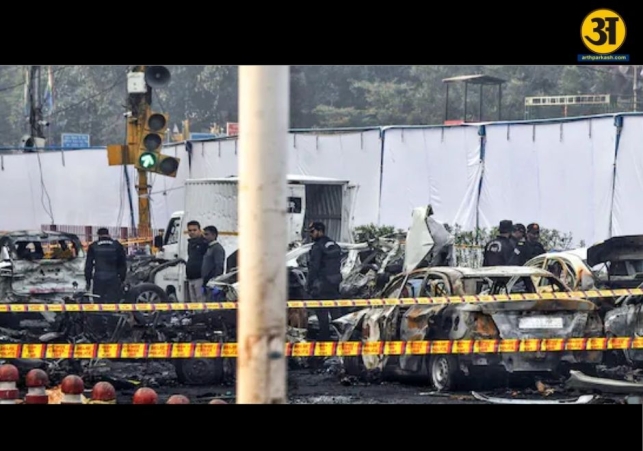
The Red Fort blast on November 10, 2025 shocked the country. Eleven people were killed and several others injured when a car exploded on a busy road near the historic monument in Delhi.
The blast happened in a crowded area, leading to panic and a major security operation. Emergency services rushed to the spot, while investigators began tracing the source of the vehicle and the people involved.
Officials later said the prime accused, Dr Umar Un Nabi, was also killed in the explosion.
The NIA has been leading the main investigation into the bombing. While it has not publicly commented in detail on the SIA findings, officers indicated that their own probe has found links to Ansar Ghazwat-ul-Hind.
According to officials, some handlers connected to the group may have been operating from Pakistan and certain Gulf countries. Investigators are also examining whether the accused were self-radicalised through online channels before becoming part of a larger network.
Security experts say such cases show how extremist groups are changing their methods. Instead of relying only on traditional camps or known operatives, some networks now use educated individuals, digital platforms and hidden cells.
This makes detection more difficult because suspects may appear to live normal professional lives while secretly supporting violent activities.
The case has also raised questions about online radicalisation, misuse of educational institutions and the spread of encrypted communication tools.
Authorities are expected to file more chargesheets as the investigation continues. Courts will now examine the evidence presented by agencies.
For now, the latest claims by the SIA suggest that the Red Fort blast case may have involved not just one attack, but a broader plan to revive a banned militant outfit under a false name.
If proven in court, the case would expose how terror groups attempt to survive by changing identities, using new faces and exploiting fear to regain influence.
Security agencies across India are now likely to increase monitoring of such hidden networks to prevent future attacks.
Related News