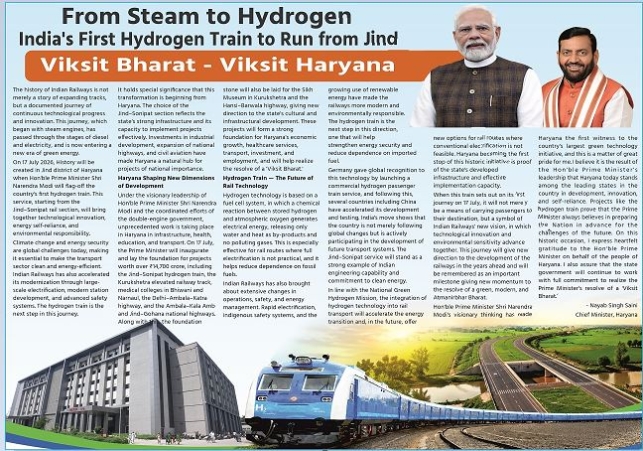
India's First Hydrogen Train to Run from Jind
India's First Hydrogen Train to Run from Jind
Viksit Bharat - Viksit Haryana
The history of Indian Railways is not merely a story of expanding tracks, but a documented journey of continuous technological progress and innovation. This journey, which began with steam engines, has passed through the stages of diesel and electricity, and is now entering a new era of green energy.
On 17 July 2026, History will be created in Jind district of Haryana when Hon'ble Prime Minister Shri Narendra Modi will flag-off the country's first hydrogen train. This service, starting from the Jind–Sonipat rail section, will bring together technological innovation, energy self-reliance, and environmental responsibility.
Climate change and energy security are global challenges today, making it essential to make the transport sector clean and energy-efficient. Indian Railways has also accelerated its modernization through large-scale electrification, modern station development, and advanced safety systems. The hydrogen train is the next step in this journey.
It holds special significance that this transformation is beginning from Haryana. The choice of the Jind–Sonipat section reflects the state's strong infrastructure and its capacity to implement projects effectively. Investments in industrial development, expansion of national highways, and civil aviation have made Haryana a natural hub for projects of national importance.
Haryana Shaping New Dimensions of Development
Under the visionary leadership of Hon'ble Prime Minister Shri Narendra Modi and the coordinated efforts of the double-engine government, unprecedented work is taking place in Haryana in infrastructure, health, education, and transport. On 17 July, the Prime Minister will inaugurate and lay the foundation for projects worth over ₹14,700 crore, including the Jind–Sonipat hydrogen train, the Kurukshetra elevated railway track, medical colleges in Bhiwani and Narnaul, the Delhi–Ambala–Katra highway, and the Ambala–Kala Amb and Jind–Gohana national highways. Along with this, the foundation stone will also be laid for the Sikh Museum in Kurukshetra and the Hansi–Barwala highway, giving new direction to the state's cultural and infrastructural development. These projects will form a strong foundation for Haryana's economic growth, healthcare services, transport, investment, and employment, and will help realize the resolve of a 'Viksit Bharat.'
Hydrogen Train — The Future of Rail Technology
Hydrogen technology is based on a fuel cell system, in which a chemical reaction between stored hydrogen and atmospheric oxygen generates electrical energy, releasing only water and heat as by-products and no polluting gases. This is especially effective for rail routes where full electrification is not practical, and it helps reduce dependence on fossil fuels.
Indian Railways has also brought about extensive changes in operations, safety, and energy management. Rapid electrification, indigenous safety systems, and the growing use of renewable energy have made the railways more modern and environmentally responsible. The hydrogen train is the next step in this direction, one that will help strengthen energy security and reduce dependence on imported fuel.
Germany gave global recognition to this technology by launching a commercial hydrogen passenger train service, and following this, several countries including China have accelerated its development and testing. India's move shows that the country is not merely following global changes but is actively participating in the development of future transport systems. The Jind–Sonipat service will stand as a strong example of Indian engineering capability and commitment to clean energy.
In line with the National Green Hydrogen Mission, the integration of hydrogen technology into rail transport will accelerate the energy transition and, in the future, offer new options for rail routes where conventional electrification is not feasible. Haryana becoming the first stop of this historic initiative is proof of the state's developed infrastructure and effective implementation capacity.
When this train sets out on its first journey on 17 July, it will not merely be a means of carrying passengers to their destination, but a symbol of Indian Railways' new vision, in which technological innovation and environmental sensitivity advance together. This journey will give new direction to the development of the railways in the years ahead and will be remembered as an important milestone giving new momentum to the resolve of a green, modern, and Atmanirbhar Bharat.
Hon'ble Prime Minister Shri Narendra Modi's visionary thinking has made Haryana the first witness to the country's largest green technology initiative, and this is a matter of great pride for me. I believe it is the result of the Hon'ble Prime Minister's leadership that Haryana today stands among the leading states in the country in development, innovation, and self-reliance. Projects like the hydrogen train prove that the Prime Minister always believes in preparing the Nation in advance for the challenges of the future. On this historic occasion, I express heartfelt gratitude to the Hon'ble Prime Minister on behalf of the people of Haryana. I also assure that the state government will continue to work with full commitment to realize the Prime Minister's resolve of a 'Viksit Bharat.'
Nayab Singh Saini
Chief Minister, Haryana
Related News