Gold crashes sharply, outlook remains uncertain
Gold sees worst weekly fall in over 40 years, investors remain cautious amid global tensions
- By Gurmehar --
- Monday, 23 Mar, 2026
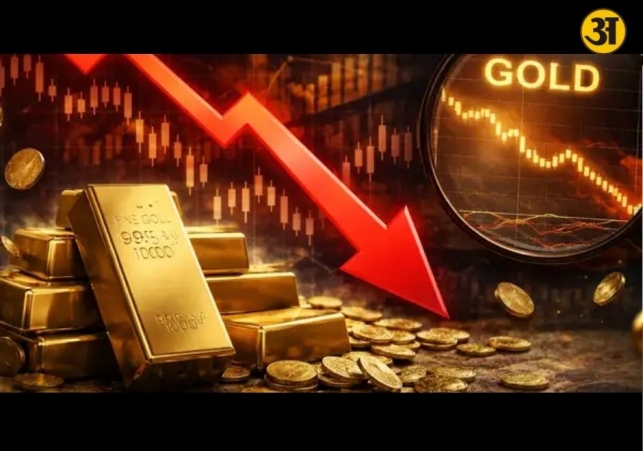
Gold prices have witnessed a sharp and unexpected fall, marking their worst weekly performance in more than 40 years. On March 23, 2026, the precious metal dropped significantly, raising concerns among investors across the world. The sudden decline has come at a time when global uncertainty and geopolitical tensions are already high.
In the international market, spot gold prices fell over 6 per cent to around 4,215 dollars per ounce. This is the lowest level recorded since December last year. Just a few months ago, gold had reached an all-time high of over 5,595 dollars per ounce. The sharp fall from such high levels has surprised many market participants.
In India, the impact was clearly visible on the Multi Commodity Exchange (MCX). Gold futures for April delivery opened with a sharp decline and continued to fall during the trading session. Prices dropped from around ₹1,44,492 per 10 grams to nearly ₹1,29,595 at one point. Although there was a slight recovery later, gold was still trading much lower than previous levels.
Silver prices also followed a similar trend and recorded a steep decline. This shows that the fall is not limited to gold alone but reflects broader weakness in precious metals.
Reasons behind the sharp fall
There are several factors behind this sudden drop in gold prices. One of the key reasons is the ongoing geopolitical situation involving the United States, Israel, and Iran. While gold is usually considered a safe-haven asset during uncertain times, the current situation has created mixed signals in the market.
In some cases, investors move towards gold during conflicts to protect their wealth. However, at the same time, global economic pressures, rising interest rates, and strong currency movements can reduce the demand for gold. These factors appear to have influenced the recent price decline.
Another important factor is profit booking. When gold prices reached record highs earlier, many investors bought the metal expecting further gains. As prices started to fall, traders began selling to secure profits, which added to the downward pressure.
Market experts also point out that technical factors are playing a role. Gold prices have broken key support levels, which has triggered further selling in the market. When such levels are breached, automated trading systems and short-term traders often increase selling activity.
Despite the fall, experts say that geopolitical tensions are still providing some support to gold prices. This is preventing a deeper and more sustained decline for now.
ALSO READ: Netanyahu pauses Iran gas field strikes after Trump request amid rising Middle East tensions
What investors should expect
According to market analysts, the overall trend for gold currently appears to be cautious to bearish. This means that while prices may stabilise in the short term, there is still a risk of further downside.
Experts suggest that gold may trade within a range in the coming weeks. On the higher side, the range between 4,400 and 4,500 dollars per ounce is seen as an important resistance zone. If prices move above this level and stay there, it could signal a possible recovery.
On the other hand, if gold prices fall below 4,250 dollars per ounce, it may lead to further weakness. In such a case, prices could move towards the 4,100 to 4,150 range.
For Indian investors, similar trends are expected on MCX. Prices may remain volatile, with sudden ups and downs during trading sessions. This means investors need to be careful and avoid making quick decisions based on short-term movements.
Experts advise that long-term investors should not panic during such corrections. Gold has historically been a stable asset over long periods. However, short-term traders need to be cautious and follow market trends closely.
Diversification is another important strategy. Instead of investing all money in one asset, spreading investments across different options can help reduce risk. Gold can still be a part of a balanced portfolio, but it should not be the only investment.
Investors are also advised to keep an eye on global developments. Changes in interest rates, currency movements, and geopolitical events can have a direct impact on gold prices. Staying informed can help in making better decisions.
In conclusion, the recent fall in gold prices marks a significant moment in the market. A decline of this scale, especially after a record high, has created uncertainty among investors.
While the worst may not be completely over, signs of stabilisation could emerge in the coming weeks. The market is likely to remain volatile, influenced by global events and economic conditions.
For investors, the key is to stay calm, focus on long-term goals, and avoid reacting to short-term fluctuations. Gold remains an important asset, but like any investment, it requires careful planning and a balanced approach.
Related News