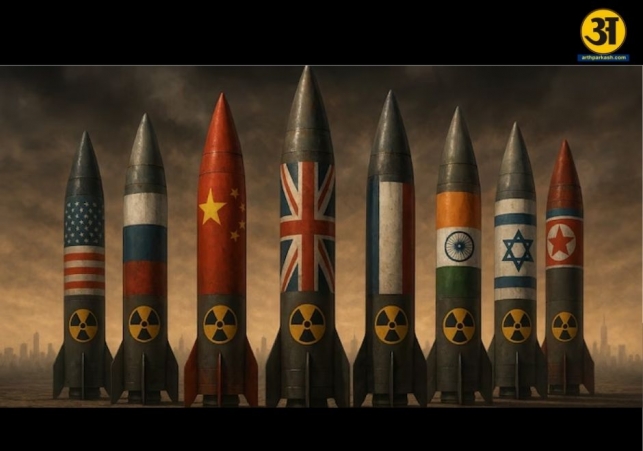
Global nuclear arms race intensifies
Nations compete to strengthen nuclear capabilities worldwide
- By Gurmehar --
- Friday, 26 Sep, 2025
Nuclear weapons are no longer just a Cold War issue—they have returned to the center of global attention. On September 22, 2025, Russia’s President Vladimir Putin proposed extending the 2011 Strategic Arms Limitation Talks (SALT) treaty for one more year. This treaty limits the number of nuclear weapons that the US and Russia can deploy: up to 1,550 warheads and a maximum of 700 long-range missiles and bombers. Without this treaty, both countries could expand their arsenals, raising tensions worldwide.
Experts say nuclear weapons are not primarily meant for fighting wars. Instead, they serve as political tools. They deter other countries through the threat of retaliation and act as a powerful signal in international politics. Global events like Russia’s ongoing war in Ukraine, tensions between Israel and Iran, and the rise of China have added to fears about nuclear escalation. In 2025, nuclear weapons are back at the forefront, influencing geopolitical strategies and security decisions. Dr. Manpreet Sethi, a Distinguished Fellow at the Centre for Air Power Studies, notes that the value of nuclear weapons is higher than it has been since the end of the Cold War in 1991. Countries are now openly using nuclear threats, targeting potential weapon sites, and increasing their strategic readiness.
Nuclear programs and global players
India: India has taken a strong stance against Pakistan’s nuclear strategy. On May 13, Prime Minister Narendra Modi criticized Pakistan’s policy of Nuclear Weapons Enabled Terrorism (NWET), which used the threat of nuclear weapons to prevent India from responding to terrorist attacks. Earlier in May, India carried out Operation Sindoor, targeting Pakistan’s airbases, including Chaklala and Sargodha, where nuclear weapons are loaded onto aircraft. Pakistan’s strategy of deterring India with nuclear threats has now reached a critical limit.
United Kingdom: Britain does not have its own nuclear weapons and relies on the US for its arsenal. In June, Prime Minister Keir Starmer confirmed the UK would buy F-35A fighter bombers from the US, capable of carrying nuclear weapons. This restores the UK’s air-launched nuclear capability, which was retired in the 1990s. Along with its Trident-2 submarine-launched missiles, this purchase shows the UK’s concern over possible conflicts with Russia.
Iran: Iran’s nuclear ambitions suffered a major setback in June when US warplanes struck three nuclear facilities: the Fordow Uranium Enrichment Plant, the Natanz Nuclear Facility, and the Isfahan Nuclear Technology Centre. While the strikes delayed Iran’s program, they did not completely destroy its nuclear ambitions. These actions are part of a larger regional conflict that escalated after the October 2023 Hamas attack on Israel.
United States and Russia: Tensions between the US and Russia continue. In July, former Russian President Dmitry Medvedev and President Donald Trump exchanged warnings on social media. Medvedev emphasized that Russia is not like Israel or Iran, while Trump announced the deployment of two nuclear submarines near Russia. In August, Russia withdrew from the 1987 Intermediate-Range Forces Treaty, which had limited nuclear-capable missiles between 500 km and 5,500 km ranges. These moves signal a new stage in nuclear rivalry.
China: China has completed its nuclear triad, capable of striking from land, sea, and air. On September 7, it showcased its full nuclear capability, making it only the second country after Russia able to target the US with a complete triad. For the first time in history, the US faces two near-peer nuclear-armed rivals.
Saudi Arabia and Pakistan: On September 17, Saudi Arabia and Pakistan signed a strategic defense agreement, allowing both countries to support each other in emergencies. Saudi Arabia has funded Pakistan’s nuclear program and initially suggested it could access Pakistani nuclear weapons if needed. Although Pakistan’s defense minister later retracted that statement, the pact highlights growing Middle East concerns over nuclear security.
ALSO READ: BJP names Dharmendra Pradhan to lead Bihar election campaign
ALSO READ: Germany and Italy take diverging stances as allies rally for Palestine
US and China: On September 18, President Trump mentioned regaining the Bagram airbase from the Taliban, citing its proximity to Chinese nuclear sites. This indicates potential US plans to target China’s ICBM bases in case of conflict, showing how nuclear strategy influences military positioning.
North Korea: North Korean leader Kim Jong Un has shown willingness to negotiate with the US if Washington drops its demand for complete denuclearization. South Korea’s President Lee Jay Myung has supported freezing North Korea’s nuclear program, though the US continues to push for complete disarmament.
In conclusion, nuclear weapons are shaping global politics more than ever. From India-Pakistan tensions to US-Russia rivalry, China’s triad, and Middle East concerns, countries are revisiting strategies that rely on both deterrence and active defense. The return of nuclear weapons to center stage highlights the delicate balance of power in 2025, reminding the world that these weapons, though primarily political tools, carry immense risk for global security.
Related News