Dhami announces renaming of Roorkee junction as Shaheed Chowk
During a five-day spiritual gathering in Roorkee, Pushkar Singh Dhami unveils plan to rename local junction as Shaheed Chowk
- By Gurmehar --
- Monday, 24 Nov, 2025
Uttarakhand chief minister Pushkar Singh Dhami took part in a five-day religious and social event held at Jeevandeep Ashram in Roorkee. The programme, organised by Jeevan Deep Seva Nyas, brought together saints, religious leaders, devotees, and local residents for a series of activities meant to promote faith and community service. During his visit, the chief minister inaugurated several new facilities and announced that an important road junction in Roorkee would now be known as Shaheed Chowk.
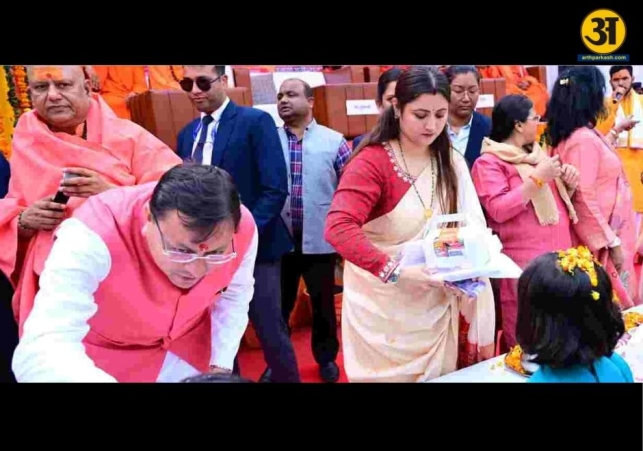
Dhami participated in ceremonies, interacted with children, and attended major rituals organised at the ashram. He told the gathering that institutions led by the saint community act like “living pilgrimages” that guide society towards what he described as moral and spiritual values. He remembered the late Swami Satyamitranand Giri, a Padma Bhushan awardee, and offered respects to other seers present at the occasion, including Jagadguru Mahamandaleshwar Swami Yatindranand Giri.
The five-day programme included a Shat Chandi Mahayagya, spiritual discourses based on Bhaktamal, worship of 1,100 young girls, distribution of study material, and the mass wedding of girls from needy backgrounds. According to Dhami, these activities represent the combined spirit of devotion and social responsibility, sending a message of kindness and service to the wider community.
During the event, Dhami inaugurated the Swami Satyamitranand Giri auditorium, the Shri Siddhbali Hanuman gate, and the newly developed Shaheed Chowk inside the ashram campus. He said that a major intersection—located at Main Marg and Sunahara Marg—would now officially be named Shaheed Chowk to honour the bravery and sacrifice of martyrs. He added that the square should inspire future generations to remember those who gave their lives for the country.
Cultural projects and state government measures
Speaking about the cultural landscape of India, Dhami said that the country’s “Sanatan culture” had received greater global attention under the leadership of the prime minister. He pointed to major religious projects such as the construction of the Ram temple in Ayodhya, redevelopment of the Badrinath and Kedarnath temples, and corridor projects at Kashi Vishwanath and Ujjain’s Mahakal temple. These, he said, were examples of nationwide efforts to strengthen religious infrastructure and improve facilities for pilgrims.
Dhami also reiterated the Uttarakhand government’s goal of establishing the state as a “spiritual capital” for visitors from across India and abroad. He spoke about works being carried out in the Kedarkhand and Manaskhand areas, the proposed redevelopment of Yamuna pilgrimage sites, the Haridwar–Rishikesh corridor project, the Sharda corridor, and the creation of a Centre for Hindu Studies at Doon University. According to him, these projects aim to improve pilgrimage experiences and promote the state’s cultural identity.
The chief minister then turned to a series of legal and administrative steps taken by his government. He said that Uttarakhand had introduced an anti-conversion law and a strict law to deal with riots. He claimed that actions were being taken against what he described as “land jihad”, “love jihad” and “thook jihad”. According to him, more than 9,000 acres of government land had been freed from encroachment due to these efforts.
ALSO READ: What happens if antibiotics stop working: the rising threat of superbugs
ALSO READ: How stable tax rules can rebuild business trust and boost growth
He also highlighted the implementation of the Uniform Civil Code (UCC) in the state, saying it was meant to provide a common legal framework for all citizens. For young people, he mentioned the anti-cheating law brought in to prevent irregularities in recruitment exams. This, he said, had helped more than 26,000 youths secure government jobs.
Dhami also spoke about steps taken regarding religious education institutions. He said that more than 250 unauthorised madrasas had been sealed for alleged violations, and that a law had been passed to dissolve the madrasa board. As per the new law, any madrasa not meeting the required standards would automatically stop functioning from 1 July 2026. He further mentioned “Operation Kalnemi”, under which action had been taken against individuals accused of insulting Sanatan Dharma.
Dhami said that his government was committed to making Uttarakhand one of the leading states in India. He expressed confidence that with the support of saints and the public, the state could achieve this ambition. He praised the role of religious institutions in supporting education, healthcare, value-based learning, women’s empowerment, and cow protection.
Geeta Dhami, the chief minister’s wife, also attended the programme and said it was an honour to participate in the five-day event. She noted that the ashram had organised worship and community meals for 1,100 girls, as well as mass weddings for six brides. She offered her blessings to the newly married couples and wished them well for the future.
During the programme, the chief minister worshipped 11 girls, presented them with gifts and honorariums, and blessed six couples whose weddings took place at the venue. The event drew participation from seers belonging to different akharas and religious organisations, along with public representatives and senior district and police officials. The gathering reflected a blend of religious tradition, community support, and state-led initiatives aimed at cultural and social development.
Related News