Chandigarh college holds demos on effective learning
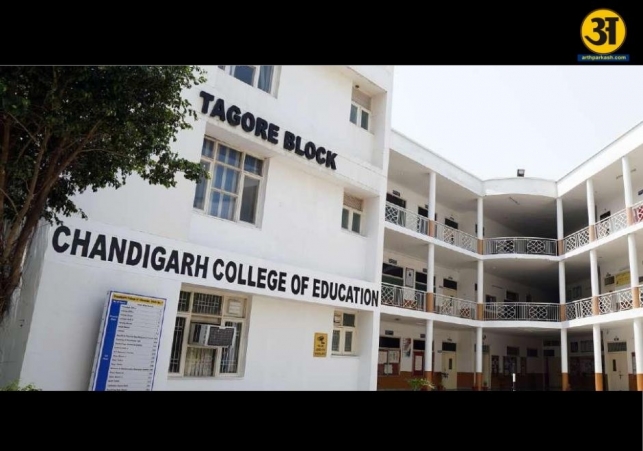
Government College of Education Chandigarh conducts experimental demonstrations for effective learning
The Government College of Education, Sector 20-D, Chandigarh, organized a special session on Wednesday to encourage students to explore new ways of learning science through visualisation and hands-on experiments. The programme was held as part of the Anveshika Physics Bharat Yatra, a nationwide initiative to promote interest and creativity in science classrooms.
The event drew participation from over 100 students of B.Ed first semester and PGDGC, who actively engaged in the demonstrations and lectures. Teachers and experts explained how simple experiments and visual tools can make classroom teaching more effective, lively, and inspiring.
The ceremonial e-torch, or Mashal, of the yatra was formally handed over to the college dean, A K Srivastava, along with other faculty members, marking the beginning of the session at the institution.
Hands-on activities inspire students
M S Marwaha, a science educator, conducted several simple demonstrations to show how practical experiments can spark curiosity and make concepts easier to understand. He highlighted that hands-on activities not only bring uniqueness to the classroom but also create a sense of joy and inspiration among students.
Marwaha’s engaging experiments were designed to prove that even with limited resources, science can be taught in a way that excites learners. Students responded enthusiastically, and many said that such sessions helped them understand the real-life application of theories they study in books.
Dean A K Srivastava welcomed the guests and encouraged students to take maximum benefit from the session. He said that such programmes are important because they bridge the gap between theoretical knowledge and practical learning. By witnessing experiments directly, students can connect ideas with real-world examples, making their education more meaningful.
Purpose of the Bharat Yatra explained
Sanjay Sharma, secretary of the Indian Association of Physics Teachers (IAPT), addressed the students and explained the larger purpose of the Anveshika Physics Bharat Yatra. He shared that the initiative is the brainchild of noted physicist Padmashree H C Verma and was formally launched in May 2025 at Srinagar by Verma and Manoj Sinha, the Lieutenant Governor of Jammu and Kashmir.
The yatra, Sharma said, aims to spread the joy of learning Physics across India, especially to regions and communities that often do not get access to high-quality science education. He explained that under the aegis of IAPT, the programme is supported by a network of 28 Anveshika centres spread across the country. Each centre works to promote innovative methods of teaching Physics and to reach students in remote areas.
Highlighting the role of visualisation in education, Sharma used simple video animations to demonstrate how modern tools have changed science learning. He said that through visual content, students can better grasp abstract concepts that are often difficult to understand through textbooks alone. According to him, this approach is already transforming classrooms under the guidance of H C Verma and his team.
The session encouraged students to think differently about teaching. Many future teachers who attended felt inspired to adopt these innovative methods in their own classrooms. Participants also appreciated that the event combined theory, technology, and practical demonstrations instead of relying solely on lectures.
ALSO READ: INS Himgiri and INS Udaygiri: India commissions indigenous stealth frigates to Navy
ALSO READ: PM Modi’s vision sparks a new era in India’s space journey
Building enthusiasm for science
The programme concluded with a vote of thanks by Sanjeev Kumar, who appreciated the efforts of all faculty members and students for making the event successful. The coordination of the programme was handled by Sheojee Singh, ensuring that the demonstrations and lectures ran smoothly.
Through this event, the Government College of Education reinforced the importance of nurturing creativity and curiosity in education. The organisers stressed that teaching should not be confined to rote learning but should involve activities that stimulate imagination and problem-solving.
Students left the session with a renewed enthusiasm for science and a better understanding of how they could make classrooms more interactive and enjoyable when they step into teaching roles in the future. The session also gave them a sense of belonging to a larger movement—the Bharat Yatra—that is working to bring quality science education to all corners of India.
The Chandigarh leg of the yatra reflected the commitment of educators, scientists, and institutions towards making learning more engaging and accessible. It showed that with collective effort, teaching methods in Indian classrooms can evolve into models that are both effective and inspiring.
Related News