Ambani sees strong economy and energy independence ahead
Sustained double-digit growth for India is achievable, says Mukesh Ambani
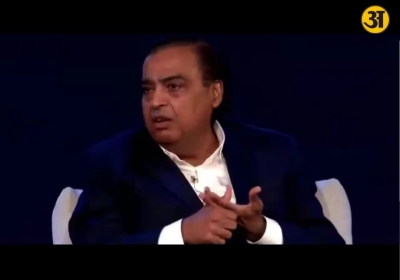
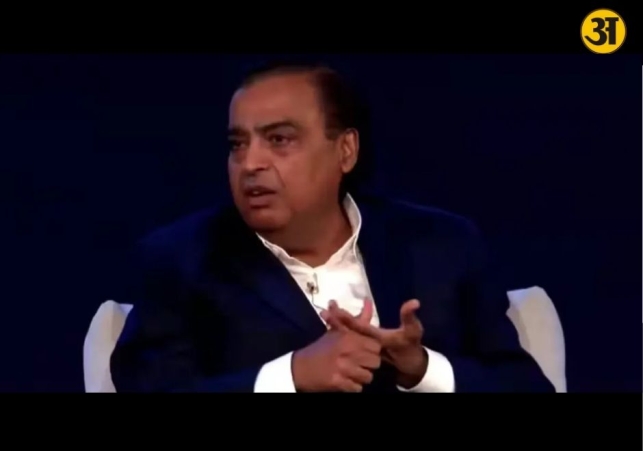
Reliance Industries Chairman Mukesh Ambani has said that India can achieve sustained double-digit economic growth if the country continues on a path of stable leadership, strong law and order, and social harmony. Speaking at a JioBlackRock event in Mumbai, Ambani shared an optimistic view of India’s future, highlighting major changes in energy, technology, and business that could shape the next decade.
Ambani said that stable economic leadership defines a successful nation. According to him, when policies remain consistent and institutions stay strong over long periods, businesses gain confidence to invest, innovate, and expand. He added that India has reached a stage where long-term, high-speed growth is not just a dream but a realistic possibility.
India’s growth, energy and digital strength
Ambani said that sustained law and order for 15 to 20 years, along with social harmony, are essential conditions for long-term economic growth. He explained that when society is stable and peaceful, entrepreneurs are encouraged to take risks and build large enterprises. He expressed confidence that many new large companies would emerge in the coming years, saying he could “clearly see 100 new Reliances” coming up across the country.
One of Ambani’s key observations was about India’s energy future. He said that in the next decade, India will not be importing 80 per cent of its energy, as it does today. This, he explained, would be a major shift for the country, improving economic security and reducing dependence on foreign energy sources. He linked this change to India’s growing focus on renewable energy, clean fuels, and domestic energy production.
Ambani also highlighted India’s rapid progress in digital infrastructure. He said every Indian village now has access to a 5G network that is better and cheaper than those in many other countries. According to him, affordable and high-quality connectivity has become a powerful tool for economic inclusion, education, healthcare, and entrepreneurship, especially in rural areas.
He noted that digital access is no longer limited to cities and large towns. With strong networks reaching villages, people across the country can participate in the digital economy. Ambani said this widespread connectivity gives India a unique advantage and lays the foundation for faster growth in the coming years.
Reliance’s AI vision and future plans
Earlier at the event, Ambani unveiled a draft Reliance AI Manifesto, outlining an ambitious plan to transform the group into an AI-native deep-tech enterprise. He said the goal is to use artificial intelligence to deliver a tenfold improvement in productivity for over six lakh employees, while also creating a 10 times impact on India’s economy and society.
Calling artificial intelligence the most important technological development in human history, Ambani said Reliance wants to lead India’s AI revolution in the same way it led the country’s digital transformation. He said AI is not just another technology upgrade but a fundamental shift in how businesses operate and create value.
The core idea behind the manifesto is to make “Affordable AI for every Indian.” Ambani said Reliance aims to embed AI across all its businesses, while ensuring safety, trust, and accountability. He stressed that technology must be used responsibly and that human oversight will remain essential.
According to Ambani, Reliance has already started transforming itself into an AI-native deep-tech company with advanced manufacturing capabilities. He said the company is reorganising its operations around outcomes and end-to-end workflows rather than traditional departmental structures.
ALSO READ: Is Jeffrey Epstein dead or alive? New files spark bizarre online theories
ALSO READ: JEE Main April session 2026 registration begins at jeemain.nta.nic.in
The first part of the manifesto focuses on internal transformation. AI will be used to reduce repetitive work, improve decision-making, and increase speed and quality across operations. Ambani said this approach treats AI not as a separate technology project, but as a new way of working across the organisation.
Reliance plans to use small, cross-functional teams, or “pods,” with clear ownership and measurable goals. These teams will be supported by common digital platforms and strong governance systems. Continuous data flow, learning, and automation will help improve performance, while human accountability will remain clear at every stage.
The second part of the manifesto looks beyond Reliance and focuses on India’s broader AI transformation. Ambani said the company wants to help build an AI ecosystem that benefits businesses, government, and citizens alike. He believes that when AI is made affordable and widely available, it can help solve large-scale problems in areas such as healthcare, education, agriculture, and manufacturing.
Ambani’s message at the event was one of confidence and long-term vision. He said India stands at a historic moment, with the opportunity to combine economic stability, digital strength, energy transformation, and advanced technology to achieve sustained high growth.
According to him, if the country stays focused on stability, inclusion, and innovation, double-digit growth can be maintained for years to come. He concluded by saying that India’s future depends not just on policies and investments, but also on the collective belief that the country can achieve far more than it has in the past.
Related News