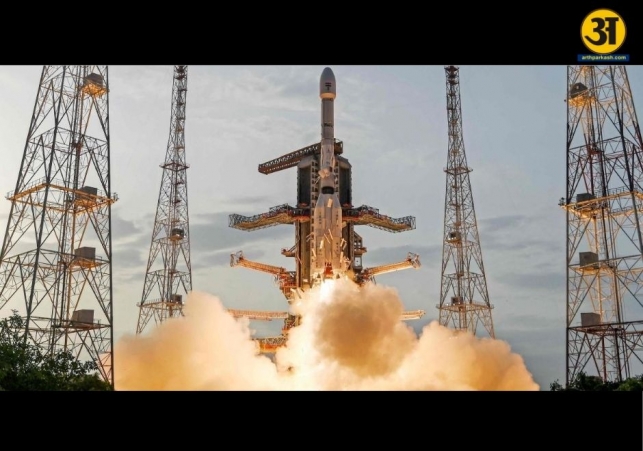
Why India launches key space missions from Sriharikota and Balasore
National Space Day: Why Sriharikota and Balasore are key launch sites for India’s missions
- By Gurmehar --
- Monday, 25 Aug, 2025
Every year on August 23, India celebrates National Space Day. The date marks the proud moment in 2023 when Chandrayaan-3 successfully landed on the Moon’s south pole. It was not just a scientific achievement but also a cultural one, proving that India has the courage and intelligence to stand with the world’s top space powers.
This celebration is more than an anniversary. It is a reminder of India’s determination to push boundaries — from the first humble rocket launch in the 1960s to interplanetary missions that inspire young minds today. On this day, we also look at the two places that have become the foundations of India’s space and defence strength: Sriharikota in Andhra Pradesh and Balasore in Odisha.
Sriharikota: India’s civilian gateway to space
The Satish Dhawan Space Centre (SDSC) in Sriharikota is India’s most important civilian launch site. Sometimes called “India’s Cape Canaveral,” it has hosted almost every historic launch by the Indian Space Research Organisation (ISRO). But why here?
-
Close to the equator: Sriharikota is just 13 degrees north of the equator. This location gives rockets a natural speed boost from Earth’s rotation, saving fuel and making launches cheaper. For a cost-conscious space agency like ISRO, this is a priceless advantage.
-
Safe over the sea: Rockets launch eastward, and their debris falls safely into the Bay of Bengal. This protects people and property while giving ISRO freedom in choosing launch paths.
-
Room to grow: Being on a barrier island, the site has space for multiple launch pads, tracking stations, and control centres, far away from busy cities. This isolation makes launches safer and more secure.
-
Modern facilities: From massive solid motor factories to clean rooms for satellites, Sriharikota has everything needed to prepare and launch advanced rockets. The famous PSLV, GSLV, Chandrayaan, Mangalyaan, and the upcoming Gaganyaan human mission all rely on this base.
In short, Sriharikota is where India’s civilian dreams of exploring space take flight. It is the place from which satellites connect remote villages, weather forecasts reach farmers, and Indian spacecraft set their sights on the Moon, Mars, and beyond.
Balasore: The shield of India’s defence sky
If Sriharikota is about exploration, Balasore in Odisha is about protection. The Integrated Test Range (ITR) at Chandipur, Balasore, is run by the Defence Research and Development Organisation (DRDO). This is where India tests its missiles — the silent protectors of our national security.
Missiles like Agni (nuclear-capable), Prithvi, Akash, and even the BrahMos supersonic cruise missile have been launched from here. But again, why Balasore?
-
Safe coastal launches: Like Sriharikota, Balasore sits by the sea. Its unique “disappearing beach” — where the sea retreats during low tide — gives extra safety and flexibility for test launches.
-
Secrecy and control: Being a defence base, Balasore is tightly restricted and fortified. It allows confidential testing with advanced radar tracking and coordination with the Navy and Air Force.
Balasore ensures that while India dreams of the stars, it also keeps its feet on the ground — ready to defend itself in an uncertain world.
From bicycle rockets to Moon landings
It is worth remembering how far India has come. In the 1960s, parts of the first rockets were carried on bicycles to a small churchyard launch site in Kerala. Today, India stands among the top six space powers.
Some highlights:
-
Chandrayaan-1 (2008): Discovered water molecules on the Moon.
-
Mangalyaan (2013): First Asian mission to reach Mars on its very first try.
-
Chandrayaan-3 (2023): First soft landing near the Moon’s south pole.
-
Aditya-L1 (2023): First mission to study the Sun.
-
Satellite networks: INSAT, GSAT, RISAT, and NAVIC serve millions daily with communication, weather data, and navigation.
This mix of scientific vision and practical utility shows why space is not just about prestige for India — it is about progress, security, and opportunity.
ALSO READ: Zelenskyy pushes US for stronger security guarantees before agreeing to Russia peace deal
What lies ahead
India is not slowing down. In the coming years, missions like Gaganyaan (2025) will send Indian astronauts to space. Shukrayaan will explore Venus, while Chandrayaan-4 is planned as a Moon sample return mission. ISRO is also working on reusable rockets and small satellite launch vehicles to boost commercial opportunities.
On the other side, DRDO will continue to upgrade India’s missile systems, ensuring that the country remains safe while it reaches for the stars.
Two sites, one vision
As we mark National Space Day, it is clear that Sriharikota and Balasore are not just places on the map. They are symbols of India’s rise — one through peaceful exploration, the other through strong defence. Together, they show that India’s space journey is not only about reaching new worlds but also about protecting its own.
The message is simple: India has learned to look up at the sky with pride, without ever losing sight of the ground it must defend.
Related News