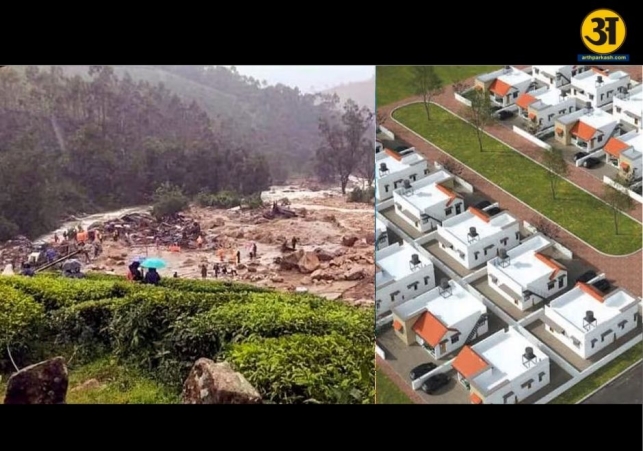
Wayanad landslide victims to get 300 houses in February
300 houses for Wayanad landslide victims to be handed over in February, says CM Vijayan
Kerala Chief Minister Pinarayi Vijayan has said that around 300 houses for victims of the Wayanad landslide disaster will be completed and handed over in February 2026. These houses will form the first phase of rehabilitation for families affected by the devastating Mundakkai–Chooralmala landslides. The chief minister shared this update while addressing a press conference in Thiruvananthapuram on Thursday.
Vijayan said the state government is working with a clear goal of rebuilding the lives of people who lost their homes and livelihoods in the disaster. He stressed that the project is not limited to constructing houses but aims to create a safe, dignified, and sustainable living environment for the affected families.
Township project and housing plan
The houses being built are part of a large township project located on the Elston Estate land near the Kalpetta bypass in Wayanad district. According to the chief minister, the full township will consist of 410 houses once completed. The first phase will see around 300 houses ready for occupation by February.
Vijayan said the construction work is progressing rapidly and is being carried out with a strong focus on safety, durability, and long-term sustainability. He described the township as a complete residential community designed to meet the daily needs of families who were displaced by the landslides.
The township will include all essential facilities required for a decent and secure life. These include an underground electricity network to ensure safety and uninterrupted power supply, a drinking water system supported by a large-capacity storage tank, and well-planned internal roads for smooth movement.
In addition, the township will have a public health centre to meet basic medical needs, an anganwadi for young children, a community hall for social gatherings, and market facilities to support daily shopping needs. Playgrounds will be provided for children, and proper waste management systems will be put in place to maintain cleanliness and hygiene.
Each individual house will be equipped with a solar power plant to promote renewable energy and reduce electricity costs. Every home will also have its own drinking water storage tank, ensuring water availability even during shortages. Vijayan said these features reflect the government’s commitment to sustainable and environment-friendly development.
“This is not just about providing a roof over people’s heads. It is about rebuilding lives that were shattered by the disaster,” the chief minister said. He added that the aim is to restore a sense of security and stability among families who suffered immense loss.
ALSO READ: Is low ovarian reserve normal in your 20s or 30s? Fertility expert answers
Quality control and long-term vision
The chief minister said that strict quality control measures are being followed throughout the construction process. Building materials such as cement, sand, and steel are being tested at on-site laboratories to ensure they meet required standards. In addition to internal checks, independent third-party agencies are also verifying the quality of materials and construction work.
Vijayan explained that work progresses to the next stage only after inspections are completed and approvals are granted. This system, he said, helps prevent defects and ensures that the houses are strong and durable. Contractors involved in the project have also been asked to provide a five-year protection guarantee against construction defects.
Around 1,600 workers are currently engaged in the project, working in multiple shifts to speed up construction. Several important tasks have already been completed, including roofing work on many houses, road formation within the township, and construction of large drinking water tanks.
Referring to the broader approach adopted by the state, Vijayan said the rehabilitation project follows the “Build Back Better” principle. This means that homes rebuilt after disasters should be safer and better than those that were lost. He said the government’s responsibility does not end with emergency relief but extends to long-term rehabilitation and improved living conditions.
“Our responsibility is to ensure that every disaster-affected family gets a safer and better living space than before,” he said. The chief minister added that climate resilience and disaster preparedness have been kept in mind while planning the township.
Vijayan also linked the Wayanad rehabilitation project to the state’s wider housing initiatives, particularly the LIFE Mission. He said programmes like the LIFE Mission reflect Kerala’s belief that housing is a basic human right and not a privilege.
According to him, a total of 4,76,076 houses have already been completed and handed over under the LIFE Mission and similar housing schemes. This means that nearly five lakh families have moved into secure homes provided by the state. Vijayan said this milestone of five lakh completed houses will be reached by February 2026.
He added that construction work on another 1,24,471 houses is currently underway at various stages across Kerala. These projects, he said, show the government’s sustained commitment to inclusive development and social welfare.
As the first phase of the Wayanad rehabilitation project nears completion, the state government hopes that the new township will offer not just shelter, but a fresh start for families affected by one of the worst natural disasters in the region. The chief minister said the focus remains on restoring dignity, safety, and hope to those who lost everything in the landslides.
Related News