Villagers tie ‘raksha sutras’ to protect ancient Deodar trees near Harsil
Local residents tie ‘raksha sutras’ and pray for old-growth Deodar trees near Uttarakhand’s Harsil
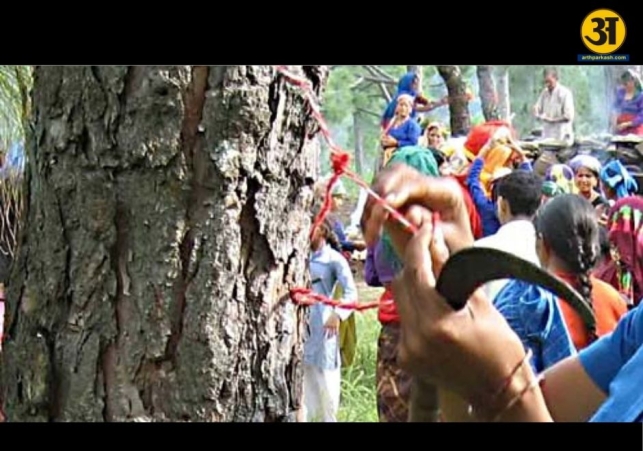
Old Deodar trees near Harsil in the Bhagirathi eco-sensitive zone have become the centre of a major environment vs. development debate in Uttarakhand. Villagers, activists, and local leaders have joined hands to save thousands of these old-growth trees that are likely to be cut for widening a 20.6-km stretch of the Char Dham road between Bhaironghati and Jhala. In a symbolic act of protection, local residents tied raksha sutras — sacred threads that represent safety and blessings — to the Deodar trees and offered prayers, asking for their survival.
This unique protest took place on Sunday in the upper reaches of the Bhagirathi region, where the Char Dham project runs through thick forests. People familiar with the matter say that nearly 6,000 Deodar trees have been marked for felling after receiving approval from the Uttarakhand government. Residents and activists fear that cutting so many old trees will harm the fragile Himalayan ecosystem.
Community comes together to protect the Himalayan forests
Before tying the sacred threads, villagers sang traditional Garhwali songs that speak of saving mountains, forests, and rivers. They then held a special Deodar pooja, treating the trees as living guardians of the region. For local communities, these trees are not only part of their environment but also their cultural and spiritual identity.
Reports indicate that the forest department has estimated a loss of nearly 41.92 hectares of forest land for the widening project. A letter from the Uttarakhand head of forest forces said that the project falls under a special provision of the Forest (Conservation and Augmentation) Act, 1980, amended in 2023. This provision allows strategic linear projects within 100 km of international borders or the Line of Actual Control to be approved without standard forest clearances.
Officials have said that the road expansion is of “strategic importance for national security.” Because of this classification, the project was cleared at the state level. A monitoring committee set up by the environment ministry also considered the project during its review.
However, environmental groups argue that the decision ignores the ecological fragility of the Bhagirathi zone. They say that the route is located in a sensitive Himalayan region where landslides, soil erosion, and deforestation can destabilize the mountains and harm local communities. To voice their opposition, several organisations have planned a protest march from Delhi and Rishikesh to Uttarkashi, Bhaironghati, and finally Harsil. Public gatherings will be held throughout the route to discuss the environmental concerns and the possible impact of losing so many Deodar trees.
ALSO READ: 150 years of Vande Mataram: BJP, Congress clash over missing stanzas
ALSO READ: Government expands crackdown by banning 23 organisations under UAPA in five years
Leaders, activists warn of threat to fragile Himalayan ecosystem
Several prominent leaders have spoken against the rapid tree felling in this region. Former Union minister and senior BJP leader Murli Manohar Joshi addressed the gathering virtually, stressing that environmental security and national security cannot be separated. He said that if the Himalayas become unstable, no form of development can survive. According to him, protecting the mountains is essential for safeguarding the country’s environment, economy, and agriculture.
Joshi called the Himalayas a symbol of India’s identity and urged people to protect the sacred Ganga, the forests, and the fragile ecology. He also emphasised that anyone who values India’s cultural heritage has a duty to protect these regions.
Members of several organisations, including Swadeshi Jagran Manch and Rashtriya Swayamsevak Sangh, also participated in the yatra. Environmentalist Mallika Bhanot, from the civil society group Ganga Ahvaan, explained that tying the raksha sutra is a symbolic act that demonstrates citizens’ commitment to protecting their ecology and culture. She said the Deodar trees are centuries old and play a vital role in maintaining the stability of the Himalayan slopes.
Activists also highlighted that climate change has already made the region more vulnerable. Heavy rains, cloudbursts, and landslides have increased in recent years, causing damage to roads, villages, and natural habitats. Cutting thousands of trees, they argue, will further destabilise the region and endanger both local residents and travellers.
Despite the pushback, authorities maintain that the Char Dham road project is necessary for improving connectivity and supporting national defence needs. The route provides access to border areas and is used by security forces. The government believes the widened road will make travel safer and faster, especially during natural disasters or emergencies.
For now, the conflict continues between communities trying to save their forests and officials pushing for strategic development. The tying of raksha sutras marks a peaceful yet emotional appeal from the residents: that the Deodar trees, which have stood for generations, should continue to protect the valley rather than be sacrificed for the widening of a road.
Related News