Vance’s remarks on wife’s faith stir US debate on religion in politics
JD Vance’s comments on his wife’s religion spark national conversation on faith and politics
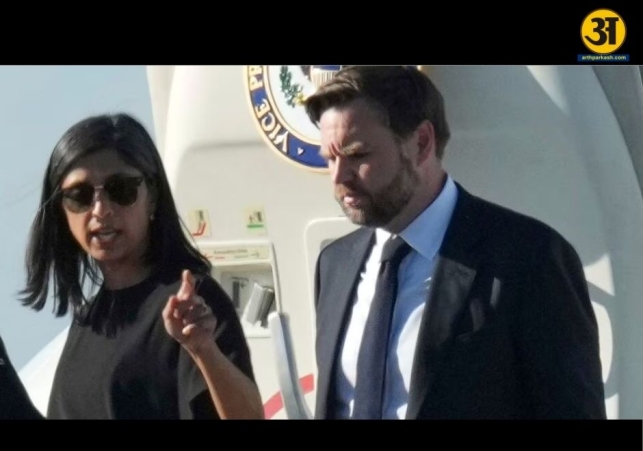
US Vice President JD Vance has found himself at the center of a heated national debate after his remarks about his wife’s Hindu faith stirred controversy. Speaking at a public event in Mississippi on October 29, 2025, Vance said that he “hopes” his wife, Usha Vance, who was raised Hindu, will one day embrace Christianity. His comments drew sharp criticism from many, particularly from the Indian American community, who saw them as disrespectful toward religious diversity and interfaith relationships.
The 41-year-old vice president, who converted to Catholicism in 2019, later issued a clarification, saying that his wife has “no plans to convert” and that he continues to respect her beliefs. Still, the discussion around his remarks has highlighted America’s ongoing struggle with cultural and religious inclusivity—especially as the possibility of a Hindu First Lady becomes more visible in the national conversation.
What JD Vance said at the event
Vance was speaking at a Turning Point USA event in Mississippi before a crowd of over 10,000 people when he mentioned his wife’s faith. During his speech, he spoke warmly about Usha attending church with him on most Sundays but admitted that he hoped she would “be moved” by Christianity one day.
“Now, most Sundays, Usha will come with me to church,” he said. “As I’ve told her, and as I’ll say now in front of all my closest friends—do I hope that she is somehow moved by the same thing that I was moved by in church? Yeah, I honestly do wish that because I believe in the Christian gospel and I hope eventually my wife comes to see it the same way.”
He added that he does not have a problem with his wife’s Hindu faith, saying, “God says everybody has free will.”
While some in the audience cheered, others felt the statement carried an uncomfortable message—that Vance believes his faith is superior and that his wife’s religion needs to be replaced rather than respected.
Reactions from Hindu American and online communities
Vance’s comments quickly went viral on social media and sparked widespread reactions. Many criticised the vice president for what they saw as a lack of respect toward Hinduism. The Hindu American Foundation (HAF), a leading advocacy group, issued a statement urging Vance to engage with Hindu philosophy and pluralistic values.
“With respect, @JDVance,” HAF wrote on X (formerly Twitter), “if your wife encouraged you to re-engage with your faith, why not reciprocate that and engage with Hinduism too? You may well learn that Hinduism doesn’t share the need to wish your spouse comes around to see things as you do in terms of religion.”
The organisation added that Hinduism has always been inclusive and pluralistic, promoting the idea that there are many ways to understand and experience the divine.
ALSO READ: Indian forces showcase integrated war readiness in massive Trishul exercise
ALSO READ: Good fat, bad fame: Doctor debunks six biggest myths about cholesterol
Other social media users echoed similar thoughts. One X user, @YourAnonCentral, accused Vance of publicly embarrassing his wife, saying, “Usha is the biggest victim here, constantly humiliated by Vance on stage. Remember she met him before he was a politician, in law school.”
Another post read, “It’s one thing to hope your spouse shares your faith, but it’s another to announce it in public, knowing how much cultural baggage it carries.”
However, Vance also received support from conservative Christians, many of whom praised him for speaking openly about his beliefs. One user, @zacpennington, wrote, “Vance’s marriage shows mutual respect while his faith quietly points to Christ. The left’s attacks are just noise from those who fear real conviction. As a conservative Christian, I fully stand with you, JD, and we pray Usha sees that light too.”
Supporters argued that Vance was simply expressing his personal belief in his religion without intending to disrespect his wife’s faith or Hinduism as a whole.
Vance issues clarification amid growing backlash
As criticism mounted, JD Vance posted a long clarification on X, defending his comments and calling the backlash “disgusting.” He explained that his comments were in response to a question about his interfaith marriage and were not meant to demean his wife’s religion.
“First off, the question was from a person seemingly to my left, about my interfaith marriage,” Vance wrote. “I’m a public figure, and people are curious, and I wasn’t going to avoid the question.”
He continued, “My Christian faith tells me the Gospel is true and good for human beings. My wife—as I said at the TPUSA event—is the most amazing blessing I have in my life. She herself encouraged me to re-engage with my faith many years ago. Regardless, I’ll continue to love and support her and talk to her about faith and life and everything else, because she’s my wife.”
Vance also reaffirmed that Usha has “no plans to convert”, a point that many of his critics said should have been made more clearly during the original event.
Larger questions about faith, politics, and identity
This controversy has triggered a broader national conversation about the role of faith in American politics and the growing visibility of multicultural families in leadership. Usha Vance, who is of Indian origin and a practicing Hindu, has largely stayed out of the political spotlight. However, as her husband’s political career rises, her identity has become a subject of public debate.
Many Indian Americans have expressed concern that discussions like this reflect a lack of understanding of non-Christian faiths in American society. The idea of a Hindu First Lady—once a mere curiosity—has now become a topic of serious political and cultural reflection.
Observers note that while Vance’s comments were likely rooted in personal belief, the tone of his message reflects a broader challenge in US politics: balancing faith and inclusivity. As one analyst put it, “America has always celebrated religious freedom, but that freedom also includes the right to be different—and to be respected for it.”
In the end, JD Vance’s remarks may have revealed less about his marriage and more about how America still grapples with the idea of diverse faiths coexisting at the highest levels of power. Whether this moment leads to greater understanding or deeper division will depend on how leaders, communities, and families choose to engage with one another in the days ahead.
Related News