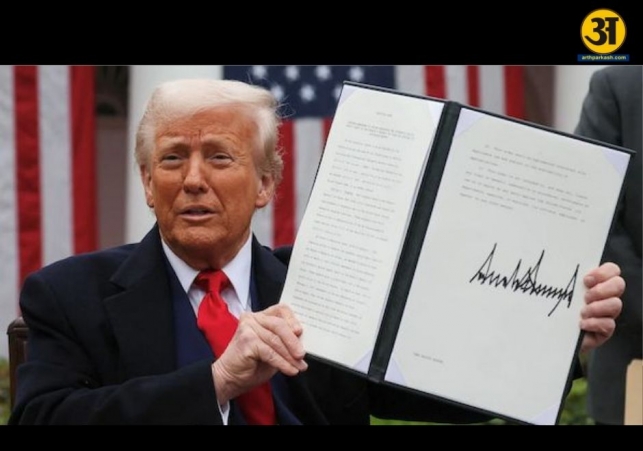
Trump’s trade war driven more by control than policy
Trump’s trade tactics reveal a pursuit of dominance, not diplomacy
The trade dispute between India and the United States under President Donald Trump has grown into something much bigger than just tariffs or negotiations. What was expected to be a fair and balanced trade deal has now become a show of political power. Trump's recent decisions are hurting not only India–US relations but also the long-standing strategic partnership that took two decades to build.
India and the US have been allies on many fronts, including defense, counter-terrorism, and trade. But now, India finds itself being punished with sudden tariffs—25 percent on goods, plus an unexpected 10 percent penalty—just for doing business with Russia. This penalty came without prior warning and wasn’t even part of earlier discussions.
India’s refusal to open its market to genetically modified (GM) foods and dairy was one reason talks stalled. These products are restricted under India’s current policies, and even countries like New Zealand have been denied access in the past. Despite that, India made several generous offers to the US—similar to what it agreed to with the UK in a recent trade deal. US negotiators were said to be satisfied with India’s proposals, and the agreement was just waiting for President Trump’s approval.
Trump’s ego derails progress
However, Trump appeared to want personal credit for any deal. Some reports suggest that he even asked Prime Minister Narendra Modi to acknowledge him for “stopping” a potential war between India and Pakistan. Modi refused. When US Vice-President JD Vance tried to contact him during Operation Sindoor—India’s military response to terrorism from Pakistan—Modi didn’t take the call immediately because he was in meetings with defense officials. Later, he told Vance that India would respond strongly to any attack.
Trump, in contrast, continued to claim he had played a role in maintaining peace and then hinted at more tariffs against India. On top of this, the US announced a plan to develop Pakistan’s “massive oil reserves,” though it’s unclear what exactly those reserves are. It seems more like a political move to challenge China’s influence in Pakistan.
These actions send a message that decisions about trade, peace, and diplomacy are now being driven by personal ambition, not real policy. As one expert said, trade discussions no longer follow economic logic—they're about politics and power plays.
The countries that have accepted Trump’s demands, such as Japan and South Korea, may have encouraged him to push harder. But India has a history of standing its ground. It didn’t back down during the 1998 nuclear tests, and it is unlikely to surrender now. India’s economy is not as dependent on exports as countries like Vietnam. About 4–5 percent of India’s growth is fueled by domestic demand. While US tariffs will hurt exports in the short term, they won’t cripple the economy.
ALSO READ: Forensic clue cracks case: Inside the probe that linked guns to Pahalgam attack
ALSO READ: Divya Deshmukh checkmates history to become India’s first Women’s World Cup champion
India has options, but must act wisely
India must now prepare for a few challenging quarters ahead. Exporters will be affected, and some industries may slow down. But the bigger issue is how to respond to the US’s unfair treatment. The Indian government has already started planning for this situation. It’s also watching legal cases in the US that question the legality of Trump’s tariff decisions, which were made by invoking emergency powers without consulting Congress.
India still has strong trade ties with other countries and is working on new trade agreements that don’t require bending its core policies. The UK deal is one such example, and India is also increasing its trade with Southeast Asia and Africa.
In the end, this conflict is less about trade policies and more about showing who holds power. Trump wants to be seen as the global dealmaker, even at the cost of friendships and trust. India, on the other hand, is defending its economic interests and sovereignty. That’s not a trade war—it’s a test of dignity.
If anything, this situation shows the importance of building strong internal markets and reducing over-reliance on any one country. The future may bring more difficulties, but India has weathered worse storms—and has always emerged stronger.
Related News