Trump pressures India on Russian oil, ignores Europe’s billion-dollar deals
Trump urges India to halt Russian oil imports while Europe continues large purchases
- By Gurmehar --
- Friday, 17 Oct, 2025
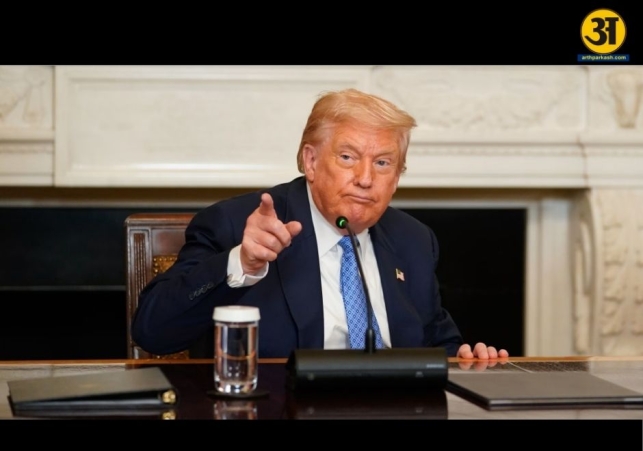
US President Donald Trump recently criticized India for buying oil from Russia and claimed that Prime Minister Narendra Modi has assured him that India will soon stop these imports. Speaking at the White House, Trump said, “He (PM Modi) assured me today that they will not be buying oil from Russia. That’s a significant step. Next, we’ll work to get China to do the same.”
Trump and other Western leaders have been critical of India’s oil purchases, arguing that buying Russian crude helps fund Russia’s war in Ukraine, which started in February 2022. As part of this pressure, the US has imposed tariffs on India for continuing Russian imports. Initially, a 25 percent tariff was applied, and now the total penalty has reached 50 percent.
However, the US president’s criticism of India overlooks a key point: European nations continue to buy large amounts of Russian oil and gas, often worth more than India’s purchases. Even with sanctions and public pressure, countries in the European Union (EU) remain heavily dependent on Russian energy, highlighting an inconsistency in singling out India alone.
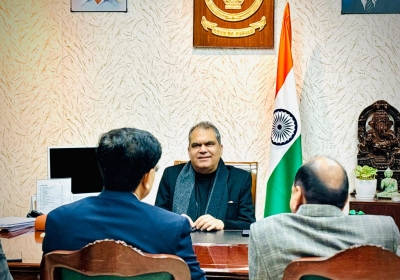
India, on the other hand, has defended its stance. The Ministry of External Affairs (MEA) said that India’s energy import policies are guided by national interest. MEA spokesperson Randhir Jaiswal explained, “Ensuring stable energy prices and secured supplies have been the twin goals of our energy policy. This includes broad-basing our energy sourcing and diversifying as appropriate to meet market conditions.” He added that India has been steadily expanding its energy procurement over the past decade to meet domestic needs.
Europe’s heavy reliance on Russian energy
According to the Centre for Research on Energy and Clean Air (CREA), which tracks fossil fuel flows, the European Union spent 1.15 billion euros (about USD 1.35 billion) on Russian oil and gas in August 2025. Five countries accounted for 85 percent of this total, importing around 979 million euros (USD 1.15 billion). The remaining 15 percent came from countries including Spain, Bulgaria, Romania, Italy, Greece, Croatia, Slovenia, Austria, and Poland.
The top buyers of Russian energy in Europe were:
-
Hungary: 416 million euros (USD 488 million)
-
Slovakia: 275 million euros (USD 323 million)
-
France: 157 million euros (USD 184 million)
-
Netherlands: 65 million euros (USD 76 million)
-
Belgium: 64 million euros (USD 75 million)
Hungary and Slovakia import both crude oil and pipeline gas from Russia. France, the Netherlands, and Belgium rely mainly on liquefied natural gas (LNG), which is cooled and transported by ship instead of pipelines.
Oil and gas together make up more than half of Europe’s energy supply. Specifically, oil accounts for 33 percent and natural gas for 24 percent. Coal makes up 11.7 percent, nuclear 11.2 percent, biofuels 10.9 percent, solar and wind 6.1 percent, and hydropower 3.1 percent. This shows that Europe still depends heavily on Russian energy for its daily power needs.
ALSO READ: Kashmir voters face disappointment after high expectations
ALSO READ: Inflammation linked to 60% of global deaths: What you need to know
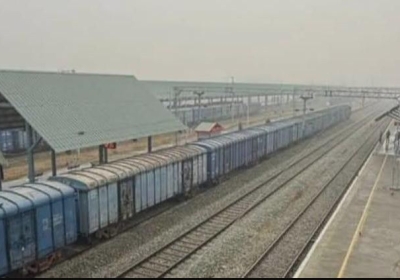
To transport oil and gas, Europe relies on an extensive pipeline network spanning more than 202,000 km as of 2023. A major part of this network is the Druzhba pipeline, one of the world’s longest, stretching 4,000 km (2,500 miles) from eastern Russia through Belarus and Ukraine to Hungary and Slovakia. The pipeline has a capacity of 1.2 to 1.4 million barrels of oil per day, supplying critical fuel to central European countries.
Even with sanctions in place, Europe continues to maintain trade with Russia because of its energy needs. This dependence highlights a major difference in how the West treats India compared to European countries. While India’s purchases are heavily criticized, European nations continue substantial Russian imports without similar public pressure.
Meanwhile, India continues to focus on securing stable and affordable energy for its population. While there has been a slight reduction in Russian oil imports recently, Russia still remains one of India’s top oil suppliers. Data shows that India imported 4.5 million barrels per day of Russian crude in September 2025. Crude oil made up 77 percent of India’s Russian imports, followed by coal at 13 percent and refined products at 10 percent, showing that energy security is the key priority for New Delhi.
In conclusion, while Trump praises India for potentially halting Russian oil purchases in the future, current data indicates that Europe still trades heavily with Russia. India’s decision reflects a careful balance between international pressure and domestic energy needs. Meanwhile, Europe’s reliance on Russian oil and gas shows that the global energy trade is complex, and singling out one country ignores broader realities.
Related News