Trump issues warning to Nigeria on attacks against Christians
Trump warns Nigeria of strong action over Christian persecution claims
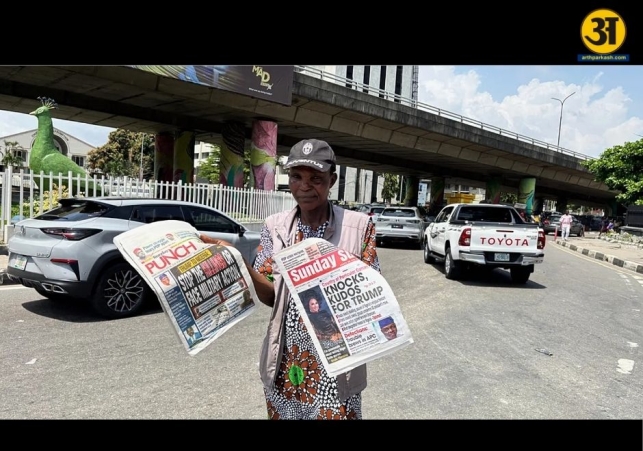
Former US President Donald Trump issued a strong warning to Nigeria, saying that the United States could stop all aid and even take military action if the Nigerian government fails to stop what he called the “killing of Christians.” His comments, made on Truth Social, have sparked global attention and debate.
In his post, the 79-year-old Republican leader said the US “will immediately stop all aid and assistance to Nigeria” if the violence continues. He added that America “may very well go into that now disgraced country, guns-a-blazing, to completely wipe out the Islamic terrorists who are committing these horrible atrocities.”
Trump further said he had asked the Department of War to prepare for “possible action,” promising that if the US attacks, it would be “fast, vicious, and sweet.” He ended his statement by warning Nigeria’s government to act quickly to stop the violence.
Over the past few days, Trump has spoken repeatedly about what he described as the persecution of Christians in Nigeria, blaming “radical Islamists” for what he called their “mass slaughter.” His remarks have drawn both support and criticism — support from those concerned about religious freedom, and criticism from analysts who say the situation is more complex than he suggests.
The European Union (EU) has also raised concerns about religious violence in Nigeria. On October 2, the European Parliament passed a resolution condemning the alleged attacks against Christians. The resolution called for stronger diplomatic measures and more protection for religious minorities.
“Religious freedom is a fundamental right and a cornerstone of human dignity,” the EU Parliament said in its statement. It also urged the EU to strengthen its diplomatic tools, such as appointing special envoys to protect religious freedom worldwide.
Nigeria, the most populous country in Africa, is evenly divided between Muslims and Christians. Generally, Muslims live in the northern part of the country, while Christians are more common in the south. However, since the rise of extremist group Boko Haram in the early 2000s, religious and ethnic tensions have deepened, leading to widespread violence.
According to international reports, over 40,000 people have been killed in attacks linked to Boko Haram and other armed groups. The ongoing conflict has also displaced around two million people, creating one of Africa’s most severe humanitarian crises.
What the data really shows
While Trump and some international voices describe the situation as targeted violence against Christians, researchers say the available data does not fully support claims of genocide.
According to data from the US-based Armed Conflict Location and Event Data (ACLED) program, between January 2020 and September 2025, Nigeria recorded 11,862 attacks against civilians, leading to 20,409 deaths.
Out of these incidents, only 385 attacks were directly aimed at Christians, resulting in 317 deaths. In contrast, 196 attacks were targeted at Muslims, leading to 417 deaths during the same period.
ALSO READ: Indian forces showcase integrated war readiness in massive Trishul exercise
ALSO READ: Good fat, bad fame: Doctor debunks six biggest myths about cholesterol
These numbers suggest that while religiously motivated violence exists, the larger pattern involves widespread civilian attacks not limited to one faith group. Many incidents in Nigeria stem from a mix of ethnic, economic, and political tensions, as well as criminal activity unrelated to religion.
Dr. Olajumoke Ayandele, an assistant professor at New York University’s Center for Global Affairs, explained that describing the situation as genocide is misleading. “If anything, what we are witnessing is mass killings, which are not targeted against a specific group,” she told the Associated Press.
She also warned that framing the violence as a religious genocide could make things worse. “The drumming-up of genocide might worsen the situation because everyone is going to be on alert,” she said. This kind of rhetoric could deepen divisions between religious groups and make peace efforts harder to achieve.
Experts point out that Nigeria’s violence problem is multi-layered. In the country’s northwest, armed gangs known as bandits attack villages and kidnap people for ransom. In the northeast, the Boko Haram insurgency continues to threaten communities. Meanwhile, in the Middle Belt, farmers and herders often clash over land and water resources — conflicts that sometimes take on a religious tone, even though the root causes are economic and environmental.
The Nigerian government, led by President Bola Tinubu, has repeatedly said it is working to control the violence. Security forces have launched operations against Boko Haram and bandit groups, but progress has been slow. Corruption, limited resources, and lack of trust between communities have made peace efforts difficult.
Trump’s remarks have also raised questions about the role of US foreign policy in Africa. Analysts say that using strong language like “guns-a-blazing” could harm diplomatic relations and increase tensions in a region already facing instability.
The US government under President Joe Biden has so far avoided direct threats, focusing instead on supporting humanitarian aid, economic development, and regional counterterrorism efforts.
While Trump’s statement has reignited attention on Nigeria’s violence, experts stress that the real solution lies in addressing the root causes — poverty, inequality, corruption, and weak governance. Religious freedom remains important, they say, but it should be protected through diplomacy and support for local peacebuilding efforts, not threats of military action.
In the end, Nigeria’s crisis is not only about religion but about a nation struggling with multiple challenges — from terrorism and poverty to political instability. Simplifying it as a “Christian genocide” risks ignoring the bigger picture. As experts warn, what Nigeria needs most right now is not more confrontation, but cooperation and understanding to heal its deep social divisions and bring peace to all communities.
Related News