Students clash with police in Indonesia allowance protest
Indonesia students clash with riot police during protest over lawmakers’ allowances
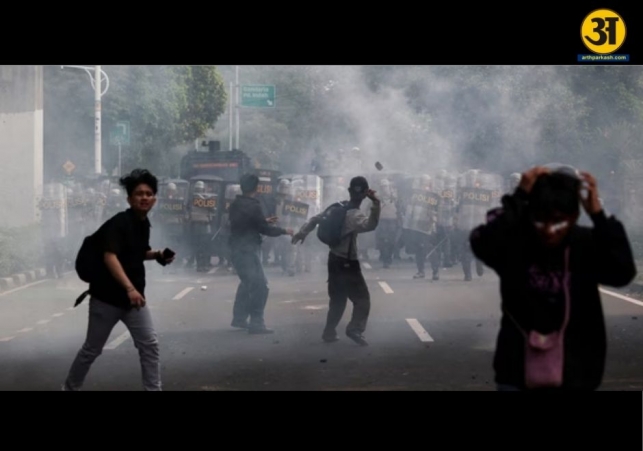
Jakarta: Thousands of students in Indonesia clashed with riot police on Monday while protesting against high allowances given to members of Parliament. The demonstrations turned violent when the students tried to approach the Parliament building, prompting police to fire tear gas. Protesters retaliated by throwing rocks and bottles and even set fires under a flyover near the heavily guarded Parliament compound.
The protests were sparked by reports that 580 members of the House of Representatives had been receiving a housing allowance of 50 million rupiah ($3,075) per month since September 2024. Many Indonesians, especially students, view this allowance as excessive, particularly given the widespread economic hardship faced by ordinary citizens. In poor areas, the allowance is about 20 times the monthly minimum wage.
Authorities blocked streets leading to the Parliament, including toll roads, to prevent the protesters from reaching the building. This caused severe traffic jams across the city. More than 1,200 security personnel were deployed to guard the Parliament compound. Despite the clashes, there were no immediate reports of injuries.
The students demanded that the government abolish these allowances, arguing that lawmakers already receive a salary in addition to these benefits. The demonstration highlighted the growing frustration among young Indonesians about corruption and inequality in the country. Many activists say that both the police and members of Parliament are widely perceived as corrupt in Indonesia, a country with a population of more than 280 million people.
Background and government response
The House Speaker, Puan Maharani, told reporters that the allowances had been carefully considered and adjusted to match current prices in Jakarta. She argued that the amounts were justified based on the cost of living in the capital. However, protesters rejected this explanation, saying that lawmakers should not receive such large benefits while many Indonesians struggle to make ends meet.
Corruption has been a persistent issue in Indonesia for decades. Activists argue that the high allowances and salaries of lawmakers are symbolic of a larger problem in which government officials benefit financially while public services and economic opportunities for ordinary citizens remain limited. The student protests are seen as a way to draw attention to these broader issues of inequality and lack of accountability.
The clashes with riot police reflect both the anger and the frustration of Indonesia’s youth, who often feel that their voices are ignored by the political establishment. The protesters’ use of rocks, bottles, and small fires underscores the intensity of their anger over the allowances. Police used tear gas to push back demonstrators and maintain order, but the confrontations still caused disruption in central Jakarta.
Observers note that protests over financial mismanagement and corruption are common in Indonesia, especially in urban areas where students and young people are more politically active. The recent demonstrations echo previous movements where citizens have demanded transparency, accountability, and reforms in governance.
The government faces a difficult challenge. While authorities argue that the allowances are necessary for lawmakers to maintain their responsibilities, critics say the public perception of excessive benefits undermines trust in elected officials. The student protests serve as a reminder of the widespread frustration over corruption and inequality in the country.
ALSO READ: Why the UN declaring a famine in Gaza holds critical global importance | Explained
In addition to the immediate issue of housing allowances, the protests have drawn attention to broader concerns about government spending, accountability, and the role of youth in demanding reforms. Many young Indonesians are frustrated with a system they see as favoring politicians over citizens, and they are increasingly willing to protest to make their voices heard.
Analysts say that the demonstrations could pressure lawmakers to reconsider their benefits and take steps to increase transparency in government spending. Whether these protests will lead to real reforms remains uncertain, but they reflect growing public awareness and activism among the younger population.
In conclusion, the clash between students and riot police in Jakarta highlights deep-seated anger over lawmakers’ high allowances and perceived corruption. Thousands of students protested near the Parliament building, throwing stones and bottles, while police responded with tear gas to maintain order. The protests have sparked national discussion about inequality, corruption, and the need for transparency in government spending. With public frustration continuing to grow, the government may face increasing pressure to reform allowances and restore trust among citizens.
Related News