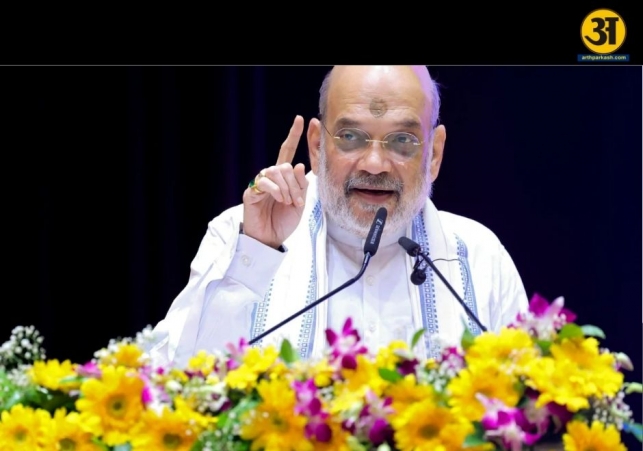
Six years of Amit Shah shaping India
Amit Shah’s six-year journey: Record-breaking reforms and policy impact
- By Gurmehar --
- Friday, 29 Aug, 2025
Amit Shah’s six-year tenure as India’s Union Home Minister, starting in 2019, has made him the longest-serving Home Minister in India, surpassing LK Advani’s record of five years and ten months. His leadership has left a deep mark on India’s internal security, governance, and political landscape. Often compared to a modern-day Chanakya, Shah has turned the Home Ministry into a center of decisive reforms and electoral strategy. His ability to pass major legislation, even in a challenging Parliament, shows his legislative skill and strategic thinking.
Shah’s journey from a grassroots organiser in Gujarat to a national political leader demonstrates a mix of ideological conviction and practical leadership. As Home Minister, he has tackled internal security threats like left-wing extremism and strengthened India’s governance framework. His policies have sparked both praise and criticism. Supporters see him as a leader solving long-standing issues decisively, while critics argue that some of his bills risk polarising society and undermining judicial independence.
Legislative achievements and policy decisiveness
Shah’s tenure is defined by his ability to push through landmark legislation. In 2019, the revocation of Article 370, removing Jammu and Kashmir’s special status, was a historic move, executed despite the BJP lacking a Rajya Sabha majority. Shah’s careful planning, coalition management, and parliamentary strategy ensured its success. Similarly, the Citizenship Amendment Act (CAA) and the Bharatiya Nyaya Sanhita 2023 highlight his focus on modernising India’s legal framework.
In August 2025, Shah introduced three significant bills: the Constitution (One Hundred and Thirtieth Amendment) Bill, 2025, the Government of Union Territories (Amendment) Bill, 2025, and the Jammu and Kashmir Reorganisation (Amendment) Bill, 2025. These propose automatic removal of the Prime Minister, Chief Ministers, or other ministers if they are detained for 30 consecutive days on serious criminal charges. The bills modify Articles 75, 164, and 239AA to enforce removal on the 31st day, with the President or Governors executing the process.
Shah argued these measures protect public trust and constitutional morality, ensuring elected officials cannot govern while in custody. Critics, including Congress and AIMIM leaders, called the bills “draconian” and unconstitutional, warning they could be misused to destabilise opposition governments. Amid protests and parliamentary disruptions, the bills were referred to a Joint Parliamentary Committee for review.
Over his tenure, Shah has secured the passage of over 100 bills, including the Unlawful Activities (Prevention) Amendment Act and the Triple Talaq Bill. His experience as Gujarat’s Home Minister, drafting the state’s first anti-terror law, informed his national approach. This helped reduce left-wing extremism and facilitate peace agreements, such as the Bru-Reang settlement in the Northeast.
Electoral strategy and political influence
Amit Shah is also known as a master strategist, strengthening the BJP’s presence across India. As party president from 2014 to 2020, he planned micro-level electoral campaigns, leading to sweeping victories in general elections, including 303 seats in 2019 under the “Mission 300 Par” slogan. Shah travelled extensively, covering over 790,000 kilometers, and used data-driven methods like samvad kendras to connect with voters.
He also managed coalition politics effectively, balancing alliances with parties like Shiv Sena in Maharashtra and JD(U) in Bihar, while keeping the BJP’s ideological coherence. His focus on grassroots organisation and feedback mechanisms allowed the party to respond to ground realities. Even as Home Minister, his strategic planning influenced state election victories, such as in Haryana and Assam, reinforcing BJP’s national dominance.
ALSO READ: Trump’s tariffs on India take effect: Sectors impacted and exemptions explained
ALSO READ: INS Himgiri and INS Udaygiri: India commissions indigenous stealth frigates to Navy
Shah’s leadership style combines discipline, ideological vision, and hands-on governance. His tenure as BJP president saw expansion into states like West Bengal, where he implemented the Panna Pramukh model for grassroots mobilisation. He has translated Prime Minister Modi’s popularity into organisational strength, making the BJP synonymous with governance. Supporters praise his focus on nationalist narratives and governance reforms, while critics argue his style risks alienating minorities.
As PM Modi’s most trusted lieutenant, Shah has coordinated key decisions, including the 2016 surgical strikes and 2019 Balakot airstrike. He has managed coalition tensions and political risks, ensuring Modi’s leadership remains strong. Shah’s personal commitment to initiatives like promoting Hindi and ‘Ek Bharat, Shrestha Bharat’ reflects a shared ideological vision. While some view his policies as divisive, supporters see him as a steadfast executor of transformative goals, reshaping India’s political and governance landscape.
In summary, Amit Shah’s six-year tenure highlights his ability to combine policy decisiveness, legislative skill, and electoral strategy. From passing controversial yet significant bills to strengthening the BJP’s organisational machinery, Shah has left a lasting imprint on India’s political map, making him one of the most influential Home Ministers in modern history.
Related News