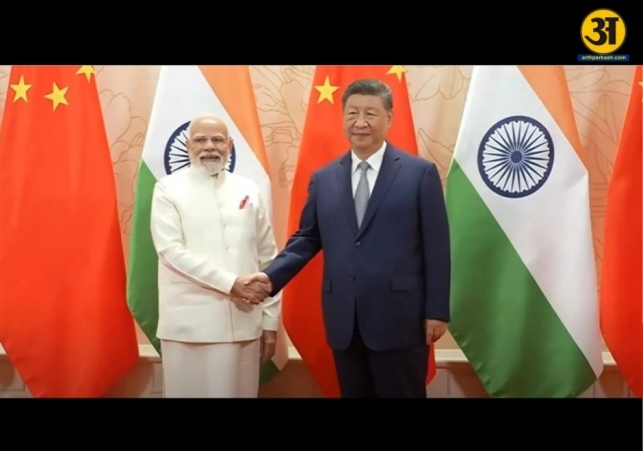
SCO Summit’s big significance for Indo-China ties
SCO Summit: Why this meeting holds greater significance than ever for Indo-China relations
- By Gurmehar --
- Sunday, 31 Aug, 2025
Prime Minister Narendra Modi’s visit to Tianjin, China, for the Shanghai Cooperation Organisation (SCO) Summit on August 31 and September 1 has caught the world’s attention. This is not just another multilateral gathering — it is his first trip to China since 2019 and his first meeting with President Xi Jinping on Chinese soil since the Galwan Valley clash in 2020. That clash, which cost lives on both sides, brought India-China ties to their lowest point in decades. Since then, mistrust has defined the relationship.
Now, with global politics becoming more uncertain and economic pressures mounting, this summit is more than just symbolism. It could mark the beginning of a cautious but important shift in how India and China engage with each other.
Strategic pressure pushing both sides to talk
This meeting comes at a time when both countries are facing major challenges abroad. India is under strain from the United States, which has raised tariffs on Indian goods and criticised New Delhi’s energy trade with Russia. These moves have hurt Indian exporters and created a sense of economic vulnerability. For China, tensions with the US remain high, and it faces growing suspicion from Western nations over its role in Asia and beyond.
This parallel pressure has created an unusual opportunity. Neither India nor China is looking for friendship, but both see value in talking. For India, keeping a dialogue open with Beijing reduces the risk of being cornered by Western pressure. For China, engaging India helps it counterbalance isolation and build influence in Asia.
It is important to understand that this is not about trust — it is about necessity. The SCO platform allows the two nations to sit across the table without the pressure of bilateral negotiations alone. It gives both Modi and Xi a chance to recalibrate without appearing weak.
From confrontation to careful cooperation
The border issue remains the biggest hurdle. Since the deadly Galwan clash, the Line of Actual Control has become one of the most militarised zones in the world. While some disengagement has taken place in certain areas, both armies continue to strengthen infrastructure near the frontier. For ordinary citizens, this means the threat of another confrontation is never too far away.
Still, in recent months, there have been signs of quiet progress. India’s National Security Advisor Ajit Doval and External Affairs Minister S. Jaishankar have held talks with Chinese leaders. Small steps like restarting direct flights, reopening pilgrimage routes, and creating better communication channels along the border are being discussed. These may not sound dramatic, but they help reduce friction and prevent accidents that could spiral into crises.
At Tianjin, Modi and Xi may not solve the border problem, but they can create space for dialogue. Even small agreements — such as new hotline mechanisms or confidence-building measures — could help prevent a repeat of Galwan. For a relationship frozen for years, that is progress.
ALSO READ: How technostress is affecting Gen Z’s mental health
ALSO READ: Trump’s tariffs on India take effect: Sectors impacted and exemptions explained
The SCO stage: balancing many worlds
The SCO Summit this year is bigger than ever, with more than 20 countries and organisations participating. For India, the event serves two purposes. First, it allows New Delhi to show its “multi-alignment” strategy — engaging with China and Russia while also maintaining strong ties with the US, Japan, and ASEAN. Second, it reinforces India’s image as an independent player that will not blindly follow Western pressure.
The SCO is built on the idea of “mutual respect and non-interference.” By attending, Modi sends a message that India is willing to talk to all sides, even those with whom it has sharp differences. This is not about agreeing with China on everything, but about showing maturity in handling disagreements without cutting ties.
At the same time, Modi is expected to raise issues that matter most to India. Chief among them is terrorism. India has often objected to watered-down SCO statements that fail to name and shame sponsors of cross-border terrorism. With Pakistan’s leadership also present, Modi’s words will carry political weight. It shows that India will not remain silent on issues central to its security, even on Chinese soil.
Opinion: Not a reset, but a realignment
It would be wrong to call this summit a reset. The structural problems between India and China remain too deep — from Beijing’s close ties with Pakistan to India’s trade deficit and China’s silence on border aggression. Trust is still missing, and it cannot be rebuilt overnight.
But what the summit can deliver is tactical stabilisation. In other words, both sides can agree to manage tensions better, even if they cannot resolve them fully. By resuming dialogue, they create a safety valve against conflict. By participating in multilateral platforms together, they show the world they can coexist, even if uneasily.
This is not the dawn of a new friendship, but it could be the start of a more pragmatic approach. Both leaders know that escalation benefits neither side. For Modi, engagement helps India gain room to breathe as it faces US pressure. For Xi, talking to India shows China is not as isolated as the West hopes.
Conclusion: Small steps, big meaning
The SCO Summit in Tianjin is significant not because it will transform India-China relations overnight, but because it signals a willingness to keep the conversation alive. In a world where US-China rivalry is intensifying and wars continue in Europe, Asia needs stability. That stability depends, in large part, on how India and China manage their rivalry.
Modi’s visit is therefore a statement: despite deep mistrust, India believes dialogue is better than silence. Even if the results are modest — a few agreements, a handshake, or an agreement to keep talking — they matter. In diplomacy, small steps often prevent big disasters.
At ArthPrakash, we believe this summit marks not a reset but a realignment. It shows that both India and China, however reluctantly, recognise that they cannot afford endless hostility. The path ahead will be slow and cautious, but in today’s turbulent world, even cautious cooperation is better than confrontation.
Related News