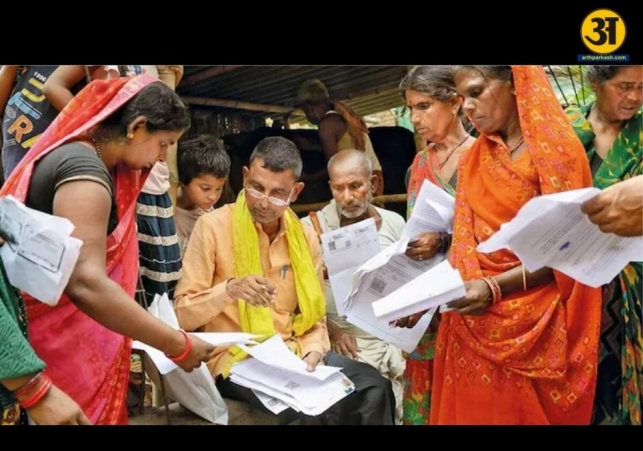
Parliament can't debate Bihar voter list issue, here's why
Bihar voter list controversy: Why Parliament has no say in electoral roll updates
- By Gurmehar --
- Friday, 01 Aug, 2025
Many Opposition leaders in India are upset about the way the voter list revision, also called the Special Summary Revision (SIR), is being conducted in Bihar. They are asking for a detailed discussion in Parliament. However, the chances of that happening are very low.
Recently, several MPs from the Opposition, both in the Lok Sabha and the Rajya Sabha, have been protesting inside and outside Parliament. Their main complaint is that the Election Commission (EC) has removed a large number of names—about 35 lakh—from the draft voter list in Bihar.
According to the EC, the SIR is not final yet. They have stated that over 7.24 crore out of 7.89 crore eligible voters have already participated in the verification process. The remaining voter names are still being reviewed.
The Supreme Court has also taken up this matter. A few petitioners filed requests asking the Court to stop the voter list revision until more clarity is given. But the Court said no. It explained that the EC is an independent body and the process is still going on. Only if there is a clear sign of mass exclusion in the final list will the Court interfere.
The MPs, however, want Parliament to debate the issue immediately. Many of them even gave suspension notices, asking that the current topics in Parliament be paused for a while so that SIR can be discussed instead. But Parliamentary Affairs Minister Kiren Rijiju called this behaviour a “U-turn” and said the Opposition was not serious about the scheduled debate on Operation Sindoor.
Why Parliament may not allow a debate
The first reason Parliament is not likely to allow a discussion on SIR is because the process is not yet complete. The Supreme Court clearly said that any order on SIR will be too early at this stage. The final voter list is yet to be released, and until then, no one knows if any big mistakes or exclusions have actually happened.
Second, the Election Commission is an independent institution. This means it is not directly controlled by the government. Therefore, ministers or departments like the Law Ministry are not answerable for the decisions of the EC. In short, Parliament cannot call the EC to reply to questions during the session, because it functions separately.
Third, the SIR is not something new. It is a regular part of election management and has taken place many times before across different states. It is not a recent policy decision or reform by the current EC or the central government. So, the argument is that this doesn’t qualify as an issue that Parliament should interrupt its schedule for.
ALSO READ: Divya Deshmukh checkmates history to become India’s first Women’s World Cup champion
ALSO READ: Subtle signs of anxiety you might be missing in everyday life
The Opposition, however, argues that this time is different. They believe the scale of errors is too large and that it could affect the fairness of the upcoming elections. They fear that some voter groups may have been targeted or wrongly removed.
But legally and procedurally, nothing can be done until the final list is released. The EC has promised to review any errors and add genuine names that may have been wrongly deleted.
Also, there’s a rule in Parliament that certain issues, especially those related to autonomous bodies or ongoing processes, should not be debated mid-way. The Speaker of the Lok Sabha or the Chairman of the Rajya Sabha has the final authority to allow or deny such debates. So far, they have not approved a discussion on the SIR issue.
In the end, while the Opposition’s concerns may be important, the rules of Parliament and the independence of the Election Commission create clear boundaries. The process is still happening, and unless the final list shows proof of large-scale voter exclusion, it’s unlikely that Parliament or even the Court will interfere.
Until then, the best way forward may be for everyone—voters, leaders, and officials—to keep a close watch, ensure transparency, and raise concerns through the correct legal routes.
Related News