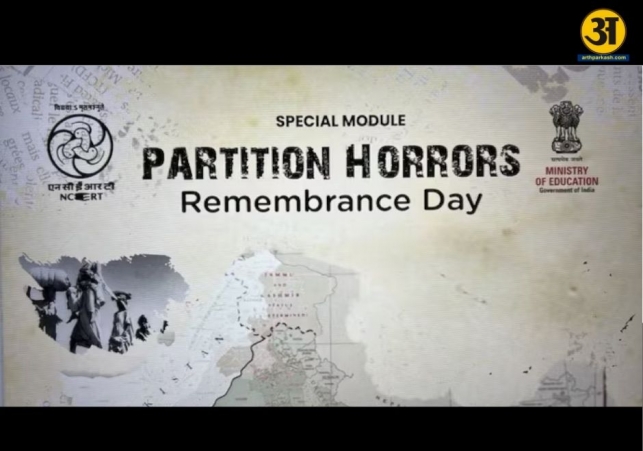
NCERT modules revisit partition history
NCERT’s new partition modules highlight roles of Congress, Jinnah, and Mountbatten
- By Gurmehar --
- Monday, 18 Aug, 2025
The National Council of Educational Research and Training (NCERT) has introduced new study modules to mark Partition Remembrance Day. These modules aim to give students a clearer and more direct understanding of how India was divided in 1947 and the painful consequences that followed.
The Partition, which led to the creation of India and Pakistan, is described as a “human tragedy without parallel.” Millions of people were displaced, thousands of families were torn apart, and horrific violence swept across both nations. NCERT’s updated texts do not simply present Partition as an unavoidable event but instead place responsibility on three major actors: Muhammad Ali Jinnah, the Congress leadership, and Lord Mountbatten.
Congress leaders, Jinnah, and the decision to divide India
According to the modules, the Congress leadership—especially Jawaharlal Nehru and Sardar Patel—underestimated the determination of Jinnah, leader of the Muslim League. They believed a compromise might still be possible and did not fully understand the dangerous consequences of dividing the nation. Eventually, they accepted Partition as the only way forward, a decision that led to unimaginable suffering.
The modules emphasise that India’s political leaders had little administrative or policing experience at that time. This lack of preparation meant they were unable to manage the scale of violence, riots, and forced migrations that came with Partition. Refugee trains filled only with the bodies of those murdered on the way are highlighted as a grim reminder of the horrors.
Jinnah, on the other hand, is portrayed as the main driving force behind Partition. His call for Direct Action Day in August 1946 led to violent clashes, particularly in Bengal, which left thousands dead. His warning that it was either a “divided India or a destroyed India” put heavy pressure on Congress leaders, eventually forcing their acceptance of Partition.
The texts also point to the role of Lord Mountbatten, the last British Viceroy of India. Instead of carefully planning the transfer of power, he rushed the process by moving the deadline from June 1948 to August 1947. This hasty decision left millions of people unsure of which country they belonged to, creating panic and chaos. The modules call this act a “great carelessness” that worsened the tragedy.
Partition’s legacy and lessons for today
The NCERT modules describe Partition not only as a historical event but also as a turning point that continues to shape India’s present. The violence, displacement, and mistrust that began in 1947 still echo in the form of the Kashmir conflict, communal politics, and wars between India and Pakistan. Later issues such as cross-border terrorism are also linked back to the divisions created at the time of Partition.
The lessons for future generations are clear. The texts warn against the dangers of political short-sightedness and of giving in to violent demands for the sake of short-term peace. “Concessions to violent groups in the hope of peace only whet their appetite for more violence,” one section reads. Students are urged to understand that true national leadership means prioritising the country’s unity and long-term interests over personal ambition or party politics.
Events such as the Noakhali and Calcutta riots in 1946 and the Rawalpindi massacres of 1947 are given as early warnings that leaders should have taken more seriously. By failing to act strongly enough, the modules argue, the Congress leadership allowed the demand for Pakistan to grow unchecked until it was too late.
At the same time, the texts highlight the human cost of Partition. Families were uprooted from homes they had lived in for generations, women suffered terrible violence, and children grew up as refugees in unfamiliar lands. In total, nearly 15 million people were forced to move across the new borders, making it one of the largest mass migrations in human history.
By placing responsibility on Congress, Jinnah, and Mountbatten, the NCERT modules encourage students to see Partition not as destiny but as the result of decisions made by individuals and political leaders. This perspective gives a more balanced and critical understanding of history, showing that choices matter and that poor judgment can have devastating consequences.
ALSO READ: PM Modi’s speech signals strong counteroffensive in demographic battle
ALSO READ: World Organ Donation Day 2025: History, significance, and how you can become a donor
Remembering the tragedy for a stronger future
Marking Partition Remembrance Day with such detailed educational material ensures that young Indians will never forget the scale of suffering their grandparents or great-grandparents endured. At the same time, it gives them a chance to reflect on how India should face the future.
The modules’ final message is one of caution and hope. They stress that India must reject communal politics, resist division, and remain united as a nation. Leaders must be chosen for their commitment to national interests, not for their ability to exploit religious or community divides.
By remembering the mistakes of the past and the pain caused by Partition, future generations can be guided to protect peace and harmony. The story of Partition is not only a history lesson but also a warning of what can happen when politics fails to rise above narrow interests.
Related News