Navi Mumbai airport a result of firm political resolve
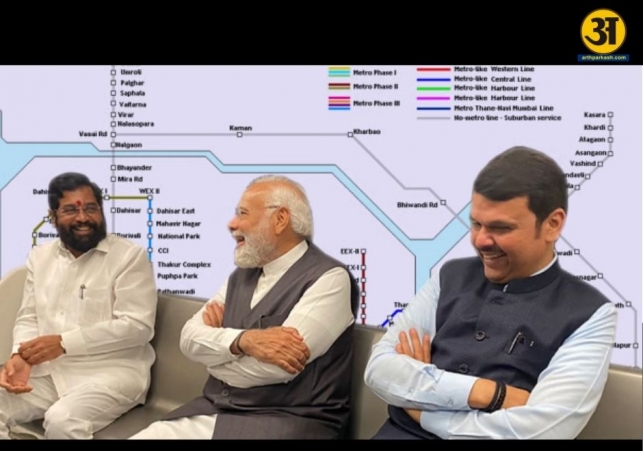
Navi Mumbai airport shows strong political will of Modi and Fadnavis
- By Gurmehar --
- Monday, 06 Oct, 2025
The Navi Mumbai International Airport (NMIA) is set to be inaugurated on October 8, 2025, by Prime Minister Narendra Modi. This airport marks a major milestone for the Mumbai Metropolitan Region (MMR), becoming its second international gateway. The project reflects strong political determination, overcoming decades of delays, bureaucratic hurdles, and local resistance. It represents the leadership of PM Modi and Maharashtra Chief Minister Devendra Fadnavis, who fast-tracked a project first conceived in the late 1990s into a modern infrastructure marvel.
The idea for NMIA was first proposed in 1997 by the Ministry of Civil Aviation to ease congestion at Chhatrapati Shivaji Maharaj International Airport (CSMIA). CIDCO submitted feasibility reports in 2000, suggesting a location near Panvel with parallel runways. While the Congress-NCP government approved development under a Public-Private Partnership in 2008 and secured environmental and defense clearances, progress remained slow due to land acquisition disputes and environmental concerns. Relocation of 2,786 households, mostly fishermen and smallholders, and hydrological studies of the Ulwe River delayed construction.
BJP-led governments turned the tide. Devendra Fadnavis, becoming Maharashtra CM in 2014, prioritized infrastructure revival. In 2017, GVK won the bid for the project, but protests over rehabilitation halted work until compensation agreements were finalized. Ground-breaking by PM Modi in 2018 injected national momentum, and Zaha Hadid Architects and Larsen & Toubro were appointed for terminal design and construction. A major boost came in 2021 when Adani Airports acquired a 74% stake in NMIAL, injecting ₹16,700 crore and accelerating construction. By late 2024, the first commercial flight landed, with recent inspections confirming near completion.
The airport will initially handle 90 million passengers and 2.5 million tonnes of cargo annually by 2032. It will reduce congestion at CSMIA, strengthen MMR’s position as a global aviation hub, and support India’s $5 trillion state economy goal. The project also integrates multi-modal connectivity, including highways, the Mumbai Trans Harbour Link, and Metro Line 8, enabling seamless access from Mumbai to NMIA in under an hour. Water taxis and rail connectivity will further ease travel, boosting trade, tourism, and investment.
ALSO READ: Rising trend of egg freezing: benefits, risks, and expert insights
ALSO READ: Economic crisis sparks unrest in Azad Kashmir against Pakistan government
NAINA: Urban Growth and Economic Impact
The Navi Mumbai Airport Influence Notified Area (NAINA) complements NMIA by transforming 556-560 sq km across 270 villages in Raigad district. Established in 2013 and headquartered at CBD Belapur, NAINA extends the Mumbai Metropolitan Region southward, integrating peripheral rural areas into planned urban development. CIDCO, as the special planning authority, ensures sustainable growth while maintaining environmental safeguards.
NAINA envisions smart mini-cities with thematic hubs for education, healthcare, IT, trade, agriculture, and services. It is linked with JNPT port, the Multi-Modal Corridor, Dedicated Freight Corridor, and SPUR to reduce congestion in Mumbai and generate jobs. Industrial parks, logistics zones, and knowledge hubs are expected to boost GDP by $300 billion by 2030. The project also promotes eco-friendly urban planning, skill development, and equitable regional growth.
The successful completion of NMIA, coupled with NAINA’s rollout, demonstrates the impact of decisive political leadership. PM Modi’s vision and Fadnavis’s policy support converted a long-stalled dream into a reality that strengthens infrastructure, supports economic growth, and enhances India’s global competitiveness. NMIA and NAINA together signify a new chapter for Maharashtra’s economy and urban development, turning political resolve into lasting development outcomes.
Related News