Muslim population growth and changing demographics
Rising Muslim population reshapes religious demographics in India and globally
The growth of the Muslim population is changing religious demographics both globally and in India. Studies show that Muslims are the fastest-growing religious group in the world. According to a Pew Research Center study, between 2010 and 2020, the number of Muslims grew by 347 million, more than all other religious groups combined. Their share of the global population increased by 1.8 points, reaching 25.6%.
In comparison, Hindus grew at the same pace as the global population, rising by 126 million to reach 1.2 billion, maintaining their share at 14.9%. Christians remain the largest religious group at 2.3 billion, but their share fell by 1.8 percentage points to 28.8%. Analysts say that the higher fertility rate among Muslims and migration trends are the main reasons for this rapid growth. Some European countries, like Sweden, France, and the UK, could see Muslims become the majority within the next two centuries, though the change might happen sooner due to immigration and high fertility.
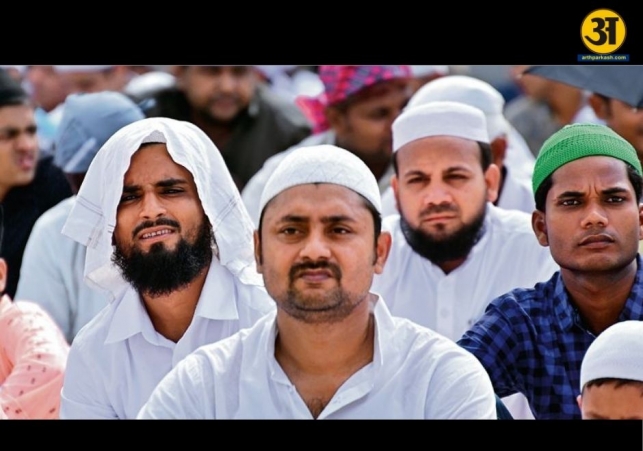
The growing Muslim population has visible social and cultural effects. More mosques are being built, public calls to prayer are becoming common, halal food is widely available, and workplaces adjust schedules for Ramadan. These changes show how population growth can influence the everyday life and culture of countries.
Religious demography in India and its effects
In India, the share of Muslims has been steadily increasing. Data from the Prime Minister’s Economic Advisory Council shows that the Hindu population’s share dropped from 84.68% in 1950 to 78.06% in 2015. In the same period, Muslims increased from 9.84% to 14.09%, a 43% increase in their share. Christian and Sikh populations also rose slightly, while the shares of Jains and Parsis fell.
The 2011 Census highlighted states with high Muslim populations. Lakshadweep had 96.58% Muslims, and Jammu and Kashmir had 68.31%. Other states with significant Muslim populations included Assam (34.22%), West Bengal (27.01%), Kerala (26.56%), Uttar Pradesh (19.26%), and Bihar (16.87%). States like Jharkhand, Uttarakhand, Karnataka, Delhi, and Maharashtra also have considerable Muslim communities. These numbers are likely higher today due to high fertility rates and migration.
Some analysts have raised concerns that continued growth in Muslim populations could affect social and political balances in India. The government identified 88 districts where Muslims make up more than 20% of the population. Rapid population growth can influence voting patterns, resource distribution, and social cohesion.
ALSO READ: Inflammation linked to 60% of global deaths: What you need to know
ALSO READ: Shoe strike at Constitution: tensions rise amid hate speech
Global and historical lessons
Looking at global trends, population changes have significant political and social consequences. Lebanon serves as a cautionary example. After the Second World War, it was a Christian-majority country in a largely Muslim region. By the 1970s, Muslims became the majority, and the country experienced violence, sectarian conflict, and became a base for groups like Hezbollah. Experts suggest that demographic shifts, if rapid and unbalanced, can lead to tensions unless managed carefully.
Globally, the Muslim population is rising faster than other religious groups, and this trend is expected to continue. In countries where Muslims are becoming a larger share of the population, societies are already adapting culturally and socially. The shift is not only a statistic; it affects politics, economics, culture, and everyday life.
The growth of the Muslim population is changing religious demographics in India and around the world. High fertility rates, migration, and social factors contribute to this growth. In India, Muslims are increasing their share steadily, while other communities have seen slower growth or declines. Globally, the effects are seen in Europe, the Middle East, and elsewhere, reshaping societies and creating cultural shifts.
Experts emphasize the need to understand these trends and plan for social harmony, economic development, and peaceful coexistence. Demographic change is a long-term reality, and countries must adapt policies and community planning to ensure stability. The shifts in religious population are significant not just for numbers but for their social, political, and cultural impact, influencing the future of nations and communities worldwide.
Related News