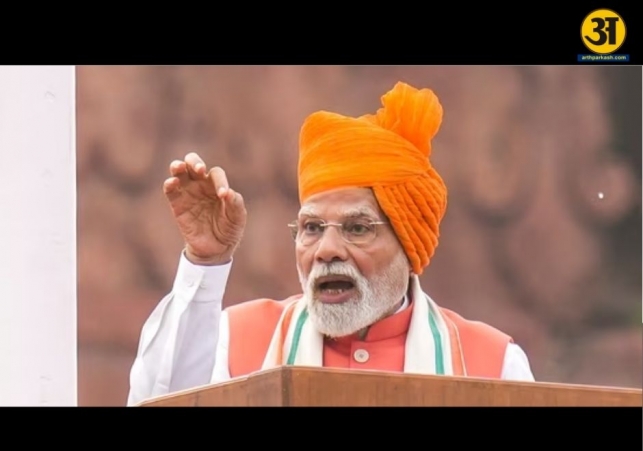
Modi announces India’s deep water exploration mission
India to launch deep water exploration mission, says Prime Minister Modi
Prime Minister Narendra Modi on Friday announced a major new programme — the National Deep Water Exploration Mission — to help India become self-reliant in energy. Speaking from the Red Fort on the 79th Independence Day, he said the country will begin extracting oil and gas from deep in the ocean.
Calling the project “Samudra Manthan” (the mythical churning of the sea), Modi said it will be carried out in “Mission Mode.” The aim is to reduce India’s heavy dependence on imported oil and gas.
India is the world’s third largest consumer of crude oil, after the US and China. In 2024–25, it imported 232.7 million tonnes of crude worth $157.5 billion. The country buys over 88% of the crude oil it refines, though it also exports refined petroleum products.
“A large part of our budget is spent on petrol, diesel, and gas imports. Lakhs of crores are going out of the country for this. If we were not dependent on these imports, this money could have been used for our youth, farmers, and villages,” Modi said. He added that the mission is part of India’s long-term plan to stop depending on foreign energy.
Self-reliance in minerals and clean energy
The Prime Minister also announced steps to achieve self-reliance in the critical minerals sector, which is essential for defence, energy, and technology. He said the government has launched the National Critical Mineral Mission to find and develop these resources, with over 1,200 exploration sites already identified.
Modi said India’s solar power capacity has increased 30 times in the last 11 years, and the country will now boost both nuclear and solar energy production. Ten new nuclear reactors are under construction, and by 2047 — when India celebrates 100 years of independence — nuclear power capacity is expected to grow tenfold.
He added that India has already achieved one of its major climate goals five years early. The target was to have 50% of the country’s power capacity come from clean, non-fossil fuel sources by 2030, but it was met in 2025. “This shows the strength and determination of our people. We care for nature as much as we care for our nation,” he said.
ALSO READ: World Organ Donation Day 2025: History, significance, and how you can become a donor
ALSO READ: Significance of IAF downing an ELINT, AEW&C aircraft in Operation Sindoor
Balancing energy security and climate goals
Modi stressed that energy security is vital for India’s growing economy. However, experts say deep sea oil and gas exploration will require large investments and take many years before production starts. By then, India’s shift to cleaner energy could make it harder for investors to commit funds.
Vaibhav Chaturvedi, Senior Fellow at the Council on Energy, Environment and Water, noted that India’s net zero target for 2070 could discourage long-term private investment in fossil fuel exploration. Still, he said energy security remains a priority, especially as the country balances economic growth with climate commitments.
Related News