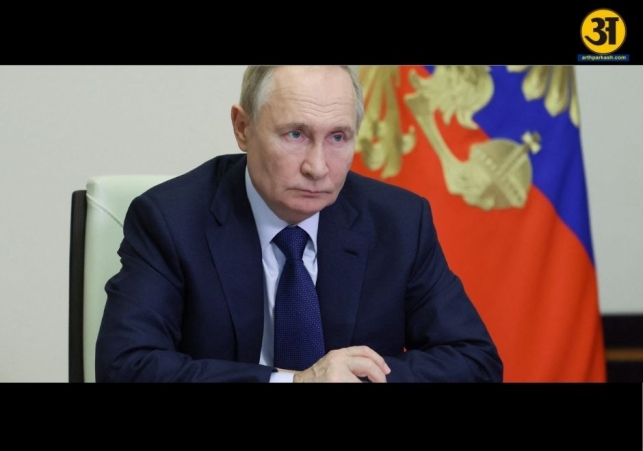
Kyiv’s political disorder strengthens Putin’s advantage
Kyiv’s internal turmoil widens opening for Vladimir Putin as U.S. peace proposal faces resistance
Just before he was scheduled to visit the United States, Andriy Yermak, Ukrainian President Volodymyr Zelenskyy’s Chief of Staff, was forced to resign. His departure came after a police raid on his home linked to a growing corruption scandal that has already led to the sacking of two cabinet ministers. Yermak was widely seen as Ukraine’s second most powerful person and was leading key negotiations to end the war with Russia. His exit puts the peace talks at risk at a time when Ukraine is under extreme pressure both militarily and politically.
Yermak was supposed to travel to Florida to meet US officials at President Trump’s Mar-a-Lago resort. Trump’s peace envoy, Steve Witkoff, along with Trump’s son-in-law Jared Kushner, is due in Moscow soon to finalize a peace deal with Russia. The Kremlin has already received a revised peace plan drafted after emergency talks between Ukrainian and American officials in Geneva. However, the chances of reaching an agreement remain slim due to Kyiv’s political instability and Russia’s firm demands.
Meanwhile, Russia continues to make slow but steady advances in the war. The city of Pokrovsk is close to falling, which could trap many Ukrainian soldiers. Russia’s war economy remains strong, aided by China, which continues to supply raw materials and buy Russian oil despite Western pressure. Western-supplied defence systems have so far been inadequate for Ukraine, and the country faces constant missile and drone attacks. Corruption scandals have also hurt the credibility of Zelenskyy’s government at home and abroad, and US support under Trump has nearly vanished. Trump has openly criticized Zelenskyy, but he continues to push for a peace deal, claiming that had he been president in 2022, the war might not have started.
The origins of the Russia-Ukraine conflict are tied to NATO expansion into Eastern Europe. Russia claims that Western promises in 1990, particularly by US Secretary of State James Baker, assured that NATO would not move eastward. Western leaders dispute this, but for Russia, the red line was crossed in 2008 when NATO agreed to allow Ukraine and Georgia to eventually join. Ukraine’s closeness to Russia, both culturally and linguistically, adds to the tensions. Russia first invaded Crimea in 2014 and then the rest of Ukraine in 2022.
An agreement nearly went through in April 2022, offering Ukraine security guarantees in exchange for neutrality and a promise not to join NATO. Zelenskyy walked away from that deal under US and European assurances of support. Ironically, Trump’s current plan covers similar issues, but the delay has made Ukraine the bigger loser, now pressured to give Russia land that it could not gain on the battlefield.
ALSO READ: Global alert issued as 6,000 jets face urgent updates to prevent flight-control failures
ALSO READ: UIDAI launches new feature allowing Aadhaar mobile update directly through app
Trump’s plan favors Russia, complicates Europe and India
Trump’s 28-point peace plan includes the “de facto” recognition of Crimea and parts of the Donbas region, as well as Russian-held territories in Kherson and Zaporizhzhia. It also calls for Ukraine to never join NATO, reduce its army from 800,000 to 600,000, and allow sanctions on Russia to be gradually lifted. The plan has alarmed Ukraine and Europe, who see it as rewarding Russia while forcing Kyiv to sacrifice dignity. Even in the US, many critics viewed it as heavily favoring Moscow. European leaders persuaded the US to revise parts of the plan, but the details of the new version are unclear.
For Russia, the plan could be a major win. Putin has remained firm on his core demands, and the deal could give him more territory, international recognition, sanctions relief, and an end to his global isolation. For Zelenskyy, it could be disastrous. Russia does not recognize his government as legitimate, and holding elections after signing the deal seems impractical. Any government emerging from such elections is likely to face political backlash.
Europe is concerned because a successful deal strengthens Russia, potentially threatening former Soviet states. However, the war has weakened Russia economically and militarily, making immediate expansion unlikely. Europe also fears uncertainty over the US security commitment as Trump focuses on Asia and China, pushing European nations to take more responsibility for their own defence.
For India, a Russia-Ukraine peace deal could be beneficial. It would allow India to strengthen ties with Moscow without friction from the West. Russia’s return to the G-8 and its reduced dependence on China present new opportunities. India could also gain from Russian military technology developed during the war, including drones and missiles, with discussions expected during Putin’s upcoming visit to India. The deal could also improve India-US relations as Washington seeks support against China.
However, the outcome is uncertain. Ukraine may be forced to give up large parts of its territory, potentially ending Zelenskyy’s political career. Russia, confident in its military capabilities, is unlikely to offer concessions. This means more years of conflict and continued destruction in Ukraine, leaving Zelenskyy in a precarious position regardless of the agreement.
In summary, Trump’s peace plan meets a politically unstable Kyiv, an emboldened Russia, and a cautious Europe. The plan may provide strategic benefits to Russia and India, but Ukraine faces a harsh choice: compromise land and sovereignty or risk continued war. With Yermak’s resignation and ongoing corruption issues, Zelenskyy’s government is weakened, making any negotiations even more challenging.
Related News