Kamchatka volcano erupts after centuries, may trigger quakes
Ancient Kamchatka volcano wakes up after centuries, sparks seismic concerns
- By Gurmehar --
- Monday, 04 Aug, 2025
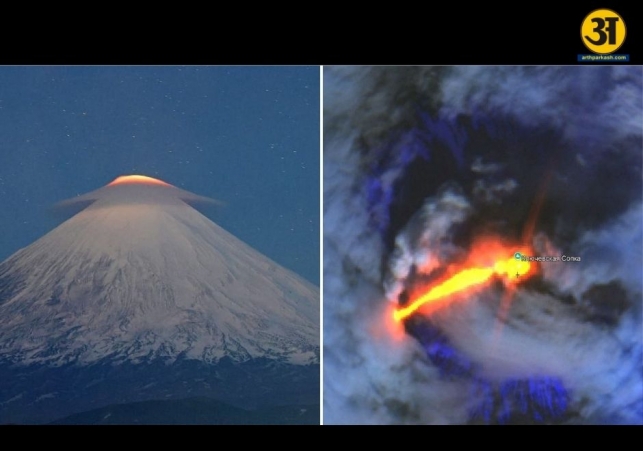
A volcano in Russia’s Kamchatka Peninsula has erupted for the first time in 600 years. Scientists think this rare volcanic activity might be connected to a very strong earthquake that hit the region earlier this week. The earthquake measured 8.8 in magnitude and caused concerns of tsunamis in several countries nearby, including Japan, the United States, and the Philippines.
The volcano that erupted is called Krasheninnikov Volcano, and it is located in Kamchatka, a remote area in the far east of Russia. This area is known for its natural beauty and large number of volcanoes. The eruption happened shortly after the powerful earthquake, which had its epicenter in the same region.
Experts confirm first eruption ever recorded in history
According to Olga Girina, who leads the Kamchatka Volcanic Eruption Response Team, this is the first time in 600 years that Krasheninnikov has erupted. She said that the volcano’s last known lava flow was around the year 1463, but there had been no activity ever recorded since then. Girina made this announcement on the Telegram channel of the Institute of Volcanology and Seismology, and it has also been reported by Russia’s state news agency RIA.
This makes the eruption highly unusual, and scientists are paying close attention. It is rare for a volcano to remain silent for centuries and suddenly come alive again. Experts say that this eruption could be directly connected to the strong earthquake that just took place in the area.
Other volcanoes erupt after earthquake
The 8.8-magnitude earthquake was one of the strongest ever recorded in that part of Russia. After it happened, other volcanoes in the Kamchatka region also showed signs of activity and even erupted. Among them was Klyuchevskoi, which is the most active volcano in Kamchatka and one of the tallest in the world. Klyuchevskoi has had several eruptions in recent years, so scientists were already monitoring it closely.
This kind of chain reaction is not surprising to volcanologists. When a powerful earthquake shakes the earth, it can disturb underground magma systems and trigger eruptions in nearby volcanoes. The Krasheninnikov eruption may be part of such a larger geological response.
More earthquakes shake nearby islands
The area has not yet calmed down. On Sunday, a new earthquake measuring 6.7 in magnitude struck near the Kuril Islands, which are also located in the far east of Russia, not far from Kamchatka. This was reported by the German Research Center for Geosciences. These islands often face earthquakes due to their location along the Pacific "Ring of Fire" — a zone known for frequent earthquakes and volcanic eruptions.
Russia’s emergency officials have warned that tsunami waves could hit three districts in Kamchatka because of the quake. However, the United States Geological Survey (USGS) recorded the earthquake as a 7.0-magnitude event. Despite its strength, the Pacific Tsunami Warning System confirmed that no tsunami alert was issued afterward, which brought some relief to people living along the coast.
ALSO READ: India holds strategic cards as Trump’s rhetoric escalates
ALSO READ: Forensic clue cracks case: Inside the probe that linked guns to Pahalgam attack
Experts are keeping watch for more activity
Scientists are continuing to watch the area carefully. The Kamchatka Peninsula is home to many volcanoes and lies in one of the world’s most geologically active regions. While the eruption of Krasheninnikov is rare, it shows that the area can still surprise even experienced volcanologists.
This sudden eruption has caught the attention of experts around the world. Since it’s been six centuries since Krasheninnikov’s last activity, many are eager to learn what triggered it and whether it will erupt again.
Authorities in Russia are also staying alert in case of more earthquakes or volcanic eruptions. For now, there have been no reports of deaths or serious damage, but the situation is still developing.
Related News