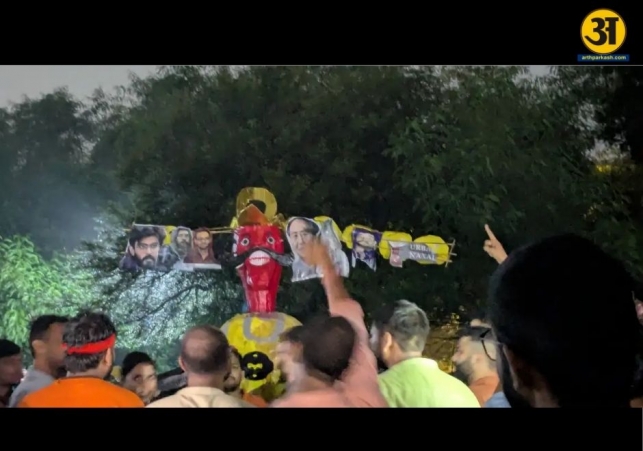
JNU sees clash over Ravan Dahan effigies
ABVP and Left groups clash at JNU over effigy burning during Dussehra
- By Gurmehar --
- Friday, 03 Oct, 2025
Violence erupted at Jawaharlal Nehru University (JNU) in New Delhi on Thursday during Dussehra celebrations, as two student groups, the Akhil Bharatiya Vidyarthi Parishad (ABVP) and Left-affiliated student organisations, accused each other of instigating the conflict. The clashes occurred amidst the traditional Vijayadashami celebrations and the immersion of Durga Puja idols on campus, which drew attention from students, faculty, and authorities.
According to the ABVP, Left-wing student groups attacked a Durga Puja idol immersion procession, injuring several male and female students through stone-pelting. Vaibhav Meena, the lone ABVP member on the JNU Students’ Union (JNUSU) panel and joint secretary, said that the violence disrupted the cultural harmony of the university and was a direct assault on the spirit of brotherhood among students. He added that the ABVP had organised a symbolic “Ravan Dahan” targeting what they described as “Naxal-like forces,” including individuals like Afzal Guru, Umar Khalid, Sharjeel Imam, G Sai Baba, and Charu Majumdar, whose ideologies they considered extremist.
Meena explained that the symbolic act was part of the nine-day Durga Puja celebration, culminating in Vijayadashami, when the idols are traditionally immersed in a ceremonial procession. He said that the ABVP’s procession, which included photographs of the so-called Naxal leaders, was attacked by Left-wing groups as the students marched with the idols for immersion. The ABVP described the incident as an attempt to stoke violence and disrupt the cultural festivities of the university.
The JNU Students’ Union (JNUSU), which includes members linked to Left groups, countered these claims. JNUSU president Nitish Kumar, associated with the All India Students’ Association (AISA), alleged that the ABVP had intentionally used religious imagery and slogans for political purposes. He said that ABVP members raised slogans of “Jai Shree Ram” and “Yogi ji’s bulldozer justice” while waving slippers to provoke other students. Kumar stated that JNUSU members formed a human chain to prevent the escalation of violence, but the ABVP allegedly tried to instigate clashes for about half an hour.
Accusations of political exploitation and Islamophobia
The Left-wing student groups strongly condemned the ABVP’s “Ravan Dahan” programme, claiming it was an exploitation of religious sentiments to gain political advantage. The AISA called the event a “blatant and dastardly display of Islamophobia,” questioning why ABVP chose to symbolically target Umar Khalid and Sharjeel Imam, instead of figures like Nathuram Godse, Gurmeet Ram Rahim Singh, or others accused of inflammatory speeches during previous communal incidents.
The JNUSU and Left groups accused the ABVP of using religion for propaganda, claiming that the symbolic “Ravan Dahan” was politically motivated and deliberately provocative. According to them, the act sought to vilify certain sections of the student body and incite communal tension on campus. The Left groups also criticised the ABVP for disrupting the immersion procession, stating that the violence had no connection to Dussehra celebrations or cultural practices.
Meanwhile, the ABVP maintained that the clash was initiated by the Left-wing groups and called for a thorough investigation. Vaibhav Meena emphasised that the attack on the Durga Puja procession represented a challenge to cultural harmony and student unity at JNU. He said that the ABVP had only aimed to symbolically denounce extremist ideologies, not target any religious community. The organisation urged authorities to act against those who attacked students and disrupted festivities.
ALSO READ: RSS completes 100 years of service and organisation
ALSO READ: Coffee on empty stomach? AIIMS doctor warns against these coffee habits
The incident at JNU highlights the ongoing tensions between student groups affiliated with different political ideologies. While the ABVP often positions itself as a defender of cultural and nationalist sentiments, Left-leaning groups accuse it of politicising religion and targeting dissenting voices. The Dussehra clash reflects the deepening divisions within the university, where campus events can quickly become arenas for ideological confrontations.
The university administration did not immediately issue a statement regarding the incident. Authorities are expected to review CCTV footage and reports from students to determine the sequence of events and assign responsibility. While the celebrations were disrupted, the incident has sparked broader debates about the role of politics in university activities and the need to maintain peaceful campus environments.
Observers have noted that such clashes during festivals are not uncommon in politically active campuses like JNU, where student unions with opposing ideologies often organise competing events. However, incidents involving physical violence and targeting of individuals raise concerns about safety and the limits of freedom of expression. Students and faculty have called for restraint and dialogue to prevent further escalation during cultural celebrations.
In conclusion, the Dussehra clashes at JNU stemmed from a mix of cultural celebration, political symbolism, and ideological rivalry. The ABVP’s “Ravan Dahan” programme, targeting what it described as Naxal-like forces, triggered accusations of Islamophobia and political exploitation by Left-leaning student groups. The resulting violence disrupted the traditional immersion of Durga Puja idols and left several students injured. The incident underscores the challenges of balancing cultural festivities, political expression, and campus safety, as well as the need for effective conflict resolution in a politically vibrant university environment.
Related News