Israel helps airdrop aid, denies Gaza starvation claims
Israel joins global effort to airdrop aid into Gaza, rejects starvation allegations
Israel’s army, the Israel Defence Forces (IDF), announced on Friday that it had dropped food aid into the Gaza Strip with the help of six other countries. This was done to help people in both northern and southern parts of Gaza who are struggling due to the ongoing conflict.
The countries involved in the operation were the United Arab Emirates (UAE), Jordan, Egypt, Spain, France, and Germany. A total of 126 aid packages, mostly food, were dropped from aircraft into different areas of Gaza. According to the IDF, this was the first joint airdrop with three European nations since the recent conflict started.
The humanitarian aid was dropped using military aircraft from the participating countries. The operation comes at a time when Israel is facing strong international criticism over the humanitarian crisis in Gaza, where many residents are said to be going hungry and lacking basic supplies.
Just days earlier, on July 27, the UAE and Jordan had carried out a separate airdrop, delivering 25 tons of aid into Gaza. That was the first aid mission in months, and it appears to have opened the door to further international cooperation to help civilians caught in the crossfire.
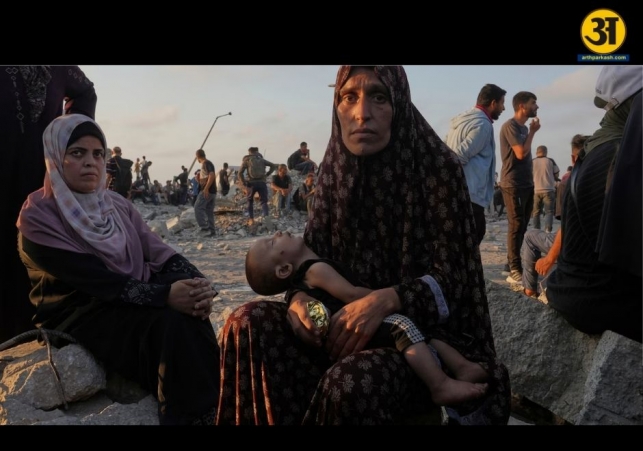
Photos shared by international news agencies show humanitarian supplies being pushed off aircraft ramps mid-flight, while some images from the ground show Palestinians collecting sacks of flour and food after the drops.
Israel denies causing hunger, blames Hamas for crisis
In response to accusations from some humanitarian groups and media outlets, the IDF has denied claims that Israel is deliberately starving the people of Gaza. IDF Chief of Staff, Lt. Gen. Eyal Zamir, said the claims were “false and coordinated,” calling them a deliberate attempt to accuse Israel of war crimes.
“The real party responsible for the suffering in Gaza is Hamas,” Zamir said. “Our soldiers act with morality and in line with international laws.” He added that the IDF has tried to allow humanitarian aid where possible, even during times of fighting.
Zamir also spoke about the ongoing hostage negotiations. He said that military operations in Gaza would continue even if a partial deal is reached. Talks have been taking place behind the scenes, but Zamir warned that if no progress is made in the next few days, the fighting would resume more aggressively.
In addition to the situation in Gaza, the IDF is also active on its northern front with Lebanon. Since a ceasefire was signed in November 2024, the IDF has continued to strike Hezbollah targets in Lebanon and Syria. Zamir said these operations have successfully reduced Hezbollah’s ability to launch a major attack.
Before the ceasefire, Hezbollah had around 150,000 rockets and many thousands of launch sites. According to the IDF, these numbers have now dropped to just a few thousand, thanks to more than 500 targeted airstrikes in the region. Most of the strikes focused on border areas between Lebanon and Syria.
Zamir also pointed out that a recent change in Syria’s government has helped Israel’s efforts. The new Sunni-led government in Syria has blocked Iran from sending weapons to Hezbollah, which the IDF considers a major step toward reducing the group’s military strength.
Despite the improvements, the IDF warned that small attacks from Hezbollah may still occur, but the risk of a full-scale ground invasion has been “greatly reduced.”
Efforts continue amid a complex regional situation
The humanitarian and military situations in Gaza, Lebanon, and Syria remain deeply connected. While Israel and its partners are working to get food and supplies to civilians, military tensions with armed groups like Hamas and Hezbollah continue to affect the region’s stability.
International governments and aid organisations are urging both sides to take stronger steps to protect civilians. The United Nations and other global bodies have called for more aid to enter Gaza through land routes, which they say would be more efficient than air drops.
ALSO READ: Forensic clue cracks case: Inside the probe that linked guns to Pahalgam attack
ALSO READ: Divya Deshmukh checkmates history to become India’s first Women’s World Cup champion
For now, the joint air operation shows that international cooperation is still possible, even during difficult times. More missions may be carried out in the coming days, depending on the situation on the ground.
In the meantime, the people of Gaza continue to suffer the most. Many families are still displaced, food and water are in short supply, and hospitals struggle to care for the injured. While aid drops are helpful, many experts say long-term peace and stable supply routes are the only real solution to the humanitarian crisis.
Related News