Indians emerge as key issue in Australia’s immigration row
Why Indian migrants are at the center of Australia’s immigration debate
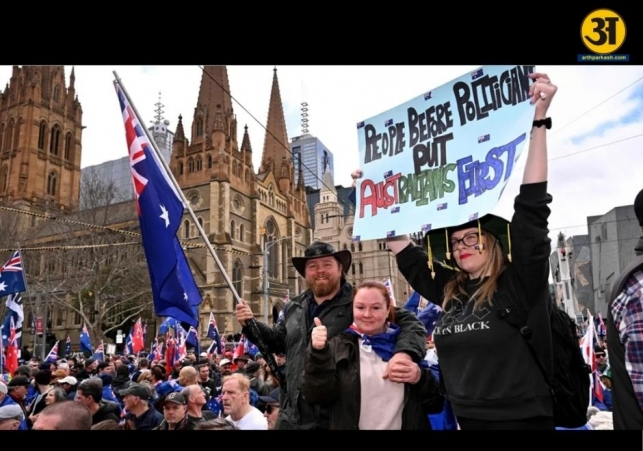
Mass protests in Australia against immigration have created a storm, placing Indians at the centre of a divisive debate. The rallies, held across major cities like Sydney, Melbourne, Brisbane, Canberra, Adelaide, and Perth, show how immigration has become both a political and cultural flashpoint. The question is whether this unrest is about real issues or a carefully built political agenda targeting migrants.
Protests against immigration and rising indian population
The “March for Australia” movement has positioned itself as a fight for protecting national culture and values. Their website and flyers argue that immigration has weakened community trust and pushed Australia into cultural risks. Protesters raised issues like housing shortage, pressure on healthcare, congestion, crime, and job competition. But what caught attention was the specific focus on Indians.
Promotional material for the rallies highlighted that the Indian-origin population has doubled in ten years, rising to nearly 8.5 lakh by 2023. Flyers compared this rise to Greek and Italian immigration over a century, calling it a “replacement” rather than cultural growth. Such language mirrors far-right arguments seen in Western nations, where immigrants are accused of “taking over” communities.
Indians now make up about three per cent of Australia’s population. On the ground, their contribution is visible — from IT jobs to healthcare, from running small businesses to leading in academics. Yet, in the eyes of protest organisers, they represent a rapid demographic shift that unsettles the traditional balance.
This fear of cultural dilution, mixed with political opportunism, is what makes the Indian community a flashpoint. It is less about crime or economy and more about how visible the Indian diaspora has become in daily life. Curry houses, Bollywood festivals, cricket fandom, and temples are now central parts of Australian cities. For some locals, this signals diversity; for others, it fuels resentment.
Politics of division or genuine concern?
The Albanese government has dismissed the protests as “far-right activism” bordering on racism. Home Affairs Minister Tony Burke made it clear: targeting any community, including Indians, undermines the spirit of multicultural Australia. He called such marches “un-Australian” and dangerous for social cohesion.
But politics always has another layer. The rallies also found support from opposition voices, showing how immigration is being shaped into an election issue. Politicians know that housing affordability, traffic jams, and public services are hot-button topics. Blaming immigrants becomes an easy way to tap public anger without addressing deeper policy failures.
Opinion surveys suggest that many Australians accept immigration but worry about its pace. This gap between acceptance and anxiety is where movements like “March for Australia” thrive. By presenting Indians as symbols of “overcrowding,” the protests are not just about numbers — they are about identity.
Australia has long been a land of migrants. Post-World War II, people from Europe shaped its economy. Later waves brought Asians, including Indians, who are now one of the fastest-growing migrant groups. The story of modern Australia is incomplete without migrants. Yet, this historical truth is often ignored when emotions run high.
As of 2024, 8.6 million people in Australia were born overseas. That is nearly one-third of the population. Among them, Indians stand out not only for their numbers but also for their rapid rise compared to other groups. In a country where politics often feeds on division, this makes them an easy target.
ALSO READ: Trump’s remarks spark controversy among Indian-origin Brahmins in Boston
ALSO READ: Comparing losses in gaming and investing sparks debate on regulation
Conclusion: Testing Australia’s multicultural promise
What is happening in Australia is more than a street protest. It is a test of the nation’s multicultural promise. Can it continue to welcome migrants while managing the pressures of urban life? Or will political forces succeed in turning communities against each other?
Indians are now caught in this storm, not because of wrongdoing, but because they represent change. And change, even when positive, often becomes the ground for conflict. The protests reveal an identity crisis within sections of Australia — a struggle between pride in diversity and fear of difference.
In my view, this is less about immigration numbers and more about the narratives being built. Housing shortages and healthcare strain are real, but blaming migrants will not solve them. Targeting Indians or any group for political mileage risks undoing decades of social progress.
Australia has to decide whether it wants to remain a beacon of multiculturalism or slip into the politics of division. The answer will shape not only the lives of migrants but also the soul of the nation itself.
Related News