India says no country can comment on Kashmir
India strongly rejects China and Pakistan remarks on Jammu and Kashmir
India on Tuesday strongly criticised China and Pakistan over references to Jammu and Kashmir in a joint statement issued after talks between leaders of the two countries. India said Jammu and Kashmir and Ladakh are an inseparable part of the country and no foreign nation has the right to comment on these matters.
The Ministry of External Affairs (MEA) made it clear that India completely rejected what it called “unwarranted references” to Jammu and Kashmir in the China-Pakistan statement. India also objected to comments about the China-Pakistan Economic Corridor (CPEC), saying parts of the project pass through land that belongs to India but is under Pakistan’s control.
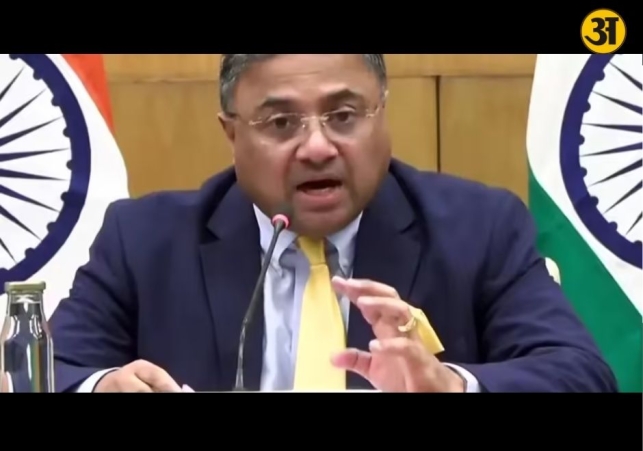
MEA spokesperson Randhir Jaiswal said India’s stand has always remained the same. According to him, Jammu and Kashmir and Ladakh “have been, are and will always remain” important and inseparable parts of India.
India rejects comments on Kashmir
Speaking to the media, Randhir Jaiswal strongly rejected the mention of Jammu and Kashmir in the joint statement released by China and Pakistan.
He said India does not accept any outside comments on Jammu and Kashmir or Ladakh because these territories are part of India’s internal matters. According to India, no other country has the right to interfere or speak about them.
India has repeatedly maintained this position for many years. The government says Jammu and Kashmir and Ladakh are fully integrated into India and decisions related to these areas belong only to India.
The statement from the MEA came shortly after Pakistan Prime Minister Shehbaz Sharif met Chinese President Xi Jinping and Chinese Premier Li Qiang in China. After these meetings, both countries released a joint statement talking about stronger cooperation, regional projects and the China-Pakistan Economic Corridor.
India quickly reacted to references made in that statement, especially those related to Kashmir.
The Indian government said it strongly opposes any suggestion or statement that questions India’s sovereignty over Jammu and Kashmir or Ladakh.
India objects to the CPEC project
India also strongly criticised references related to the China-Pakistan Economic Corridor, commonly known as CPEC.
CPEC is a major infrastructure and development project between China and Pakistan. It includes roads, ports, transport systems, power projects and economic zones. It is also seen as one of the biggest parts of China’s Belt and Road Initiative, which aims to improve trade and connectivity across countries.
However, India has objected to CPEC from the beginning because some parts of the project pass through Pakistan-Occupied Kashmir (PoK), an area India says belongs to it but remains under Pakistan’s control.
According to India, carrying out projects in such areas violates India’s sovereignty and territorial integrity.
Randhir Jaiswal said India strongly opposes any move by other countries that could “reinforce” or “legitimise” what India calls Pakistan’s illegal occupation of Indian territory.
He added that India has raised these concerns many times with both China and Pakistan in the past and continues to make its position clear.
India’s concern is that infrastructure development in disputed areas may indirectly strengthen Pakistan’s control over territory claimed by India.
Water cooperation claim also rejected
India also dismissed references to “trans-boundary water resources cooperation” between China and Pakistan.
The Indian government said such claims are baseless because, according to India, China and Pakistan do not share a common border.
The MEA spokesperson rejected the wording used in the joint statement and said India does not agree with the description of water-related cooperation between the two countries.
India also repeated its position on the 1963 boundary agreement signed between Pakistan and China.
India has never recognised that agreement and continues to reject it. The agreement involved territory claimed by India, and New Delhi has long maintained that it has no legal validity.
By repeating this position, India once again signalled that it does not accept arrangements involving territories it considers its own.
ALSO READ: Can a spoon of peanut butter before bed help you sleep better? Experts explain
ALSO READ: China coal mine explosion kills at least 82, rescue teams search for trapped workers
What China and Pakistan said
The joint statement between China and Pakistan came after high-level meetings involving Pakistan Prime Minister Shehbaz Sharif and Chinese leaders.
Both countries said they had reached a “new broad consensus” to further strengthen their strategic partnership.
They agreed to speed up development under CPEC and focus on improving infrastructure and economic ties.
One important point discussed was Gwadar port in Pakistan. China and Pakistan said they want to transform Gwadar into a major regional connectivity hub. This means they hope to make it an important centre for trade, shipping and transport in the region.
The two countries also welcomed the possibility of third-party participation in CPEC projects under an existing framework. This means other countries or partners may join or invest in some future projects.
China and Pakistan further agreed to improve roads, transport links and port facilities to increase regional connectivity and economic cooperation.
For China, CPEC is considered a flagship project under the Belt and Road Initiative. Pakistan also sees it as important for economic development, trade and infrastructure growth.
India stands firm on its position
India’s response shows that it continues to strongly defend its position on Jammu and Kashmir, Ladakh and CPEC.
New Delhi says these territories are integral parts of India and rejects any statement from foreign countries on matters related to them.
India also remains firmly opposed to projects in Pakistan-Occupied Kashmir and has made clear that it will continue raising objections whenever such issues are discussed.
The latest exchange highlights ongoing tensions between India, China and Pakistan over regional borders, sovereignty and strategic projects, especially in areas claimed by India.
Related News