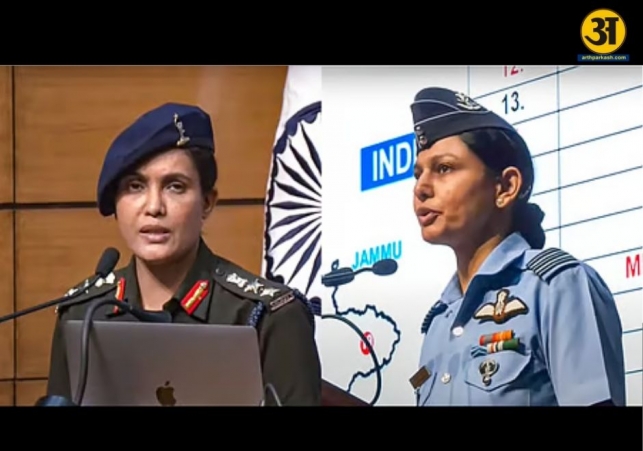
India’s Operation Sindoor and the realities of war
Voices from the frontlines: Understanding India’s Operation Sindoor
The words war and peace are often used loosely in history. Many people think peace simply means the absence of armies fighting on the battlefield. But peace is more than that. In reality, war can be any hostile interaction between rivals who are trying to weaken each other—militarily, politically, economically, or even in cyberspace. Seen this way, India and Pakistan have been at war not just in 1947, 1965, 1971, or Kargil in 1999, but continuously for the last 78 years since Partition. Independence Day 2025 reminds us that this war is still not over—it has only taken new forms.
Policy, strategy and tactics explained
One way to understand war is to think about three connected parts: policy, strategy, and tactics. Policy is the broad direction set by the state. In India’s democracy, policy is influenced by the people through elections and shaped by national emotions. Strategy is the government’s job. It is more intellectual, based on long-term thinking and how best to use resources to achieve goals. Tactics are left to the armed forces. These are the day-to-day operational choices made on the battlefield.
Policy tells us why we fight, strategy tells us how we plan to fight, and tactics show us what we actually do in real time. For example, in the India-Pakistan context, India’s main policy is to contain Pakistan so that it cannot physically threaten us along our long land border. Another policy aim is to stop Pakistan from interfering in India’s internal affairs, especially since India has more Muslims than Pakistan, many of whose families chose to remain in India during Partition. A deeper long-term policy goal is to correct what many see as the mistakes of Partition—what some call the “unfinished agenda.” Whether this goal is achieved now, later, or never is unknown, but it is part of the thinking that has always guided Indian wars with Pakistan.
India’s strategy, in turn, is shaped not only by Pakistan but also by other powers like the US, Russia, China, Europe, and the Gulf. For example, during Operation Sindoor, India’s oil trade with Russia continued smoothly because of strong relations between the two countries. Strategic questions also include whether India should target areas like Gilgit-Baltistan or Pakistan-occupied Jammu and Kashmir (PoJK) rather than Punjab or Sindh. They even include bigger ideas such as whether supporting Baluchistan’s independence could weaken Pakistan more effectively than a direct assault across the border.
Finally, tactics are about the timing and methods of battle—when to attack, whether to use drones, whether to carry out feint attacks to confuse the enemy, and whether to strike across the Line of Control (LoC) or the international border. These are highly technical choices best left to military experts, not politicians. In the past, civilian interference in tactical decisions has been harmful. In Operation Sindoor, however, there has been little political meddling, and the military has been free to fight in physical, cyber, and cognitive domains.
The wider war and the road ahead
Operation Sindoor must also be seen in the context of India’s other adversaries. China remains a major concern—if war escalates, will China send troops to support Pakistan, create trouble on the India-China border, or simply criticize India in global forums? Internally, India also faces what the author calls a “half-enemy”: political groups or actors who, for their own reasons, may weaken national unity by aligning with hostile foreign powers. This internal challenge is not fought with guns but must be countered by citizens in political, economic, and social ways.
ALSO READ: Punjab government saves ₹383 crore, empowers 10,000 teachers with AI training
ALSO READ: How opposition parties exploit voter dynamics while accusing others of manipulation
The Chief of Army Staff has already stated that Operation Sindoor is not over. What happened on May 10 was only a pause in fighting, not a peace agreement. Since then, international events—Donald Trump’s tilt toward Pakistan, Prime Minister Modi’s talks with President Putin, and his planned visit to China—have changed the situation further. The Army expects another round of hostilities soon, possibly with more active involvement from foreign countries. In today’s world, wars often begin without formal declarations.
The “new normal” created by Operation Sindoor is that India is willing and able to fight Pakistan using modern technology. This includes cyber warfare, drones, and information campaigns. India has also signaled that it may escalate the war on its own terms. By challenging the fading US-led “rules-based order,” India is showing that it may now have the confidence to punch above its weight, much like China did two decades ago.
Public opinion in India is clear: for them, true victory in war means gaining enemy territory, not just temporary ceasefires. Two main possibilities are often discussed. The first is to take back parts of Gilgit-Baltistan and PoJK across the LoC, areas that India has always claimed legally. This would be less controversial internationally. The second is to cross the international border and seize territory in Punjab or Sindh. This option challenges the post-1945 principle of fixed national borders. But with those borders already violated in places like Ukraine and the Horn of Africa, and with US dominance weakening, such actions may not be unthinkable anymore.
In this larger picture, Pakistan remains the key obstacle to India’s rise as a major world power. Operation Sindoor, and any future extensions of it, are seen as steps towards securing land—what many Indians see as the real currency of victory. For India, the war is not just about defending against Pakistan but about reshaping the balance of power in South Asia and ensuring a stronger place in the world order.
Related News