India faces increasing challenges from cross-border infiltration
Rising cross-border threats pose new risks to India’s security
- By Gurmehar --
- Monday, 22 Sep, 2025
Cross-border infiltration has increasingly become India’s most pressing internal security concern, moving beyond a regional issue to a national crisis. On August 15, 2025, Prime Minister Narendra Modi, addressing the nation from the Red Fort, highlighted the growing risks posed by illegal migrants. He warned that “illegal infiltrators are snatching the bread and butter of our youth, targeting our daughters and sisters, and capturing forest land belonging to innocent tribals.” The demographic shifts in border areas are now seen as a serious threat to national security, prompting the government to announce the creation of a high-powered Demographic Security Mission aimed at tackling this challenge.
In the early 2000s, India’s internal security threats were dominated by terrorism and separatist movements in Kashmir, Left-Wing Extremism (LWE), and North-East insurgencies. While these problems still exist, their intensity has declined significantly. Naxalism, for example, which affected 182 districts in 2009, has now reduced to just 18 districts, and the Home Ministry estimates it could be eliminated by March 2026. Similarly, insurgency in the North-East has declined by nearly 90% due to improved infrastructure, integration of alienated communities, and peace accords with rebel groups. Kashmir has also experienced relative calm since the abrogation of Article 370 in 2019, although Pakistan and its intelligence agency, ISI, continue to fuel unrest in the region. With these traditional security challenges largely under control, illegal infiltration has now surfaced as India’s most urgent internal threat.
Illegal infiltration is no longer confined to border regions and is creating significant social, political, and economic pressures across the country. States like Assam, West Bengal, and Tripura are witnessing demographic changes that disrupt ethnic balances and create tensions over land, language, and cultural identity. Political debates over the Citizenship Amendment Act (CAA) and National Register of Citizens (NRC) continue to shape public discourse. Many locals feel that infiltrators benefit from welfare schemes and political patronage, leading to ethnic nationalism and communal friction. Radical groups exploit these divisions, further threatening social cohesion.
The impact of illegal migration is now felt across the Indian heartland, from Bihar to Punjab and Uttarakhand to Karnataka. Major cities including Delhi, Hyderabad, Gurugram, and Pune are seeing growing numbers of undocumented migrants, putting pressure on urban infrastructure, housing, and public services. Politically, infiltration has created perverse incentives. Some parties have used vote-bank strategies, helped settle migrants on government land, and turned a blind eye to the consequences. These actions undermine national security while alienating local populations, deepening mistrust between citizens and the state.
Economically, illegal infiltration strains both employment and public services. Undocumented migrants, often working in agriculture, construction, and domestic labour, flood the labour market with cheap workers, depressing wages and displacing local employees. Many also participate in the informal or grey economy, engaging in cattle smuggling, narcotics trafficking, fake currency, and other illicit activities. This not only weakens the formal economy but also strengthens organised crime networks, some of which have links to terrorist groups. Public resources such as healthcare, education, and welfare are further stretched, threatening India’s development goals and ambitions for a “Vikshit Bharat” by 2047.
National security risks and government response
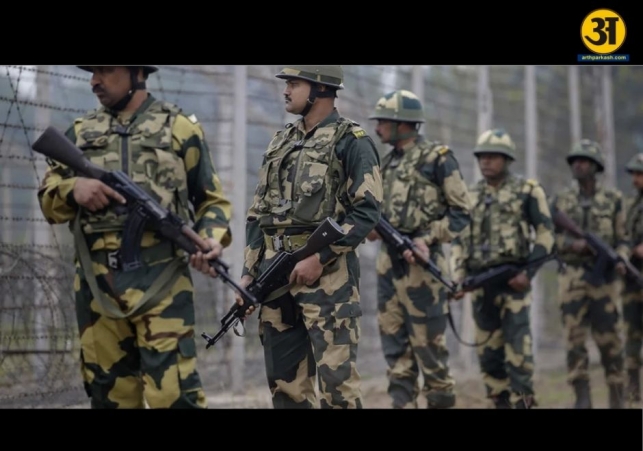
India’s borders face increasing vulnerabilities due to evolving tactics by hostile actors. In Punjab, narco-terrorism has expanded, with drugs and arms being delivered via drones. Difficult terrain along the India–Myanmar border allows insurgents to move and enter illegally, while cyber radicalisation and sleeper agents disguised as labourers complicate detection. Arrests of Pakistani militants along the Bangladesh–Meghalaya border suggest a strategic shift by Pakistan’s ISI, exploiting weaknesses along India’s eastern frontier.
Despite diligent efforts by border forces, enforcement remains challenging due to India’s vast and varied geography. Incidents such as the 2011 killing of a head constable by cattle traffickers in Malda, West Bengal, highlight the dangers posed by heavily infiltrated regions. Surveys have shown that certain stretches of land are fully occupied by illegal settlers, making security operations difficult and disrupting local intelligence networks. Infiltration, therefore, is not merely a border violation; it can weaken internal coordination, disrupt intelligence flow, and enable collusion with enemy states during crises.
ALSO READ: Kejriwal targets Congress leadership in new political move
ALSO READ: Uttarakhand landslide buries family, heroic mother shields children
The Demographic Security Mission, announced by the government, is a timely step to address these threats. For effective outcomes, it must enforce zero tolerance for the creation and use of fake IDs and documents. Strengthening border fencing, deploying advanced surveillance technologies, and improving citizen verification systems are essential measures. Centuries ago, Kautilya, in the Arthashastra, emphasized fortified border towns populated with trustworthy people to protect the state. His advice remains relevant today: a nation’s sovereignty depends on maintaining demographic integrity.
Illegal infiltration is more than a regional concern; it is a test of India’s political will, policy resolve, and social cohesion. A unified national response is essential, transcending short-term politics. If left unaddressed, infiltration could destabilize communities, threaten internal peace, and hinder India’s long-term development. Any short-term political gains from neglecting the problem will appear insignificant when the country faces the full consequences of unchecked infiltration. Kautilya’s warning is clear: a kingdom that neglects its borders invites disorder. India must act decisively to secure its demographic, social, and economic future.
Related News