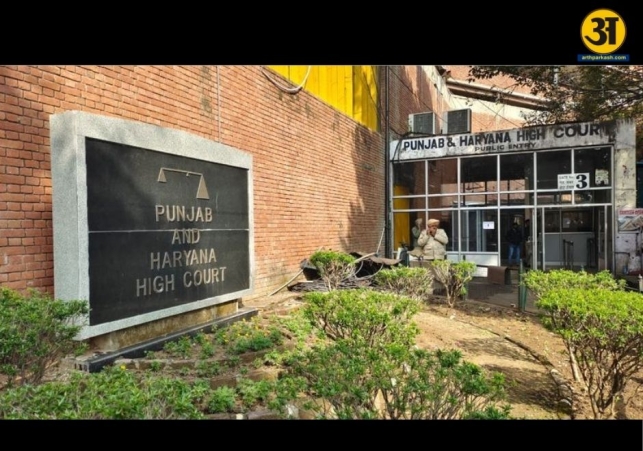
HC demands report on Punjab school shortages
Punjab and Haryana High Court asks for detailed status of school infrastructure and staffing
The Punjab and Haryana High Court has asked the Punjab government to give a detailed report about the poor conditions and shortage of teachers in government schools across the state. The matter came up after the court noticed serious issues while hearing two separate cases involving school staff transfers. Justice N.S. Shekhawat took the matter up on his own (suo motu) in September and sent it to the Chief Justice, who registered it as a public interest litigation (PIL).
The High Court bench said that the situation in many schools shows how little attention the state gives to children’s education. It observed that several schools lack even the most basic facilities such as proper classrooms, toilets, and qualified teachers. The court has now directed the secretary of the Department of School Education, Punjab, to file a detailed reply by December 15, 2025, addressing all the points raised by the single judge bench.
Court takes notice after two transfer petitions
The issue came to the court’s attention during hearings of two different petitions. In the first case, a teacher challenged the local authorities’ decision not to relieve him from a middle school despite his official transfer order. Later, it was revealed that this teacher was the only one available in the entire school located in Amritsar, and his transfer could not be implemented because there was no one else to teach the students.
In the second petition, a woman primary school teacher had approached the court regarding a dispute about her deputation to a school in Ludhiana. The issue was that this particular school too had only one teacher posted there. When the court examined both cases together, it realized that these were not isolated incidents but part of a much larger and serious problem in the state’s education system.
Seeing the widespread nature of the issue, Justice Shekhawat observed that it was not just about transfers or postings but about the overall failure to maintain basic educational standards in Punjab’s government schools. He noted that many institutions lacked proper classrooms, toilets, and head teachers. The judge said that if immediate steps were not taken, the quality of education in government schools would continue to fall, harming thousands of students.
He then referred both cases to the Chief Justice, recommending that they be treated as matters of public interest since they directly affect the future of young children studying in these schools. Acting on that recommendation, the Chief Justice registered the matter as a suo motu PIL to investigate the larger issue of poor school infrastructure and lack of staff.
ALSO READ: How Cyclone Montha got its name and what it means
ALSO READ: How data is shaping our future decisions and opportunities
Government asked to submit detailed data
Now, the High Court has ordered the Department of School Education to provide comprehensive information on the condition of government schools. The court has asked for a detailed report covering both middle schools and primary schools.
The report must include:
-
A list of all middle schools that have fewer than five classrooms.
-
The number of schools where no regular headmaster has been posted.
-
Details of schools where fewer than five teachers are working.
-
Information about schools where there are no separate toilets for boys, girls, and staff.
In addition, the government has been asked to submit a list of all schools that have fewer than 50 students enrolled. The department must also explain what steps, if any, it has taken to increase enrollment in such schools. Similar information has been sought for primary schools, to ensure that the issue is examined across all levels of basic education.
The court’s direction indicates a strong concern for the state of school education in Punjab. It reflects the judiciary’s effort to push the government into taking urgent action to improve conditions for students and teachers alike.
Court’s observation on lack of priority for education
During earlier hearings, the High Court had made strong remarks about how the state seemed to be neglecting the education of young children. Justice Shekhawat had noted that if schools continue to function without teachers, proper classrooms, or essential facilities, then the right to education—guaranteed to every child—would become meaningless.
The court stated that education is one of the most important duties of the state and that children deserve access to clean, safe, and well-managed schools. It also emphasized that the absence of qualified teachers and proper school management directly affects students’ future.
By demanding a detailed report, the court wants to ensure that the Punjab government is held accountable for the conditions in its schools. The direction to submit a comprehensive response by December 15 suggests that the court expects quick and serious action from the authorities.
The outcome of this PIL could lead to major reforms in Punjab’s school system if the court decides to issue further directions after reviewing the report. For now, the High Court’s intervention has brought long-overdue attention to the pressing issues of infrastructure shortage, teacher vacancies, and declining enrollment in government schools across the state.
If implemented properly, the court’s move could help thousands of children studying in rural and under-resourced schools finally receive the basic educational environment they deserve.
Related News