France: India’s logical choice for defense cooperation
Why France remains India’s key partner in defense and technology
- By Gurmehar --
- Friday, 29 Aug, 2025
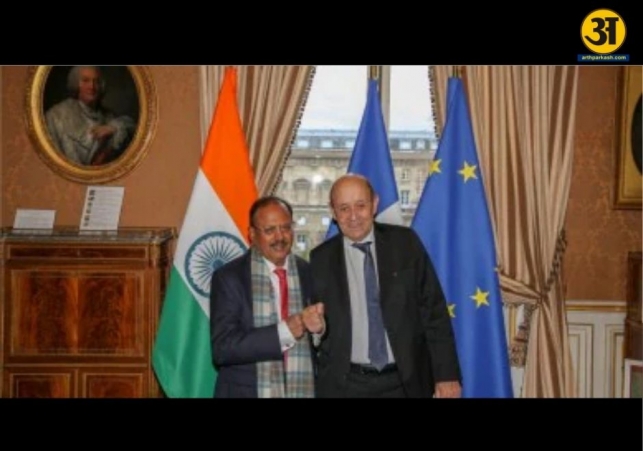
India’s defence partnership with France has reached a historic moment. For the first time, France has agreed to share its most advanced jet engine technology with India. This is not just a regular defence deal—it is a recognition of India as a strategic global partner capable of handling cutting-edge aerospace technology. No Western country has ever shared such comprehensive technology with a non-member of the established aerospace club. The agreement with Safran for full technology transfer in engine development marks a major milestone in India’s defence and industrial capabilities.
India’s journey with French fighter jets started in 1953, when the newly independent nation purchased 71 Dassault Ouragan fighters, nicknamed “Toofani” by Indian pilots. At a time when many developing countries relied on surplus aircraft from Western powers, India deliberately diversified its sources. These jets proved their worth not only in training but also in combat during early conflicts, including the 1961 border skirmishes and the 1962 Sino-Indian War. By 1965, India had ordered 104 Ouragans, establishing a pattern of substantial and long-term procurement from France.
A long history of French-Indian aviation cooperation
In the late 1950s, India acquired the Mystère IVA, France’s first transonic fighter, which saw action in the 1965 war with Pakistan. Squadron Leader AB Devayya famously shot down a Pakistani F-104 Starfighter, earning the Maha Vir Chakra. This proved that Indian pilots could master advanced French technology under high-pressure combat situations.
The real transformation came in 1982, when India purchased Mirage 2000 fighters, including provisions for local assembly through HAL. Renamed “Vajra,” these jets could pull 9 Gs at supersonic speeds, carry nuclear payloads, and perform precision strikes. Their effectiveness was proven during the 1999 Kargil conflict, where Indian pilots used laser-guided bombs for the first time. France’s trust in India continued with the sale of retired Mirage 2000 aircraft in 2021 and their selection for the 2019 Balakot strikes.
India also joined the SEPECAT Jaguar programme, a joint Anglo-French venture. India acquired 160 Jaguars, with 80 built locally as “Shamsher” aircraft. This experience taught India how to absorb complex technology, manage precision manufacturing, and integrate sophisticated systems—a foundation for future partnerships.
The Rafale programme further strengthened the industrial bond. Dassault-Tata now produces Rafale fuselages in India, marking the first time these components are made outside France. The recently signed deal for 26 Rafale-M naval fighters extends cooperation into maritime aviation. These projects reflect France’s confidence in India as a reliable, long-term partner.
Safran engine partnership: A game changer
India’s struggle with indigenous jet engines, notably the Kaveri programme, showed the difficulty of developing high-performance engines independently. After decades and significant investment, Kaveri did not produce a flight-ready engine due to technical challenges like insufficient thrust and metallurgical issues.
The partnership with Safran addresses these weaknesses. Indian engineers will work on every stage of engine development—from materials research to certification—creating genuine indigenous capability, not just licensed production. This collaboration brings proven technology, established supply chains, and decades of manufacturing expertise, ensuring that India can master the complex field of advanced propulsion.
ALSO READ: Trump’s tariffs on India take effect: Sectors impacted and exemptions explained
ALSO READ: INS Himgiri and INS Udaygiri: India commissions indigenous stealth frigates to Navy
Several factors make India the logical partner for France. India has reduced its defence import dependency, demonstrating serious commitment to building domestic capabilities. Its strategic location and growing military needs align with France’s geopolitical interests, especially amid China’s expanding military presence in the Indo-Pacific. Moreover, commercial logic favors long-term cooperation: India’s requirements for fighter jets, including future variants and potential exports, create sustainable production for decades.
This partnership is a recognition of India’s evolution from a traditional aid recipient to a strategic global partner. As India approaches its 2047 development goals, such collaborations are crucial to achieving technological sovereignty, a foundation for real strategic autonomy. Seven decades after the first Toofanis arrived at Indian bases, France is betting its most advanced aerospace technology on India’s ability to master next-generation jet engines, securing a unique position for India in the global aerospace landscape.
Related News