Fall of Berlin Wall marks end of Cold War divide
The fall of the Berlin Wall: A turning point that reshaped global politics
- By Gurmehar --
- Monday, 10 Nov, 2025
On November 9, 1989, the Berlin Wall — one of the most powerful symbols of the Cold War — finally opened, allowing thousands of East and West Berliners to reunite. For nearly three decades, the Wall had stood as a harsh reminder of the world’s division between communist and democratic ideologies. Its fall did not just reunite a city; it reshaped global politics, ended the Cold War era, and inspired a wave of freedom movements across Europe.
The Berlin Wall was built in 1961 by the German Democratic Republic (East Germany) under Soviet influence. It was designed to stop East Germans from fleeing to West Berlin, which was controlled by the United States, Britain, and France. During the years following World War II, Germany had been divided into four zones of occupation, each managed by one of the Allied powers — the U.S., the U.K., France, and the Soviet Union. Although Berlin was located deep within the Soviet zone, it too was split into four sectors, making it a political and symbolic battlefield between East and West.
The Western Allies promoted democracy and capitalism, while the Soviet Union promoted communism. This ideological battle soon became the foundation of the Cold War, an era marked by political tension, propaganda, and fear rather than direct warfare.
The Berlin Wall became the physical embodiment of this global divide. Stretching 155 kilometres (around 96 miles) and standing four metres (13 feet) high, it was more than just a wall — it was a heavily guarded border zone. The space between its two parallel walls, called the “death strip,” was filled with barbed wire, landmines, floodlights, and watchtowers. Guards had orders to shoot anyone who tried to escape to the West.
Over the 28 years that the Wall stood, more than 100 people were killed attempting to cross, though historians believe the true number could be higher. Families were torn apart, friendships ended, and the Wall became a daily reminder of lost freedom.
How cracks began to appear in the communist world
By the late 1980s, the communist bloc — led by the Soviet Union — began to weaken. Countries across Eastern Europe were facing economic hardship, political unrest, and mass protests demanding freedom and reform. The Soviet Union, under the leadership of Mikhail Gorbachev, had introduced new policies such as glasnost (openness) and perestroika (restructuring), allowing greater freedom of speech and limited economic reforms. These policies inspired citizens in neighbouring countries to demand similar changes.
In East Germany, dissatisfaction was growing. People were tired of government control, shortages, and restrictions on travel. In the months leading up to November 1989, thousands of East Germans began fleeing through neighbouring countries like Hungary and Czechoslovakia, which had started relaxing their border rules. At the same time, massive protests erupted across East German cities, demanding free elections and the right to travel abroad.
Under mounting pressure, the East German government decided to relax travel restrictions to calm the protests. However, during a press conference on November 9, 1989, government spokesperson Gunter Schabowski mistakenly announced that citizens could cross into West Berlin “immediately.”
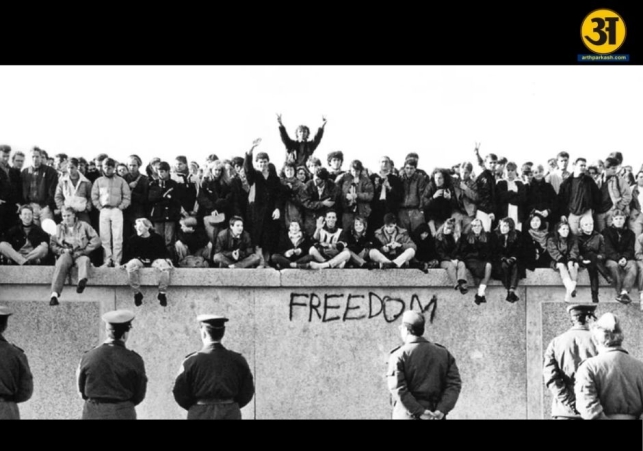
The news spread rapidly. That evening, thousands of East Berliners rushed to the border checkpoints. The guards, overwhelmed and confused, had no clear orders. Facing enormous crowds chanting for freedom, they finally opened the gates. For the first time in 28 years, Berliners could walk freely from East to West.
People climbed atop the Wall, hugging strangers, singing, and chipping away pieces of concrete as keepsakes. These images were broadcast across the world, symbolising the collapse of oppression and the triumph of human spirit.
ALSO READ: Tech glitch cripples Delhi airport operations, hundreds of flights face major delays
ALSO READ: BJP still needs Nitish Kumar despite differences in Bihar politics
A turning point that reshaped the world
The fall of the Berlin Wall became one of the most defining moments of the 20th century. It marked the end of the Cold War, the decline of communist power in Eastern Europe, and the beginning of democratic transitions across the region. Countries like Poland, Czechoslovakia, Hungary, and Bulgaria soon saw their communist governments fall.
The event also paved the way for German reunification. Less than a year later, on October 3, 1990, East and West Germany officially became one nation again. Berlin was restored as the capital of a united Germany. The reunification not only healed the divisions within Germany but also strengthened the idea of a unified Europe, setting the stage for future cooperation through the European Union.
Beyond Europe, the fall of the Wall carried a deeper meaning. It represented the collapse of authoritarian regimes, the power of people’s movements, and the global shift toward democracy and human rights. It showed that even decades of political division could be overcome through collective will and peaceful protest.
However, the transition was not without challenges. The merging of East and West Germany revealed economic and cultural differences that took years to bridge. Many East Germans struggled to adapt to capitalism, and the process of rebuilding trust and equality between the two sides took time.
Still, the fall of the Berlin Wall remains one of the most hopeful and transformative moments in modern history. It was not just the destruction of a barrier made of concrete and steel — it was the collapse of fear, isolation, and division that had dominated global politics for nearly half a century.
The legacy of freedom and unity
More than three decades later, the fall of the Berlin Wall continues to be remembered as a symbol of peace, unity, and resilience. It reminds the world that no wall — whether physical or ideological — can stand forever against the desire for freedom.
For Germany, it marked a new beginning; for Europe, it opened a path toward unity; and for the world, it demonstrated the power of ordinary people to change the course of history.
As historian Frederick Taylor once wrote, “The Berlin Wall was not just a wall. It was the front line of the Cold War. And when it fell, the world itself changed.”
The night of November 9, 1989, proved that freedom can rise even from concrete walls — and that hope, once awakened, can reshape the destiny of nations.
Related News