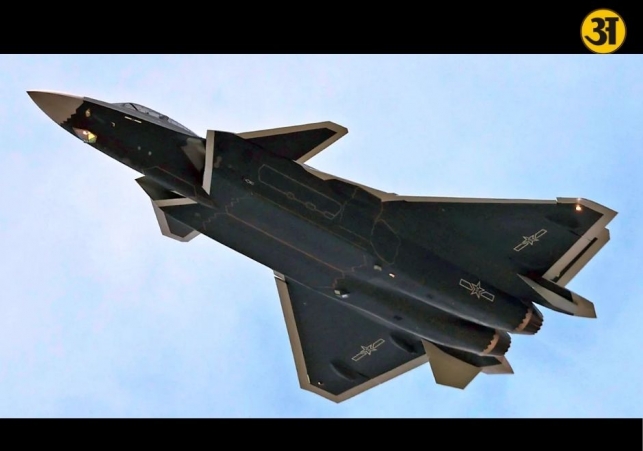
China Debuts Two-Seat J-20 Fighter
China Unveils Two-Seat J-20 Stealth Fighter at Victory Parade, Marking Global First
China’s 80th Victory Parade on September 3 gave the country a chance to display its military strength and advanced weapons to the world. Among the highlights of the event were the Chengdu J-20s, China’s most advanced fighter aircraft. Known as the “Mighty Dragon”, the J-20 is a fifth-generation stealth fighter jet, designed to operate in all weather conditions and equipped with the latest technology for modern warfare.
The Victory Parade is held every year in Beijing to mark China’s victory over Japan in World War II. This year’s parade, the 80th since the war, was attended by 26 world leaders, including Russian President Vladimir Putin and North Korean leader Kim Jong Un. For China, the presence of global leaders provided the perfect stage to showcase the J-20s and highlight its growing role in military aviation.
The J-20 family and its special variants
The Chengdu J-20 program began more than a decade ago, with the first design introduced in 2010. Since then, the aircraft has evolved into three main variants — J-20, J-20A, and J-20S.
-
The original J-20 was China’s first fifth-generation fighter, entering service to compete with advanced US jets.
-
The J-20A, which appeared in 2022, introduced performance upgrades and improvements to stealth and engines.
-
The J-20S, officially revealed during the 2024 Zhuhai Airshow, is the most advanced version and has created global attention for its special design.
The J-20S is the first-ever two-seat fifth-generation fighter jet in the world. It was first spotted in 2021 during testing and has since been developed into an operational aircraft. Unlike other fifth-generation fighters such as the American F-22 and F-35 or Russia’s Su-57, the J-20S includes space for a second pilot.
Military experts say this second pilot is not just a co-pilot but a crucial addition to the aircraft’s combat abilities. The extra seat allows the J-20S to perform advanced missions that go beyond normal fighter jet operations.
How the J-20S changes modern air combat
According to Chinese military analysts, the role of the second pilot in the J-20S could completely change how air battles are fought. Instead of focusing only on flying, one pilot can handle navigation and flight, while the other takes on more complex tasks such as managing electronic warfare systems, controlling drones, or coordinating with other aircraft in the air.
One Chinese military expert compared the second pilot to a soccer team’s “number ten” player, who not only scores goals but also directs the play on the field. In the same way, the second pilot of the J-20S could act as a mission commander in the sky, coordinating other jets in combat.
Another possible role of the second pilot is to command “loyal wingmen” — unmanned drones that fly alongside the J-20S and act as its support. These drones could attack enemy targets, gather intelligence, or act as decoys while the main jet carries out critical missions. With one pilot focusing on the jet and the other giving instructions to the wingmen, China’s air force could gain a major advantage in future wars.
Military experts also say the second pilot could perform tasks usually handled by large aircraft, such as airborne early warning and control (AEW&C). This means the J-20S could detect threats, guide other aircraft, and share real-time data across the battlefield. If proven successful, this would reduce the need for slower, more vulnerable support aircraft in dangerous airspaces.
ALSO READ: WHO says over one billion people lived with mental health conditions in 2021
ALSO READ: Trump’s remarks spark controversy among Indian-origin Brahmins in Boston
Some analysts even believe the J-20S might be considered the world’s first “5.5 generation fighter jet” because of its advanced manned-unmanned cooperative capabilities. This would place China ahead of the United States and Russia in certain aspects of air combat development.
China’s growing military power
The appearance of the J-20S at the Victory Parade is not just about showing off technology — it also reflects China’s larger military ambitions. With the US operating F-22 Raptors and F-35 Lightning II jets, and Russia fielding the Su-57, China is determined to prove it can match and even surpass these powers in certain areas.
By creating the world’s first two-seat stealth fighter, China has introduced a new direction in fighter jet design. Instead of focusing only on stealth and speed, the J-20S emphasizes versatility and teamwork in modern warfare.
For now, the exact number of J-20s in China’s air force is not clear, but reports suggest the fleet is growing steadily. With continued upgrades and the addition of the J-20S, China aims to strengthen its position as a leading military power in Asia and beyond.
The 80th Victory Parade gave the world a clear message: China is investing heavily in its defense technology and wants to be seen as a major force in the future of air combat.
Related News