Centre plans Anganwadis inside schools
Government releases new rules to set up Anganwadis within school campuses
The central government has released new guidelines for setting up Anganwadi Centres (AWCs) inside or alongside schools across India. The move is aimed at improving early childhood care and education, ensuring smooth transition of children from Anganwadis to primary school, and boosting retention and learning outcomes.
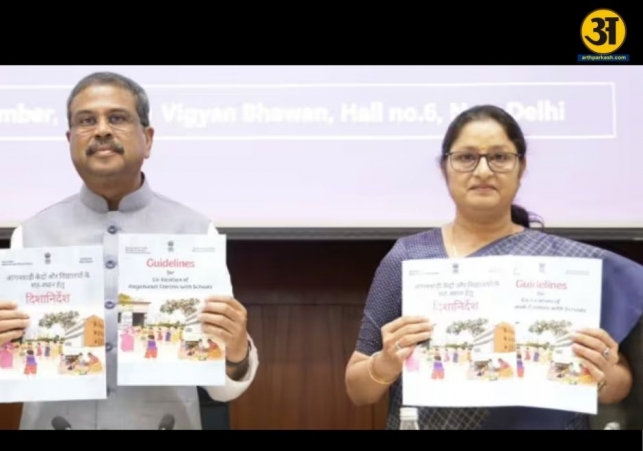
The guidelines, prepared jointly by the Ministry of Women and Child Development (MoWCD) and the Department of School Education and Literacy (DoSEL), were launched on Wednesday. They highlight the importance of early childhood development, proper infrastructure, and coordination between state education and women and child development departments.
Currently, India has more than 14.02 lakh operational Anganwadi Centres, of which about 2.90 lakh are already co-located with government and government-aided schools.
Focus on early education and better facilities
While launching the guidelines, women and child development minister Annpurna Devi stressed the importance of early education. She said that nearly 85% of brain development takes place by the age of six, making the first few years crucial for a child’s growth. She added that by setting common standards for co-location of Anganwadis, the government hopes to provide better facilities and learning opportunities to young children.
The guidelines provide two ways to co-locate Anganwadis with schools. If schools have enough space and infrastructure, Anganwadis will be physically set up within school campuses. Where schools lack extra space, Anganwadis will be mapped to the nearest primary school. The decision will be taken jointly by the state’s school education department and the department of women and child development.
Priority will be given to Anganwadi Centres that currently do not have proper buildings, those operating in rented premises, or those serving marginalized communities. The guidelines say the new locations should be within 500 meters in urban areas and within 1 km in rural areas, though states and union territories will have flexibility based on local needs.
Anganwadi workers have welcomed the decision. Rekha Kumari, a worker from Loni block in Ghaziabad, Uttar Pradesh, said her centre currently runs from a rented building without basic facilities. Moving it inside a school would give children access to better classrooms, playgrounds, and other amenities. “This will allow us to teach children more effectively and create a joyful learning environment,” she said.
Anganwadi Centres provide six important services: supplementary nutrition, pre-school education, nutrition and health awareness, immunization, health check-ups, and referral services. With improved facilities through co-location, the centres will be able to provide these services more efficiently.
Training and support for anganwadi workers
Union education minister Dharmendra Pradhan also addressed the event and described Anganwadi workers as the “first teachers” in a child’s life. He said they play a key role in early childhood education and deserve opportunities to grow in their careers.
He suggested creating a special training module for Anganwadi workers who may not have completed Class 12 but wish to continue their education. This training would be similar to professional development courses available for school teachers. “The experience of Anganwadi workers is invaluable, but we must also give them chances to learn new skills and adapt to the needs of the new education framework,” he said.
The government believes that stronger linkages between Anganwadi Centres and schools will help children transition smoothly from pre-school to Grade 1. It will also make learning more engaging and joyful, while ensuring better health and nutrition support during the early years.
DoSEL Secretary Sanjay Kumar said that a meeting will soon be held with officials from state education departments and state women and child development departments to help them implement the new guidelines. The aim is to provide operational clarity and speed up the process of co-location.
The MoWCD’s Early Childhood Care and Education (ECCE) programme already supports holistic development of children under six. It focuses on stimulation, play-based learning, creativity, skill-building, healthy habits, and school readiness. With the new guidelines, these objectives will be strengthened by linking Anganwadi Centres more closely with formal schooling.
A step towards convergence of services
Minister Annpurna Devi highlighted that the guidelines mark an important convergence of health, education, and values. She said that the large network of Anganwadis represents the strength and trust of millions of families across India. By co-locating them with schools, the government hopes to make early childhood services more effective and accessible.
Parents, teachers, and workers agree that the move will not only benefit children but also strengthen the overall education system. With better infrastructure, trained workers, and closer coordination with schools, children will be better prepared for their educational journey.
The step is also expected to reduce dropout rates by ensuring that children are already familiar with the school environment before starting formal education. Experts say that children who attend well-functioning Anganwadis tend to perform better in primary school, both academically and socially.
As India continues to modernize its education system under the National Education Policy (NEP) 2020, these guidelines are seen as a major step toward integrating early childhood education into the broader schooling framework. The central government has urged states and union territories to move quickly on implementation so that more children can benefit from better facilities, nutrition, and learning opportunities.
ALSO READ: Trump’s remarks spark controversy among Indian-origin Brahmins in Boston
ALSO READ: Comparing losses in gaming and investing sparks debate on regulation
Conclusion
The new guidelines for co-locating Anganwadis with schools are aimed at improving the quality of early childhood education and care in India. By providing better infrastructure, smoother transitions to primary schools, and training opportunities for workers, the government hopes to build a stronger foundation for children’s future.
As ministers emphasized during the launch, Anganwadi workers are not just caregivers but the first teachers who shape a child’s life. With better support and facilities, they can help ensure that every child begins their learning journey with health, confidence, and joy.
Related News